

And, so what? You're comparing one of the most affluent areas in the country with one of the poorest.Holy crap, according to this short article, Saint Louis (with 87 homicides through June) has as many homicides as Oakland, San Francisco and San Jose combined...

StlToday - Girl shot near Delmar MetroLink station
http://www.stltoday.com/news/local/crim ... dcd09.htmlA teenage girl was shot Monday night at what St. Louis police was a large gathering of young people near the Delmar MetroLink station.
^^ As dredger said, it's not like Oakland doesn't have issues; as recently as 2012 it had more homicides than STL did just by itself. We've had a dramatic jump since then and they've had a dramatic decrease. I'm sure changing demographics is playing a part in Oakland's change of fortune, but certainly more is at play than that.

Why do you say that?STLrainbow wrote:^^ As dredger said, it's not like Oakland doesn't have issues; as recently as 2012 it had more homicides than STL did just by itself. We've had a dramatic jump since then and they've had a dramatic decrease. I'm sure changing demographics is playing a part in Oakland's change of fortune, but certainly more is at play than that.
Not to say there's nothing to learn from how they decreased homicides, but the Oakland PD is hardly something to emulate these days...
-RBB
-RBB
^ quite a scandal!
^^ mark,
in general I'm a firm believer that violent crime trends are complex and almost always subject to more than one factor, whether it's our sharp increase between '13-'15 or other cities sharp declines. Like most cities, Oakland had quite a bit of up and down in homicide numbers prior to 2013, and I don't think the rate of changing demographics could fully account for the sharp decline that began in '13. However, it certainly is an issue for researchers to examine, especially if Oakland's drop is sustained.
^^ mark,
in general I'm a firm believer that violent crime trends are complex and almost always subject to more than one factor, whether it's our sharp increase between '13-'15 or other cities sharp declines. Like most cities, Oakland had quite a bit of up and down in homicide numbers prior to 2013, and I don't think the rate of changing demographics could fully account for the sharp decline that began in '13. However, it certainly is an issue for researchers to examine, especially if Oakland's drop is sustained.
^ I might add that a lot of times sharp changes are just statistical noise.... take KC's sharp decline in 2014 (now it's back to traditional levels) or ours in 2003, when we had just 73 homicides. (I'm sure the chief then attributed it to excellence in policing.)
I think in our present case the worry is that while we may have ended our upwards spike in homicide, are we at a sustained new normal? That would be brutal. Fortunately, a number of other cities that had a big jump last year seem to be going back down so far in 2016, such as Milwaukee and even Baltimore to an extent. So that gives some hope that we can get numbers back down to a still too high but much less bloody toll.
I think in our present case the worry is that while we may have ended our upwards spike in homicide, are we at a sustained new normal? That would be brutal. Fortunately, a number of other cities that had a big jump last year seem to be going back down so far in 2016, such as Milwaukee and even Baltimore to an extent. So that gives some hope that we can get numbers back down to a still too high but much less bloody toll.
For the past couple of days, a lot of attention has been paid to a recent study (http://www.nytimes.com/2016/07/12/upsho ... .html?_r=0) conducted by a young African-American professor at Harvard which he says proves there is no racial bias on the part of police in terms of cops shooting black people. His study concludes that whites are just as likely - if not more likely - to be shot by a police officer than are whites. (The study does go on to say that blacks indeed are more likely to be roughed up by cops than whites, more likely to be touched, more likely to be pushed to the ground, more likely to be cuffed. But not more likely to be shot).
Okay, so here's the confusing part about this study: It shows that the rate at which blacks get shot by police is far greater than the rate whites are shot. In the US, there are about 4-5X more white people than black people. And each year, the #s of whites shot by cops is comparable to the #s of blacks shot by cops. So, purely on a per capita basis, blacks are about 4X more likely to be shot by cops than whites.
So what is this author saying? In any given traffic stop, a black person is no more likely to be shot than a white person? These two narratives (higher rate of black people being shot, vs. no greater chance of black person being shot by cops than white people) just don't square with each other.
Now, I'm no Harvard PhD economist, but this just doesn't make sense to me. Does it make sense to you?
Okay, so here's the confusing part about this study: It shows that the rate at which blacks get shot by police is far greater than the rate whites are shot. In the US, there are about 4-5X more white people than black people. And each year, the #s of whites shot by cops is comparable to the #s of blacks shot by cops. So, purely on a per capita basis, blacks are about 4X more likely to be shot by cops than whites.
So what is this author saying? In any given traffic stop, a black person is no more likely to be shot than a white person? These two narratives (higher rate of black people being shot, vs. no greater chance of black person being shot by cops than white people) just don't square with each other.
Now, I'm no Harvard PhD economist, but this just doesn't make sense to me. Does it make sense to you?
^ I haven't looked at the study, or read reports on it, but what you describe is pretty classic, and you're right, it makes no sense. It's the same statistical "fact" and error that can lead someone to say that murder used to be a bigger problem in STL City. There were once more murders, but the murder rate hasn't really declined.
I have zero confidence that police reports are a reliable source of data. It makes absolutely no sense that, per the study, black people are more likely to be manhandled than white people in every way but, magically, they're less likely to be shot. That could equally well indicate that cops are less likely to accurately report an incident where a black person gets shot.
By State Rep Shamed Dogan
National Review Online - Pro-Black, Pro-Police Reforms that Conservatives Should Get Behind
National Review Online - Pro-Black, Pro-Police Reforms that Conservatives Should Get Behind
http://www.nationalreview.com/article/4 ... -help-bothI’m pro–Second Amendment. I’m pro–law enforcement. And I’m pro-black. After the deaths of two black men at the hands of police last week, and the subsequent spate of deadly ambushes on police officers in at least four states (including a non-fatal ambush less than a mile from my home), far too many extremists on the left and right have acted as if these are opposing positions. They have seized on the violence to fan the flames of resentment.
^ Hope to have Shamed on the podcast soon. We're old colleagues from WUSTL days, FWIW.
Anyway, posted these on Twitter just to prompt a discussion:
![]()
![]()
Anyway, posted these on Twitter just to prompt a discussion:
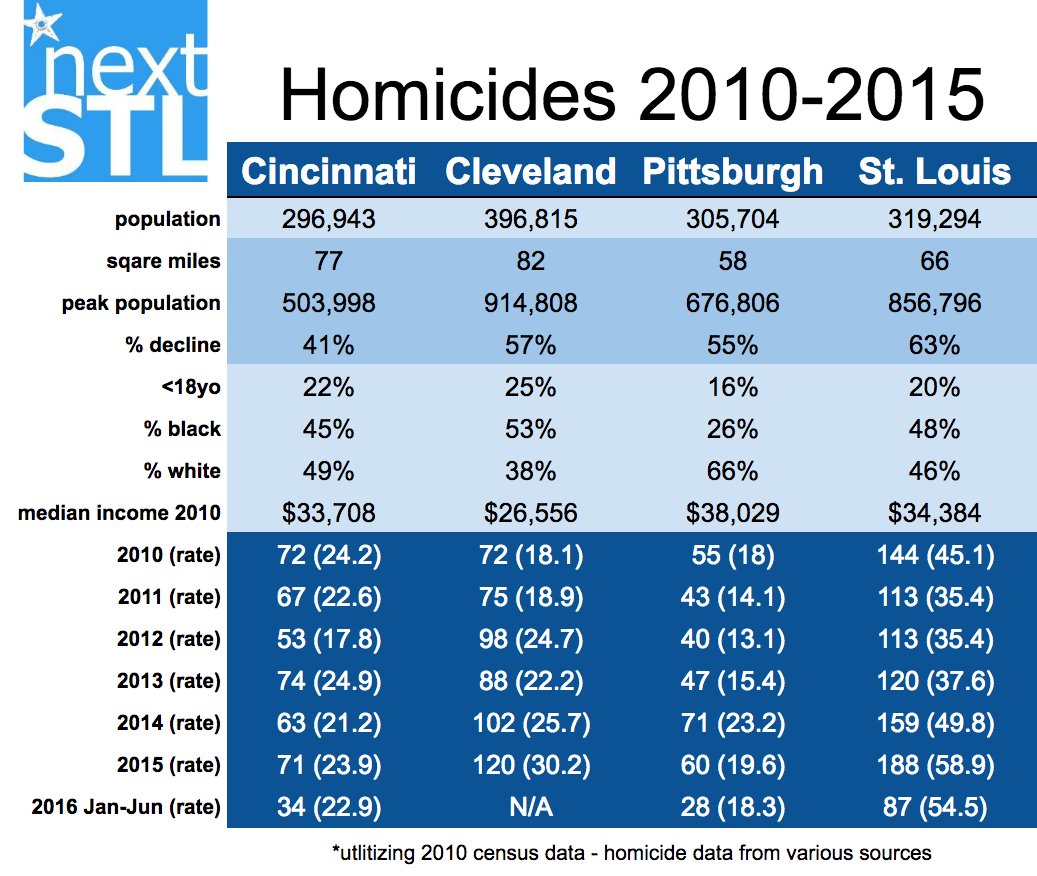
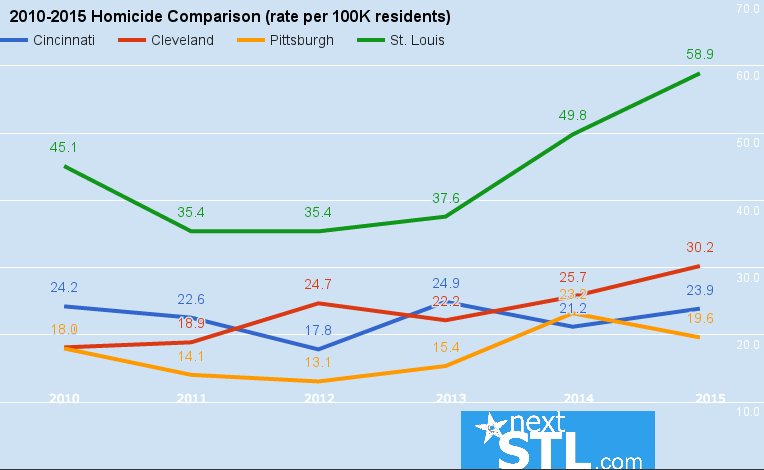

Are there any stats with adjustment for gang related homicide? Surely they don't categorize everything the same way.
So what you're really saying, Alex, is that we're way above average! 
With Saint Louis quite similar in size and socio-economics, I think we need to look at how North City is so much more isolated than say Cleveland's East Side (where there poverty-stricken, "inner-city" is concentrated) as a factor in homicide levels.
Although there is a lot of concentrated poverty on Cleveland's east side and it has major problems, it is not equivalent to our "Delmar Divide" where few if any regional employment or cultural anchors exist and where whites generally do not even venture beyond. A comparison would be to envision an alternate reality Saint Louis where our Central Corridor with SLU/Midtown/WashU/BJC/SLAM/Symphony etc. stretches along Florissant from downtown before reaching a couple inner-ring suburbs like U City.
The neighborhoods surrounding Cleveland's Euclid Avenue Corridor are largely impoverished but the east side is still very much part of the region's economic, institutional and cultural identity and there are a number of nodes of investment and opportunity. I think the situation where we have year after year and decade after decade of largely nothing but disinvestment in the North Side creates a certain level of disconnectedness and despair that has an impact upon community norms and homicide rates.
Although there is a lot of concentrated poverty on Cleveland's east side and it has major problems, it is not equivalent to our "Delmar Divide" where few if any regional employment or cultural anchors exist and where whites generally do not even venture beyond. A comparison would be to envision an alternate reality Saint Louis where our Central Corridor with SLU/Midtown/WashU/BJC/SLAM/Symphony etc. stretches along Florissant from downtown before reaching a couple inner-ring suburbs like U City.
The neighborhoods surrounding Cleveland's Euclid Avenue Corridor are largely impoverished but the east side is still very much part of the region's economic, institutional and cultural identity and there are a number of nodes of investment and opportunity. I think the situation where we have year after year and decade after decade of largely nothing but disinvestment in the North Side creates a certain level of disconnectedness and despair that has an impact upon community norms and homicide rates.
clearly, blacks are still getting shot or killed in greater numbers per capita by police, but the rates of crime are not the same per capita for whites and blacks. Blacks account for 13% or 12.6% of the population but they accounted for 50% of the murders. Obviously this is mainly due to poverty, possible systemic racism, and lack of access to a good education etc. Cops killed 123 blacks in 2012 and double the number for whites, but as adjusted for population, it's more for blacks. By far the greatest number of deaths of black people are by other blacks, a total of 6,000 in 2012. Same goes for whites, most whites are killed by other whites. both of those numbers are above 93-95%.It shows that the rate at which blacks get shot by police is far greater than the rate whites are shot. In the US, there are about 4-5X more white people than black people. And each year, the #s of whites shot by cops is comparable to the #s of blacks shot by cops. So, purely on a per capita basis, blacks are about 4X more likely to be shot by cops than whites.

"Days of Rage" tomorrow. Friday 15th ARCH 6PM.
http://www.zerohedge.com/news/2016-07-1 ... -15th-2016
http://www.zerohedge.com/news/2016-07-1 ... -15th-2016
Threatening violence will not help the movement.leeharveyawesome wrote:"Days of Rage" tomorrow. Friday 15th ARCH 6PM.
http://www.zerohedge.com/news/2016-07-1 ... -15th-2016
Sent from my iPhone using Tapatalk
A bunch of flash-mobbing nerds are not high on my list of feared physical threats.

I'm a black ex-cop, and this is the real truth about race and policing
On any given day, in any police department in the nation, 15 percent of officers will do the right thing no matter what is happening. Fifteen percent of officers will abuse their authority at every opportunity. The remaining 70 percent could go either way depending on whom they are working with.
More on police brutality
How systemic racism entangles all police officers — even black cops
Why do police so often see unarmed black men as threats?
When is it legal for a cop to kill you?
That's a theory from my friend K.L. Williams, who has trained thousands of officers around the country in use of force. Based on what I experienced as a black man serving in the St. Louis Police Department for five years, I agree with him.
http://www.vox.com/2015/5/28/8661977/ra ... ce-officer
On any given day, in any police department in the nation, 15 percent of officers will do the right thing no matter what is happening. Fifteen percent of officers will abuse their authority at every opportunity. The remaining 70 percent could go either way depending on whom they are working with.
More on police brutality
How systemic racism entangles all police officers — even black cops
Why do police so often see unarmed black men as threats?
When is it legal for a cop to kill you?
That's a theory from my friend K.L. Williams, who has trained thousands of officers around the country in use of force. Based on what I experienced as a black man serving in the St. Louis Police Department for five years, I agree with him.
http://www.vox.com/2015/5/28/8661977/ra ... ce-officer
^Reddit Hudson!! You alone made me finally post for the first time after reading on this site for years! I watched you as a young kids dozens of times at the old Kiel when you played For Rich Grawer at SLU. You were awesome, those teams were fantastic! Great memories.
St. Louis: Urban Crime Reduction--Suburban Windfall. STLStrong just published my new piece about the effect of urban crime on St. Louis metro home values. Here is the link:
http://www.stlstrong1764.org/urbanreduc ... anwindfall
In my analysis I ignored city limits completely and started at the full metro level to compare the 20 largest metro areas for crime and to determine any correlations with home property values. I don't see any correlation at the full metro levels.
![]() Full Metro Area Crime Risk by Gary Kreie, on Flickr
Full Metro Area Crime Risk by Gary Kreie, on Flickr
![]() Metro Home Values vs Crime Risk by Gary Kreie, on Flickr
Metro Home Values vs Crime Risk by Gary Kreie, on Flickr
But then I dropped down to the zip code level to built up a crime index for the inner 20% of the metro areas, and the outer 80% by population. Here there seems to be a correlation between high urban crime and low metro property values.
![]() Metro Home Values vs. Urban & Suburban Crime Risk by Gary Kreie, on Flickr
Metro Home Values vs. Urban & Suburban Crime Risk by Gary Kreie, on Flickr
This implies that all metro home values would rise if we can reduce urban core crime. I propose taxing metro homes and applying the funds toward reducing urban crime to try to get to where Minneapolis is now over the next 12 years.
I would like to hear ideas and comments from the smart folks on this site.
http://www.stlstrong1764.org/urbanreduc ... anwindfall
In my analysis I ignored city limits completely and started at the full metro level to compare the 20 largest metro areas for crime and to determine any correlations with home property values. I don't see any correlation at the full metro levels.
 Full Metro Area Crime Risk by Gary Kreie, on Flickr
 Metro Home Values vs Crime Risk by Gary Kreie, on Flickr
But then I dropped down to the zip code level to built up a crime index for the inner 20% of the metro areas, and the outer 80% by population. Here there seems to be a correlation between high urban crime and low metro property values.
 Metro Home Values vs. Urban & Suburban Crime Risk by Gary Kreie, on Flickr
This implies that all metro home values would rise if we can reduce urban core crime. I propose taxing metro homes and applying the funds toward reducing urban crime to try to get to where Minneapolis is now over the next 12 years.
I would like to hear ideas and comments from the smart folks on this site.
I really like it. You do make me curious what the result would be if you actually calculated the referred-to correlations.

I did use the correlate function in XL, and if I did it correctly, the correlation numbers came out like this.MarkHaversham wrote:I really like it. You do make me curious what the result would be if you actually calculated the referred-to correlations.
Metro Prop Values to Core minus Suburb Crime: .712
Metro Prop Values to Core Crime: .682
Metro Prop Values to Suburbs Crime: .348
Metro Prop Values to Total Metro Crime: .077