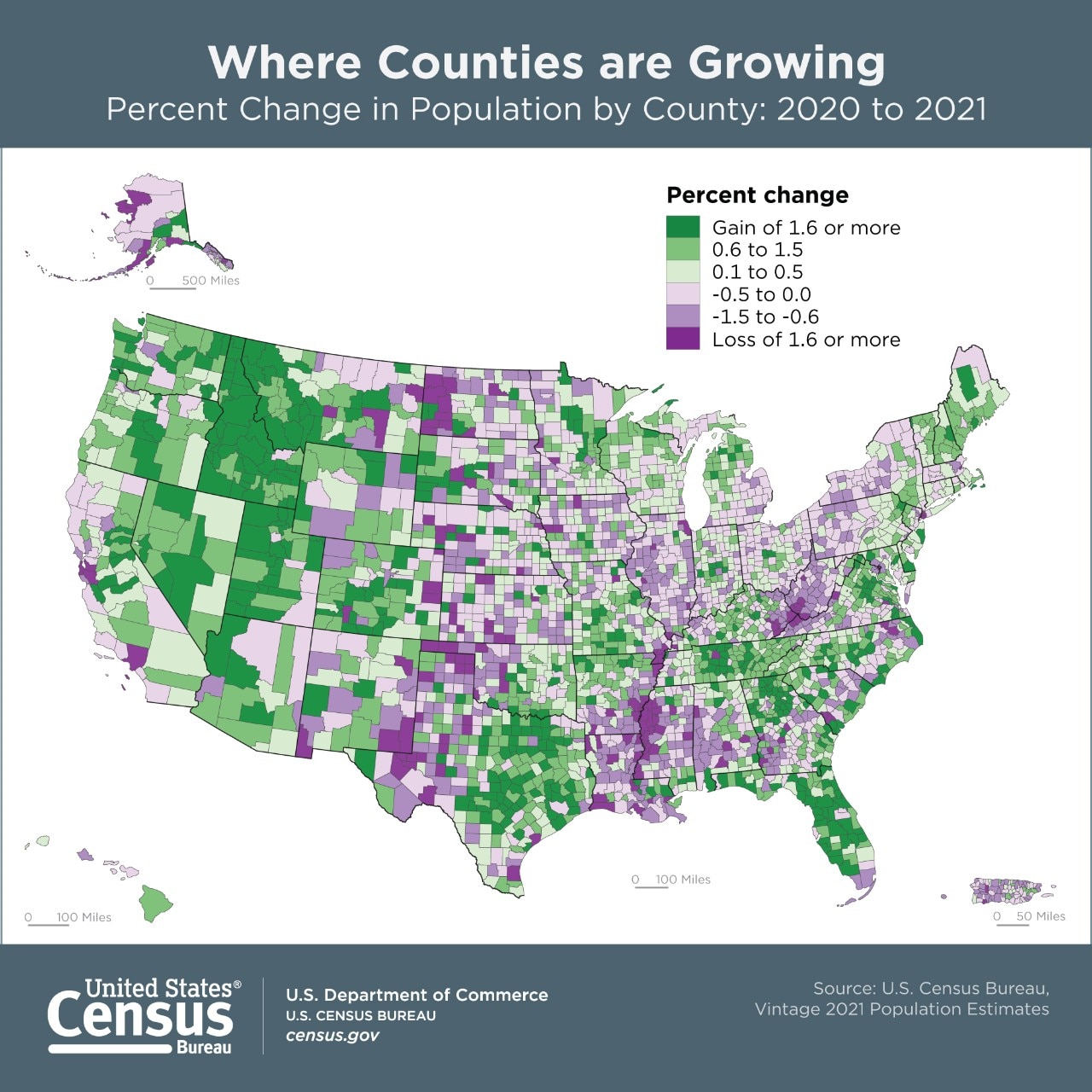
I won’t fret over a single year estimate. Almost hit on a 7 leg parlay last weekend so I’m feeling lucky enough to bet that the city will have population growth come 2030.
Sent from my iPhone using Tapatalk
Sent from my iPhone using Tapatalk
Not as much as migration for most markets..PeterXCV wrote: ↑Mar 24, 2022Wow, looks like all the pandemic deaths took a toll.
I'm always skeptical of Federal data but decisions are made on their numbers whether we accept them or not. However there have been other indicators for quite a while showing some of the largest cities have had large outmigrations over the last year+.PeterXCV wrote: ↑Mar 24, 2022Interesting, that makes me skeptical of these numbers, that so many large metros could have people moving out at once.
This is the question - at what point does the population loss stop.....I think the right things are starting to come into place for St. Louis. I really do.
That doesn't mean that they're falling into place quickly enough to offset the current losses, but I also think that the city and region will show population growth by 2030.

Like DB said…when black folks have a reason to stay. In the last Census the Central Corridor grew at a combined 13%, the South Side has stabilized (I think it was around a 2% combined loss) while North St. Louis shedded around 23%. Figure out how to keep them and the city’s population loss reverses immediately.This is the question - at what point does the population loss stop....
I think looking at the overall numbers it can feel like nothing is happening, but if we look at what areas are gaining and what area are losing population it becomes a solvable problem. The south side of the city has been more or less holding steady recently, the central corridor has been growing in population, most if not all of the latest population loss is from the north side. I believe the city has shown that it can create attractive places for people to live, if we want to stem population loss and begin growing we need to invest in providing the development and services to the north side of the city that have helped the central areas become a desirable place to live (of course those that's easier to type than to do, but I do think that at this point growing the city is dependent on growing the north side)spreadsheetwizard wrote: ↑Mar 25, 2022This is the question - at what point does the population loss stop.....I think the right things are starting to come into place for St. Louis. I really do.
That doesn't mean that they're falling into place quickly enough to offset the current losses, but I also think that the city and region will show population growth by 2030.
I'd like to think the same that 2030 will be it (just far enough away to be possible)...... but it is +20% thru this decade and unsure what the city/region are doing that will cause population growth.
Same thing could've been said in 2002, 2012 with hope for growth at the end of their respective decades.
Unsure, realistically, how this decade will be any different.
Ebsy wrote:I would be pretty suspicious of this year's ACS estimates, they seem to be "adjusting" the actual census figures back towards their busted 2019 figures that way underestimated urban populations.
Generally agree that's a possibility, but this method is based on change, not a new count. And cities/states were warning before these results that tax filings, change of address, etc indicated significant out-migration from many major cities. I wouldn't necessarily trust the exact numbers but the trends probably aren't off base. If cities/counties have significantly different results than what the recent method shows, they'd certainly challenge it.Ebsy wrote: ↑Mar 27, 2022I would be pretty suspicious of this year's ACS estimates, they seem to be "adjusting" the actual census figures back towards their busted 2019 figures that way underestimated urban populations.
Detroit is largest city to challenge 2020 census numbers
Majority-Black Detroit has become the largest U.S. city to challenge its figures from the 2020 census following a national head count in which the U.S. Census Bureau acknowledges that a higher percentage of African Americans were undercounted than last decade, according to the U.S. Census Bureau.
Leaders of Michigan’s largest city, which is more than three-quarters Black, had questioned the results of the 2020 census since last December when they released a report suggesting that more than 8% of the occupied homes in 10 Detroit neighborhoods may have been undercounted.
Detroit filed its challenge late last week, according to the U.S. Census Bureau.
Doesn’t every large city challenge them?pdm_ad wrote: ↑Apr 06, 2022Should STL do the same?
https://apnews.com/article/covid-health ... _medium=AP
Detroit is largest city to challenge 2020 census numbers
Majority-Black Detroit has become the largest U.S. city to challenge its figures from the 2020 census following a national head count in which the U.S. Census Bureau acknowledges that a higher percentage of African Americans were undercounted than last decade, according to the U.S. Census Bureau.
Leaders of Michigan’s largest city, which is more than three-quarters Black, had questioned the results of the 2020 census since last December when they released a report suggesting that more than 8% of the occupied homes in 10 Detroit neighborhoods may have been undercounted.
Detroit filed its challenge late last week, according to the U.S. Census Bureau.
Thousands of new apartments being built in St. Louis City as demand for houses rises
Take a drive through the Central Corridor of St. Louis City and you’ll see cranes and buildings rising from the streets as developers are building thousands of new apartments and condos.
Near Forest Park Parkway and DeBaliviere, the skyline is changing as Expo at Forest Park nears completion. It will have 287 market-rate luxury apartments. Across the street is The Hudson which will house 155 units.
In the Central West End, Pier Property Groups is planning 120 units for a project called The Flats at Forest Park at Kingshighway and McPherson. The same developer is adding 105 units in Midtown at Steelcote Flats and 196 units at Edwin on Grand which will be anchored by a Target store.
“I think it’s a really big deal,” Paul Hamilton said. He owns several restaurants in Lafayette Square including Vin De Set, PW Pizza and Hamilton’s Steakhouse.
They’re down the road from the Steelcote properties and across the street from the soon to open Edge District of Lafayette Square. That project includes 128 apartments.
“It’s exciting to see how far things have come, it’s exciting to see what more’s to come,” Hamilton said.
Michael Schwartz with Blackline Construction says the demand continues to grow as excitement over the MLS stadium, growth in Downtown St. Louis and the NGA bring new people into the city of St. Louis.
The latest census data shows St. Louis is losing population and dropping below 300,000. This trend is a bit confusing for some.
“All of the data we see shows we’re losing [people] yet all of these projects are getting filled. For us personally, we try not to do projects that displace residents,” Schwartz said.