Any chance we could get some of these imperial Walker like container cranes on the riverfront? Always loved them growing up in Seattle.
Sent from my iPhone using Tapatalk
I brought up the KC project just because I think it is something STL should be looking into. The St. Louis region will need a dedicated port facility if they are to be a hub for this new system. To your point 7, I agree it’s too early to build a big new port. Let’s do what KC is doing, build an intermodal terminal first with space left for the port itself.gone corporate wrote:So, I was offline for a couple days after that big damn post I did earlier on this whole thing, and I see a bunch of good comments and questions. As best I can, here’s a couple quick thoughts…
1. Estimates for Container-on-Vessel (CoV) total cost savings are 30-40%+. This will definitely drive new demand as logistics are fundamentally cost-driven. For my understanding, this is the most significant lure to this business model. BellaVilla is right to note the importance of Economies of Scale.
2. The KC harbor plan ldai_phs wrote about looks great. We mustn’t look at this as direct competition, however, or that they’re going to take an opportunity from STL. Very much, I hope this KC project comes to fruition. This is especially if KC elects to include a container port, as this would only further the market viability for CoV. Plus, what they ship out of KC has to stop in STL before it gets sent to NOLA anyways.
3. Geography plays an incredible amount into this opportunity. STL is effectively the geographic center of the country. Our catchment area is very strong as we will attract manufacturers who could potentially ship via this route from Chicago, Indianapolis, etc. We also have well established shipping networks here, as demonstrated by STL being the second-largest inland port system in the country (Cincinnati is first, but their defined “port” is about 200 miles long while STL’s is about 70) – and gaining ground.
4. Further, our intermodal logistics assets are sound and getting stronger. I note our existing infrastructure beyond the rivers to include 6 major rail yards, 2 international airports, and 4 interstate highways, all situated at the geographic center of the country. We also have strong, and growing, warehousing networks that are increasing in volume. Should CoV come to be, this industry’s development should seriously accelerate physical infrastructure and the strength of our business community.
5. Regarding competing with Memphis… I seriously hope they can keep up with us. This whole thing must not be seen as a “winner take all” scenario. For this new venture to succeed, it will need multiple markets to thrive. The biggest winners will be STL, MEM, and NOLA as these are the hubs. There will be many spokes as well. The STL spokes will include those markets up the Missouri and Mississippi Rivers, including KC, Omaha, the Great Plains, and maybe all the way up to Minneapolis. These will all consolidate at STL. Should we include the Illinois River, we could extend this all the way up to (Peoria and) Chicago via Joliet (although Chicago may not be too fond to such competition to their freight routes and rail networks). Meanwhile, the MEM hub will include those river cities up the Ohio River, including Louisville, Cincinnati, and Pittsburgh, all of which will consolidate at the MEM yards. They have a lot more market to cover. Of these metro areas, STL is the largest hub; while we are smaller than Minneapolis and Chicago, they will hub here if they participate in this. We are larger than all the spoke metro areas on the MEM/Ohio River group. And, Memphis will likely focus on their two biggest logistics-centric businesses feeding their CoV line: Walmart (Bentonville, AR) and FedEx (through which Memphis is a true “aerotropolis” according to the academic understanding of the term). Meanwhile, STL has a much greater economic presence, not only in total goods shipped but in total major corporations that can utilize this system. Our business community is far, far beyond what MEM has, and we have more than a million more people than they do. Add-in the catchment area we have, and I have no fear of MEM eating our lunch.
6. Addendum: Competition for STL’s potential CoV business is NOT Memphis; it’s the trains that go from Long Beach to Chicago.
7. Dredger is spot-on right when he says we must all be patient until we hear APH has signed a shipyard contract and the keel is laid. Promises don’t matter until the check clears. I hope we hear of such news this Quarter.
8. There’s no need to build a new rail line from NOLA to STL. The Mississippi River is our direct intermodal line between our cities. Much of this entire initiative is based on capitalizing on our rivers as a transportation network, something that this new technology in shipping can fundamentally further. Good times.

This would seem incredibly foolish if APH's vision comes to fruition. This type of thinking is literally the reason St. Louis was surpassed by Chicago.gone corporate wrote: ↑Feb 16, 20215. Regarding competing with Memphis… I seriously hope they can keep up with us. This whole thing must not be seen as a “winner take all” scenario. For this new venture to succeed, it will need multiple markets to thrive. The biggest winners will be STL, MEM, and NOLA as these are the hubs. There will be many spokes as well. The STL spokes will include those markets up the Missouri and Mississippi Rivers, including KC, Omaha, the Great Plains, and maybe all the way up to Minneapolis. These will all consolidate at STL. Should we include the Illinois River, we could extend this all the way up to (Peoria and) Chicago via Joliet (although Chicago may not be too fond to such competition to their freight routes and rail networks). Meanwhile, the MEM hub will include those river cities up the Ohio River, including Louisville, Cincinnati, and Pittsburgh, all of which will consolidate at the MEM yards. They have a lot more market to cover. Of these metro areas, STL is the largest hub; while we are smaller than Minneapolis and Chicago, they will hub here if they participate in this. We are larger than all the spoke metro areas on the MEM/Ohio River group. And, Memphis will likely focus on their two biggest logistics-centric businesses feeding their CoV line: Walmart (Bentonville, AR) and FedEx (through which Memphis is a true “aerotropolis” according to the academic understanding of the term). Meanwhile, STL has a much greater economic presence, not only in total goods shipped but in total major corporations that can utilize this system. Our business community is far, far beyond what MEM has, and we have more than a million more people than they do. Add-in the catchment area we have, and I have no fear of MEM eating our lunch.
Also shipping on the Mississippi provides a lot of jobs in a corridor with a large Black population.dredger wrote:First round of transportation grant applications due starting with Dot opening up INFRA. With a definite shift in admin it will interesting to see what the region can put together and snag. You can certainly make the cast that the longer a container stays on the water to get to its final destination the smaller carbon footprint is incurred on a per box basis
https://www.progressiverailroading.com/ ... ons--62732
The U.S. Department of Transportation (USDOT) yesterday announced it is seeking applicants for the fiscal-year 2021 round of the Infrastructure for Rebuilding America (INFRA) discretionary grant program. Funding available for the FY2021 grants is $889 million.
INFRA grants will fund transportation projects of national and regional significance that are in line with the Biden administration's priorities, including creating good-paying jobs, improving safety, applying transformative technology and explicitly addressing climate change and racial equity, USDOT officials said in a press release.
Unfortunately, these megaships are some of the highest polluting vehicles on earth and by a large margin. So I wouldn't necessarily pump the "green" aspect of this mode of transit. Certainly more-so than the intermodal train transport.dredger wrote: ↑Feb 18, 2021First round of transportation grant applications due starting with Dot opening up INFRA. With a definite shift in admin it will interesting to see what the region can put together and snag. You can certainly make the case that the longer a container stays on the water to get to its final destination the smaller carbon footprint is incurred on a per box basis
https://www.progressiverailroading.com/ ... ons--62732
The U.S. Department of Transportation (USDOT) yesterday announced it is seeking applicants for the fiscal-year 2021 round of the Infrastructure for Rebuilding America (INFRA) discretionary grant program. Funding available for the FY2021 grants is $889 million.
INFRA grants will fund transportation projects of national and regional significance that are in line with the Biden administration's priorities, including creating good-paying jobs, improving safety, applying transformative technology and explicitly addressing climate change and racial equity, USDOT officials said in a press release.
When I moved out West I believe the Long shoremen at Oakland, and for the most part pacific coast, would only work one day shift, Monday to Friday. I think they finally agreed to extended shift as well as Saturday shift a few years ago. It seems as inefficient as you get with resources and assets as you have between these ships, docks, cranes themselves and so on. Even more so as these port are increasingly adding automation. Even then, it still seems very inefficient from my industry where we operate and man a lot of dredges and equipment for 24/7 operations.BellaVilla wrote: ↑Feb 21, 2021I spoke with someone who works in logistics in Central Illinois last night and she shed some light on the issues at the port of Long Beach. Essentially, its not uncommon for a container sit on the docks in Long Beach for a month and that creates an incredible headache for shippers (Oakland and Seattle are no better apparently). They need an alternative.
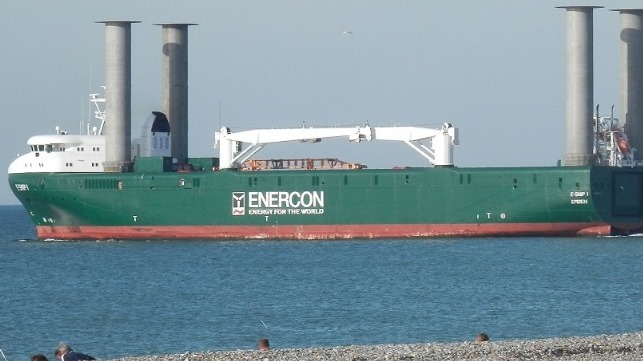
Just need to build more of these modern-day sailboats, I spose:symphonicpoet wrote: ↑Feb 21, 2021^I won't deny that there's a difference in emissions between low sulfur diesel and bunker C. But in the end, is it better to burn ten tons of "clean" low sulfur diesel or one ton of unrefined tar to ship the same amount of goods? Pappysoulard's claim that "megaships are some of the highest polluting vehicles on earth and by a large margin" doesn't ring true to me, so I'm curious where they got that information. It seems somewhat incredible.
It's also worth keeping in mind that refining those nicer, friendlier fuels has its own energy cost, which needs to figure into the equation, even if the pollution is "displaced" from the point of use. (Rather like electric cars.) If we're going to do a fair comparison, all of this stuff needs to be factored in.
I suppose the term "megaships" set me a bit on edge, as I don't recall seeing it in any of the maritime literature I've read, but I have seen it on places like the Discovery Channel and YouTube. (No disrespect to the fun stuff. I enjoy it. I just wouldn't want to use it as the basis of an argument.) So it makes me suspicious. Maybe there's something there. But if so, what? I didn't get the impression this was about anything as technical as the amount of large particulates in the exhaust. And even if it was . . . is that really enough to overturn the savings Mr. Square Cube Law affords you?
I am way too ignorant to comment on something like thatquincunx wrote: ↑Mar 25, 2021Will this relieve Memphis at all? I had a package stuck there for two weeks because of the winter storm that they couldn't handle.
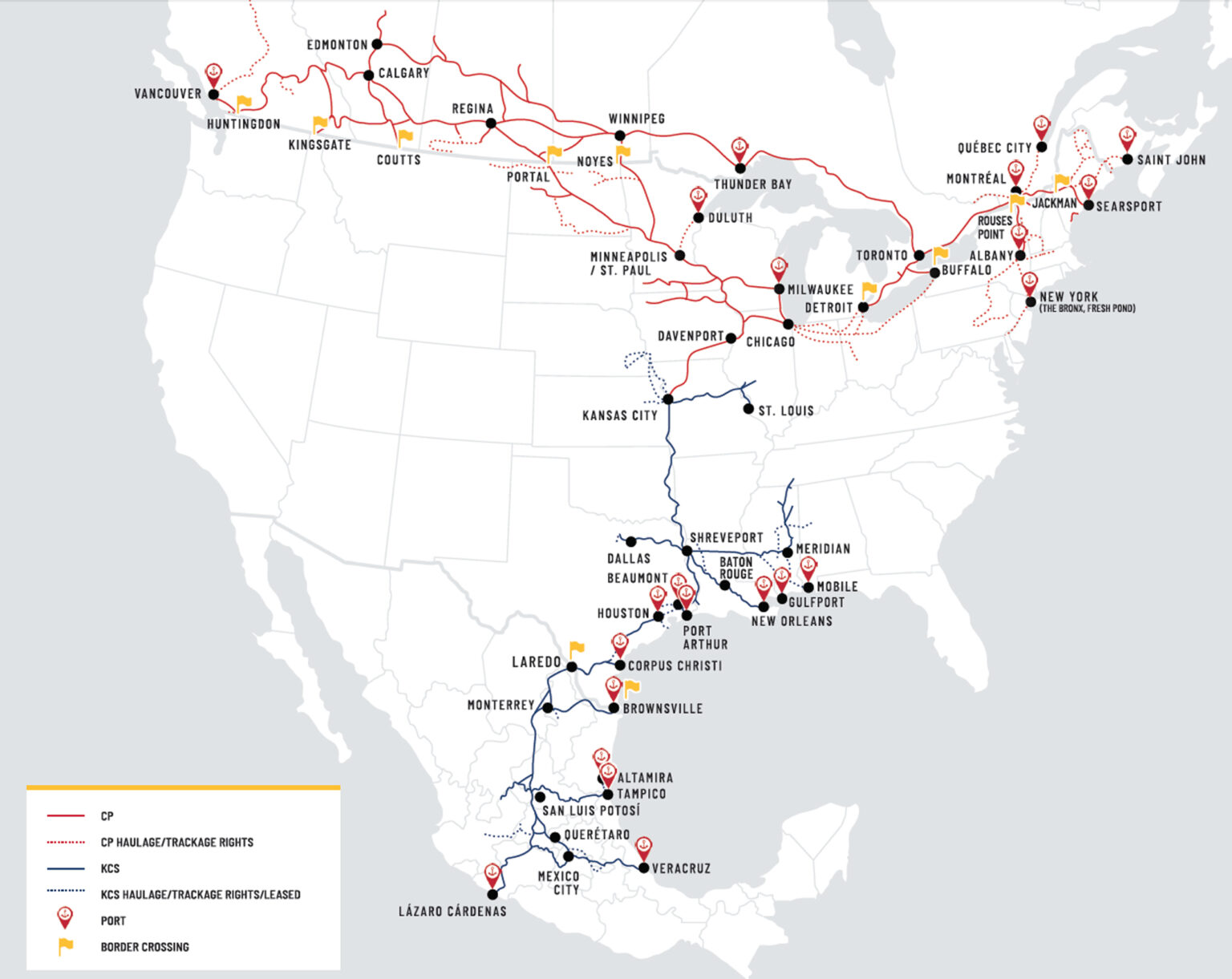
wabash wrote:The recently announced purchase of Kansas City Southern by Canadian Pacific will make it so that just three cities on the continent are served by all six remaining "Class I" railroads: Chicago, St. Louis and New Orleans.
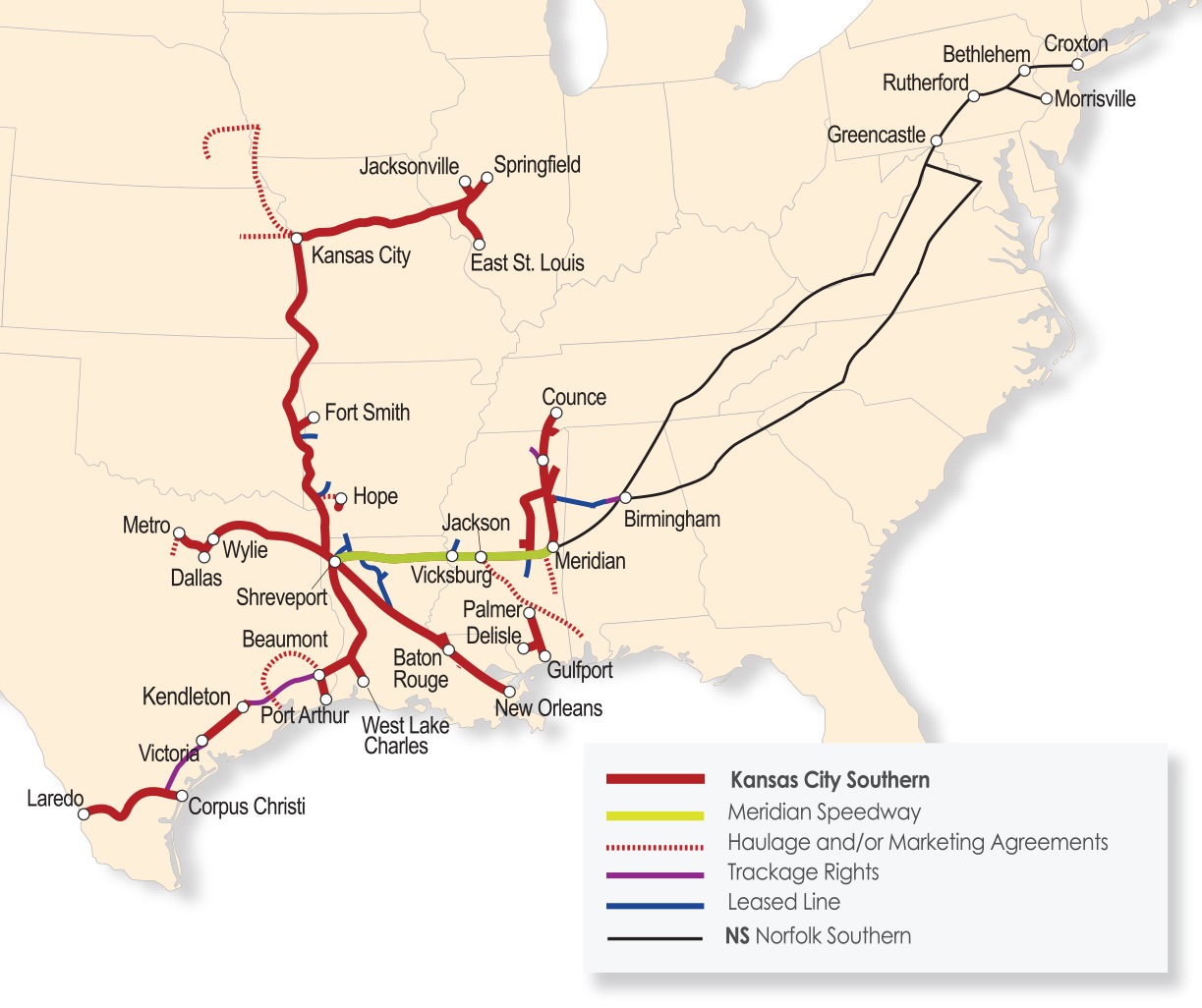
TBH I don’t think it means much for STL. The line to STL is a stub of a stub almost. Eastbound traffic from Mexico can interchange with east coast railroads at KC (NS at least) and Louisiana and MS.framer wrote:Could someone explain exactly what this means and how it may effect the STL area? I mean, they're not gonna start ripping out the other guy's infrastructure, are they?
ldai_phs wrote:TBH I don’t think it means much for STL. The line to STL is a stub of a stub almost. Eastbound traffic from Mexico can interchange with east coast railroads at KC (NS at least) and Louisiana and MS.framer wrote:Could someone explain exactly what this means and how it may effect the STL area? I mean, they're not gonna start ripping out the other guy's infrastructure, are they?
Fantastic opportunity for KC though.
Neither system overlaps with the other. So no, there won’t be any removal.framer wrote: ↑Mar 26, 2021Could someone explain exactly what this means and how it may effect the STL area? I mean, they're not gonna start ripping out the other guy's infrastructure, are they?