sc4mayor
sc4mayor

PostDec 07, 2020#601

wabash wrote:
Dec 07, 2020
sc4mayor wrote:
Dec 07, 2020
^ This.

^^^ See Chapter 9 in Death and Life of Great American Cities for further detail.
I don't think that's the case in the Loop and I don't think long blocks like those in the Loop are what Jane Jacobs was critiquing. 
What she was getting after was creating a sort of mono-culture that isn't interesting or engaging to the pedestrian. She wanted variety, diversity, eyes on the street, different places pedestrians could duck into and feel engaged, entertained, safe, etc.... Her critique works well for big box stores. There's nowhere to go, nothing engaging, nothing to make one feel safe. Another good example would be the Famous-Barr Building Downtown. Even when it was in operation it was monolithic, only had a few entrances, and those blocks felt dead. 

Long blocks like Rosedale to Skinker, with restaurants, bars, hotels, stores, music/entertainment venues and a pedestrian walking path are exactly what she was espousing. 
Solid rebuttal, I don't disagree.

I do think there is a lot of middle ground between some of the Loop blocks and a big box store though...I've always found the long blocks in the CWE to be a pain when walking around there.

3,762
Life MemberLife Member
3,762

PostDec 08, 2020#602

wabash wrote:
Dec 07, 2020
sc4mayor wrote:
Dec 07, 2020
^ This.

^^^ See Chapter 9 in Death and Life of Great American Cities for further detail.
I don't think that's the case in the Loop and I don't think long blocks like those in the Loop are what Jane Jacobs was critiquing. 
What she was getting after was creating a sort of mono-culture that isn't interesting or engaging to the pedestrian. She wanted variety, diversity, eyes on the street, different places pedestrians could duck into and feel engaged, entertained, safe, etc.... Her critique works well for big box stores. There's nowhere to go, nothing engaging, nothing to make one feel safe. Another good example would be the Famous-Barr Building Downtown. Even when it was in operation it was monolithic, only had a few entrances, and those blocks felt dead. 

Long blocks like Rosedale to Skinker, with restaurants, bars, hotels, stores, music/entertainment venues and a pedestrian walking path are exactly what she was espousing. 

As for increasing traffic, it's kind of a double-edged sword. Often it seems there's enough traffic in the Loop that it really slows things down. It's gotten to the point that people that are in a hurry and need to get east-west quickly seem to avoid it, resulting in there being slower (safer) traffic on Delmar. Furthermore, I don't see opening Limit Ave or Westgate Ave into Parkview having any sort of traffic relieving effect on Delmar. Although, DeGiverville probably could as people could actually get somewhere - Waterman/DeBaliviere. 
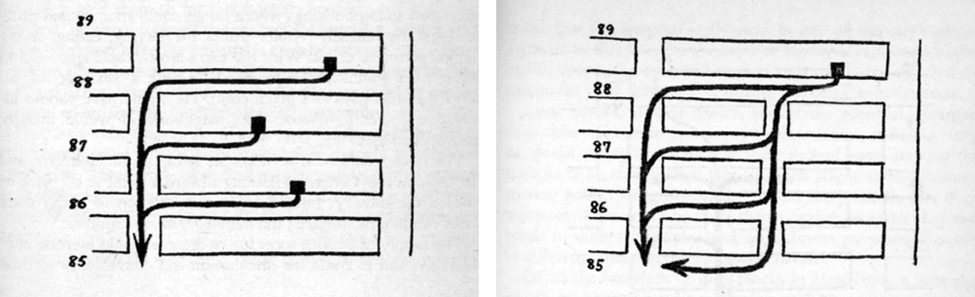
no, Jane endorsed short blocks: https://thegreatestgrid.mcny.org/greate ... ewalks/327


Image 6
Diagrams of walking patterns from Jane Jacobs, The Death and Life of Great American Cities (New York: Random House, 1961)
©1961, 1989 by Jane Jacobs. Used by permission of Random House, Inc.
While traffic engineers viewed the grid’s many intersections as a problem to overcome, Jane Jacobs sought to create more of them. In her classic book of 1961, The Death and Life of Great American Cities, Jacobs advised that shorter blocks are better blocks. With shorter blocks come more intersections, and the corner, the pedestrian corollary of the intersection, creates a valuable point of human interaction. The corner, in her view, is where neighbors bump into each other or stop to chat, ultimately leading to social cohesion. The shorter blocks diagrammed here indeed produce more corners per unit of square measure, but they also create more paths. These diagrams get to the heart of the way we move across our grid. To Jacobs, the long 800-foot blocks of Manhattan’s West Side deterred street life, sidewalk interactions, and the interpersonal city she was fighting to preserve. JR

13K
Life MemberLife Member
13K

PostDec 08, 2020#603

Imagine if Expo had blocked off DeGiverville? How annoying would that be? We know since it is during construction. It'll be great to have two CITY buildings at the corner of DeG and Delmar. I wish Laurel had been run north while there was the chance. Missed opportunity. I hope the vision in the SD plan comes true and Washington runs from DeG to DeB and Goodfellow goes south.
DeG Walk Routes.png (290.9KiB)

4,553
Life MemberLife Member
4,553

PostDec 08, 2020#604

urban_dilettante wrote:
Dec 08, 2020
wabash wrote:
Dec 07, 2020
sc4mayor wrote:
Dec 07, 2020
^ This.

^^^ See Chapter 9 in Death and Life of Great American Cities for further detail.
I don't think that's the case in the Loop and I don't think long blocks like those in the Loop are what Jane Jacobs was critiquing. 
What she was getting after was creating a sort of mono-culture that isn't interesting or engaging to the pedestrian. She wanted variety, diversity, eyes on the street, different places pedestrians could duck into and feel engaged, entertained, safe, etc.... Her critique works well for big box stores. There's nowhere to go, nothing engaging, nothing to make one feel safe. Another good example would be the Famous-Barr Building Downtown. Even when it was in operation it was monolithic, only had a few entrances, and those blocks felt dead. 

Long blocks like Rosedale to Skinker, with restaurants, bars, hotels, stores, music/entertainment venues and a pedestrian walking path are exactly what she was espousing. 

As for increasing traffic, it's kind of a double-edged sword. Often it seems there's enough traffic in the Loop that it really slows things down. It's gotten to the point that people that are in a hurry and need to get east-west quickly seem to avoid it, resulting in there being slower (safer) traffic on Delmar. Furthermore, I don't see opening Limit Ave or Westgate Ave into Parkview having any sort of traffic relieving effect on Delmar. Although, DeGiverville probably could as people could actually get somewhere - Waterman/DeBaliviere. 
no, Jane endorsed short blocks: https://thegreatestgrid.mcny.org/greate ... ewalks/327


Image 6
Diagrams of walking patterns from Jane Jacobs, The Death and Life of Great American Cities (New York: Random House, 1961)
©1961, 1989 by Jane Jacobs. Used by permission of Random House, Inc.
While traffic engineers viewed the grid’s many intersections as a problem to overcome, Jane Jacobs sought to create more of them. In her classic book of 1961, The Death and Life of Great American Cities, Jacobs advised that shorter blocks are better blocks. With shorter blocks come more intersections, and the corner, the pedestrian corollary of the intersection, creates a valuable point of human interaction. The corner, in her view, is where neighbors bump into each other or stop to chat, ultimately leading to social cohesion. The shorter blocks diagrammed here indeed produce more corners per unit of square measure, but they also create more paths. These diagrams get to the heart of the way we move across our grid. To Jacobs, the long 800-foot blocks of Manhattan’s West Side deterred street life, sidewalk interactions, and the interpersonal city she was fighting to preserve. JR
Re-read the caption you just posted. Its entire point is the importance of corners. It's saying it's important for there to be corners to create pedestrian places and points of interest, not that there need to be intersections to accommodate automobiles. You don't need auto-infrastructure breaking up long blocks to "produce more corners," "create more paths" and encourage "the interpersonal city" that Jacobs sought.
You don't have to go far to find non-auto-accommodating intersections that create exactly the sorts of pedestrian environments that Jacobs was advocating for: 


2,620
Life MemberLife Member
2,620

PostDec 08, 2020#605

To take the conversation back to the East Loop, I drove through yesterday and was impressed by the vibrancy of Delmar east of the tracks. Most of the existing retail spots are filled, particularly on the nice stretch of storefronts between Hamilton and Laurel. Another aspect that impressed me was the fact that these businesses are primarily black owned and cater to black clientele. This area may be the closest thing we have to a "Black Wall Street" in the city. I hope the city can continue this trend along the corridor.

3,762
Life MemberLife Member
3,762

PostDec 08, 2020#606

wabash wrote:
Dec 08, 2020
Re-read the caption you just posted. Its entire point is the importance of corners. It's saying it's important for there to be corners to create pedestrian places and points of interest, not that there need to be intersections to accommodate automobiles. You don't need auto-infrastructure breaking up long blocks to "produce more corners," "create more paths" and encourage "the interpersonal city" that Jacobs sought.
You don't have to go far to find non-auto-accommodating intersections that create exactly the sorts of pedestrian environments that Jacobs was advocating for:
i read it many times. i think your interpretation is a stretch. the caption clearly refers to "blocks" and "intersections," traffic engineers wanting fewer of them, etc. "corner" is discussed in that context. and she was talking primarily about NYC in the late 50s, so pretty sure she had streets in mind and not the space between 2 buildings that leads to a parking lot (as in your second photo). that said, i never claimed that auto traffic is required for good connectivity. and while your first photo is certainly an improvement over the locked gates across the street, it's one connection and doesn't help to alleviate the funneling of auto traffic onto Delmar. several more of those on both sides of Delmar (combined with development of the parking lots to the north) would be great but, again, wouldn't help to alleviate the auto congestion. if those were instead narrow streets (that are actually open to the public) providing curb parking, the parking lots wouldn't even be needed. the gated, private streets to the south of the Loop are its biggest detractors.

12K
Life MemberLife Member
12K

PostDec 08, 2020#607

I've noticed construction workers on site at Joe's indoor golf place the last couple of times I've gone by. I have no idea what's up, but hopefully it's a good sign. 

805
Super MemberSuper Member
805

PostDec 08, 2020#608

framer wrote:I've noticed construction workers on site at Joe's indoor golf place the last couple of times I've gone by. I have no idea what's up, but hopefully it's a good sign. 
Isn’t that one of the marijuana dispensary locations?


Sent from my iPhone using Tapatalk

13K
Life MemberLife Member
13K

PostDec 08, 2020#609

It's going to be Swade Marijuana dispensary.

PostDec 08, 2020#610

The Loop got rocked by Covid. Restaurants desimated.
Loop Trolley TDD Quarterly Year Over Year Taxablre Sales 2019-2020.png (14.26KiB)

4,553
Life MemberLife Member
4,553

PostDec 08, 2020#611

urban_dilettante wrote:
Dec 08, 2020
wabash wrote:
Dec 08, 2020
Re-read the caption you just posted. Its entire point is the importance of corners. It's saying it's important for there to be corners to create pedestrian places and points of interest, not that there need to be intersections to accommodate automobiles. You don't need auto-infrastructure breaking up long blocks to "produce more corners," "create more paths" and encourage "the interpersonal city" that Jacobs sought.
You don't have to go far to find non-auto-accommodating intersections that create exactly the sorts of pedestrian environments that Jacobs was advocating for:
i read it many times. i think your interpretation is a stretch. the caption clearly refers to "blocks" and "intersections," traffic engineers wanting fewer of them, etc. "corner" is discussed in that context. and she was talking primarily about NYC in the late 50s, so pretty sure she had streets in mind and not the space between 2 buildings that leads to a parking lot (as in your second photo). that said, i never claimed that auto traffic is required for good connectivity. and while your first photo is certainly an improvement over the locked gates across the street, it's one connection and doesn't help to alleviate the funneling of auto traffic onto Delmar. several more of those on both sides of Delmar (combined with development of the parking lots to the north) would be great but, again, wouldn't help to alleviate the auto congestion. if those were instead narrow streets (that are actually open to the public) providing curb parking, the parking lots wouldn't even be needed. the gated, private streets to the south of the Loop are its biggest detractors.
Strange to me to invoke the ghost of Jane Jacobs to advocate increasing auto traffic across pedestrian pathways (which opening DeGiverville would achieve). I don't think of the alleviation of auto-congestion as much of a priority of hers (see her fight against the Lower Manhattan Expressway). But we clearly have very different understandings of what she stood for. 

Rosedale should be closed from Delmar to Des Peres and either developed or turned into a Plaza - like the one near the Loop Farmers Market (which itself is much better than its predecessor - a two way street with two lanes of parking). That land can be put to higher use than an oversized bus turn-around. 

I'd also prefer to see DeGiverville at Delmar closed and turned into a pedestrian/bike pathway than increase traffic across that pathway. As is it's a massively oversized alley entrance that detracts from that stretch. 

Delmar's strength is the pedestrian experience it provides - opportunities to reclaim underutilized asphalt for that pedestrian experience should be pursued, especially as more residential density is built and the Delmar Metrolink is increasingly connected/surrounded by development. The Loop has done a great job reclaiming some of its auto-oriented private development - Loop Automotive (Blick), Yellow Cab lot/HQ (Everly), Meineke (Loop Lofts) and Shell Gas (CVS/Link in the Loop). The utility and necessity of some of the large auto-oriented public spaces should also be revisited. 

3,762
Life MemberLife Member
3,762

PostDec 08, 2020#612

^ wow, you're putting a LOT of words in my mouth. where are you getting that i'm advocating for more auto traffic? i have not once advocated for increasing auto traffic anywhere. and Jane hated cars (as do I) but she did not advocate for closing city streets to auto traffic. (an expressway is very different than a city street, and opposing an expressway is not the same as advocating for closing city streets to auto traffic). the Loop is poorly connected to the neighborhoods around it both in terms of foot traffic and auto traffic, especially to the south—i'm fairly certain Jane would agree with that. who cares about a walkway that connects to a parking lot? the connections actually have to go somewhere useful. they have to connect places full of people (and uses) with other places full of people (and uses) in order to sustain the type of pedestrian activity that she championed (which generally means they have to be more than a block long). more connections between Delmar and the surrounding neighborhoods means more people walking to Delmar means more pedestrian activity on Delmar with and fewer people driving to Delmar. additionally, the lack of street connectivity increases auto traffic on Delmar because there are fewer routes over which auto traffic can diffuse. and open city streets with curb parking means less need for massive swaths of parking. i'm not sure what the controversy is here. if we lived in an alternate reality where every human being didn't drive a car we might be able to get away with closing all of our streets to auto traffic. but since that's not the reality we live in, closing some streets to auto traffic just makes traffic worse on other streets, e.g. Delmar in the Loop.

1,465
Veteran MemberVeteran Member
1,465

PostDec 08, 2020#613

Unless we are ready to abolish auto traffic throughout the city, it irks me when people advocate for creating winners and losers by funneling traffic noise, fumes and inconvenience based on privilege or political influence.

 If you can drive through my street, I should be able to drive through yours. We are in this together and need to start acting like it.

4,553
Life MemberLife Member
4,553

PostDec 08, 2020#614

urban_dilettante wrote:
Dec 08, 2020
^ wow, you're putting a LOT of words in my mouth. where are you getting that i'm advocating for more auto traffic? i have not once advocated for increasing auto traffic anywhere. and Jane hated cars (as do I) but she did not advocate for closing city streets to auto traffic. (an expressway is very different than a city street, and opposing an expressway is not the same as advocating for closing city streets to auto traffic). the Loop is poorly connected to the neighborhoods around it both in terms of foot traffic and auto traffic, especially to the south—i'm fairly certain Jane would agree with that. who cares about a walkway that connects to a parking lot? the connections actually have to go somewhere useful. they have to connect places full of people (and uses) with other places full of people (and uses) in order to sustain the type of pedestrian activity that she championed (which generally means they have to be more than a block long). more connections between Delmar and the surrounding neighborhoods means more people walking to Delmar means more pedestrian activity on Delmar with and fewer people driving to Delmar. additionally, the lack of street connectivity increases auto traffic on Delmar because there are fewer routes over which auto traffic can diffuse. and open city streets with curb parking means less need for massive swaths of parking. i'm not sure what the controversy is here. if we lived in an alternate reality where every human being didn't drive a car we might be able to get away with closing all of our streets to auto traffic. but since that's not the reality we live in, closing some streets to auto traffic just makes traffic worse on other streets, e.g. Delmar in the Loop.
If you're advocating for opening DeGiverville to cars at Delmar, you're also advocating to accommodate more traffic crossing the pedestrian's east-west path along Delmar. Those go hand in hand. If you want to pull people East along Delmar, I don't see opening up more points for cars to cross in front of them as achieving that. 

If a bunch of cars are backed up on Delmar, as a pedestrian I don't particularly care. If they are crossing in front of me and I have a bunch of additional curb cuts between my point a and point b, then I do care. I find the idea that providing more pathways for cars, breaking up contiguous pathways for pedestrians, is somehow preferable for pedestrians to be really dubious. 

While there are plenty of closed streets along the south side of Delmar, west of Skinker they aren't gated like the two (Limit and Westgate) leading to Parkview. Des Peres, Rosedale and DeGiverville all accommodate neighborhood pedestrian connectivity to the Loop. If people want to park on Washington or Westminster or DeGiverville to access the Loop they can, today, with nothing preventing them. We don't need to live in an alternate reality where no one drives a car to try and optimize land use and prioritize the pedestrian. 

And come on, the plaza near the the U. City Farmers Market is not just a "walkway that connects to a parking lot." It's unfortunate that the most insular businesses possible - a karaoke lounge - abuts it. But over the years that plaza has had outdoor dining, art installations, buskers, drum circles, a barbecue pit, and a lot of the general weirdness that made the Loop great. It's not THAT long ago that the beating heart of the Loop oscillated between that plaza and the front door of Vintage Vinyl. 

3,762
Life MemberLife Member
3,762

PostDec 08, 2020#615

If you're advocating for opening DeGiverville to cars at Delmar, you're also advocating to accommodate more traffic crossing the pedestrian's east-west path along Delmar.
so? i used to cross Rosedale all the time and almost never even encounter a car. meanwhile, pedestrians cross Delmar continuously. the amount of "less safe" that would result from opening the streets to the south would be marginal if even perceptible, and would reduce traffic on Delmar to make it safer for crossing pedestrians.
If a bunch of cars are backed up on Delmar, as a pedestrian I don't particularly care. If they are crossing in front of me and I have a bunch of additional curb cuts between my point a and point b, then I do care.
again, because nobody ever crosses Delmar. and they ARE crossing in front of you, anyway, to turn into parking lots and parking garages and to park on the street stubs to the south and the couple of streets to the north. i hardly think opening a couple of additional side streets would make your stroll along Delmar noticeably more dangerous or unpleasant.
I find the idea that providing more pathways for cars, breaking up contiguous pathways for pedestrians, is somehow preferable for pedestrians to be really dubious.
then you would think that lots more people would walk around in St. Louis—with all of its closed and dead-end streets—than in New York, Philly, Boston, San Francisco, etc. but nope. St. Louisans do seem content with their tiny disjointed islands of "city" connected by deadly thoroughfares, though.
While there are plenty of closed streets along the south side of Delmar, west of Skinker they aren't gated like the two (Limit and Westgate) leading to Parkview. Des Peres, Rosedale and DeGiverville all accommodate neighborhood pedestrian connectivity to the Loop.
that's great but the majority of the Loop's density/destinations and the majority of adjacent residential are between Skinker and Kingsland.
We don't need to live in an alternate reality where no one drives a car to try and optimize land use and prioritize the pedestrian.
you missed the point. those cars are going to drive somewhere. fewer connections means higher auto concentration on Delmar, which means greater pedestrian danger on Delmar. oops, forgot how nobody ever crosses Delmar on foot.
And come on, the plaza near the the U. City Farmers Market is not just a "walkway that connects to a parking lot."
but it's a plaza. it's less than a block long. it literally only extends between the sidewalk on Delmar and the parking lot. it's not a route. it doesn't go anywhere. nobody is using it to travel anywhere except to their car. plazas are great, but we're not talking about plazas.

P.S. we're going to get yelled at soon.

12K
Life MemberLife Member
12K

PostDec 09, 2020#616

I am very strongly advocating for opening De Giverville to cars at Delmar. Des Peres, too. 

4,553
Life MemberLife Member
4,553

PostDec 09, 2020#617

framer wrote:
Dec 09, 2020
I am very strongly advocating for opening De Giverville to cars at Delmar. Des Peres, too. 
What's your rationale? (not itching for a fight - sincerely curious).

12K
Life MemberLife Member
12K

PostDec 09, 2020#618

To connect the Skinker DeBaliviere neighborhood with The Loop and neighborhoods to the north. To spread auto traffic over a wider area. To break the outdated St. Louis concept of urban cul de sacs. To make it easier to navigate and to unite the city.

To remove barriers and help bridge the Delmar Divide.

340
Full MemberFull Member
340

PostDec 09, 2020#619

framer wrote:To connect the Skinker DeBaliviere neighborhood with The Loop and neighborhoods to the north. To spread auto traffic over a wider area. To break the outdated St. Louis concept of urban cul de sacs. To make it easier to navigate and to unite the city.

To remove barriers and help bridge the Delmar Divide.
Yes! Amen to all of that. I used to dogsit in that neighborhood. If you're not familar with the neighborhood and make a wrong turn, best of luck to you getting back on track.

Sent from my LM-V600 using Tapatalk


4,553
Life MemberLife Member
4,553

PostDec 09, 2020#620

framer wrote:
Dec 09, 2020
To connect the Skinker DeBaliviere neighborhood with The Loop and neighborhoods to the north. To spread auto traffic over a wider area. To break the outdated St. Louis concept of urban cul de sacs. To make it easier to navigate and to unite the city.

To remove barriers and help bridge the Delmar Divide.
All good reasons. I hope you and dilettante are right about spreading auto traffic over a wider area. I worry that traffic is not a zero sum game and having more open streets will ultimately result in more auto traffic overall as opposed to simply diffusion. But the benefits of  additional connectivity and any changes in perception and territoriality could certainly outweigh that. 

1,465
Veteran MemberVeteran Member
1,465

PostDec 11, 2020#621

framer wrote:
Dec 09, 2020
To connect the Skinker DeBaliviere neighborhood with The Loop and neighborhoods to the north. To spread auto traffic over a wider area. To break the outdated St. Louis concept of urban cul de sacs. To make it easier to navigate and to unite the city.

To remove barriers and help bridge the Delmar Divide.
❤❤❤

13K
Life MemberLife Member
13K

PostDec 21, 2020#622

5899 Delmar. New home to Design Alliance.

20201221_150941.jpg (3.7MiB)

PostMar 30, 2021#623

Nextstl -What Should Be: Hardware and Apartments at Delmar and Goodfellow

https://nextstl.com/2021/03/what-should ... oodfellow/

805
Super MemberSuper Member
805

PostMar 30, 2021#624

quincunx wrote:Nextstl -What Should Be: Hardware and Apartments at Delmar and Goodfellow

https://nextstl.com/2021/03/what-should ... oodfellow/
Love this


Sent from my iPhone using Tapatalk

PostOct 18, 2021#625


Lots of great nuggets in here. Intrigued by this.


Sent from my iPhone using Tapatalk

Read more posts (154 remaining)