

Here's an editorial in the STL Biz Journal from Mary Lamie, Director of the Regional Freightway...
Commentary: New state funding strengthens Missouri’s position as a freight leader (No paywall)
She writes with appreciation on how more than 20% of the State's new infrastructure funding goes to the STL Metro Area. In the Chuck, they're increasing road capacity to the Wentzville GM plant, which is recognizing $1.5BB in new investment and expansion. In Fenton, they're redoing the roads feeding the Fenton Logistics Park, specifically the outer roads north of 44. They're also putting monies towards building out 39 North in Creve Coeur at Lindbergh & Old Olive.
I note that the City wasn't specifically mentioned here for a major allocation. Meanwhile, Parson's administration has indicated very strong support for the potential Cargo-on-Vessel program (containerized freight between STL and Plaquemines/NOLA, extending to Jeff City and KC MO). Perhaps they're not allocating much to the City this year so they can give an oversized allocation next year, ahead of that program coming online in the next couple years? They already have given an outsized allocation to the reconstruction of I-270 in NoCo, so they clearly recognize the economic output of the STL Metro Area and the State's need to invest here. Even more so to the Merchants Bridge top-down reconstruction. That all in mind, a lack of a major allocation into STL City this year doesn't worry me.
Commentary: New state funding strengthens Missouri’s position as a freight leader (No paywall)
She writes with appreciation on how more than 20% of the State's new infrastructure funding goes to the STL Metro Area. In the Chuck, they're increasing road capacity to the Wentzville GM plant, which is recognizing $1.5BB in new investment and expansion. In Fenton, they're redoing the roads feeding the Fenton Logistics Park, specifically the outer roads north of 44. They're also putting monies towards building out 39 North in Creve Coeur at Lindbergh & Old Olive.
I note that the City wasn't specifically mentioned here for a major allocation. Meanwhile, Parson's administration has indicated very strong support for the potential Cargo-on-Vessel program (containerized freight between STL and Plaquemines/NOLA, extending to Jeff City and KC MO). Perhaps they're not allocating much to the City this year so they can give an oversized allocation next year, ahead of that program coming online in the next couple years? They already have given an outsized allocation to the reconstruction of I-270 in NoCo, so they clearly recognize the economic output of the STL Metro Area and the State's need to invest here. Even more so to the Merchants Bridge top-down reconstruction. That all in mind, a lack of a major allocation into STL City this year doesn't worry me.
^The Missouri counties in the St. Louis Metro area make up 35% of the state’s population.
A 20% allocation of transit funds shouldn’t be “appreciated”. It should be highlighted as woefully inadequate.
I like your optimism, but the idea that this state legislature is shortchanging the region and City in the near term so that they can provide a much larger allocation of funding down the road seems unrealistic.
A 20% allocation of transit funds shouldn’t be “appreciated”. It should be highlighted as woefully inadequate.
I like your optimism, but the idea that this state legislature is shortchanging the region and City in the near term so that they can provide a much larger allocation of funding down the road seems unrealistic.
^I fully get what you're saying. Same time, I see less of this allocation being "short-changing" than it is that STL Metro already has the majority of the public infrastructure necessary to advance our efforts in logistics management when compared to the rest of the State. Better way of saying it: there is a lot of critical transportation infrastructure out in the middle of nowhere, Outstate Missouri, that has no tax base to pay for it because no one lives there. Think of the long, desolate drives along 70 or 44, how they have no population to pay to keep these vital roads going, let alone bridges and rail systems out in the middle of nowhere. I think STL getting 20% of these newly announced allocations is about right, because we have good roads and bridges here when compared to the rest of the State. My big thoughts are more on how I'd like to see new monies coming into the region focus on constructing an expansion of the Port of St. Louis, including building a cargo terminal and buying cranes. I'd also want to see new warehouses built along Lambert Airport.
Here are two stories related to STL... Memphis economic development officials are working to acquire a shuttered coal power plant from the TVA that sits along the Mississippi River. Their plans are to convert the site into a new harbor and docks that can receive the new Container-on-Vessel cargo ships being manufactured by American Patriot Holdings. This is the same shipping line that's looking to set up major operations in STL.
Daily Memphian: TVA, Memphis ask big things of each other
Memphis Business Journal: EDGE prepares for huge Mississippi River port project to become real
These articles provide some updates to APH's plans for CoV shipping.
1. APH is seeking a partnership with "an ocean carrier company committed to route its container vessels to and from a planned deepwater Plaquemine Port Harbor on the Mississippi River in Louisiana". I'd think they're looking to partner with a company like Maersk, Mediterranean Shipping Company (MSC), CMA-CGM Group, China Ocean Shipping Company (COSCO), and/or other large multinational heavy shipping companies. Note that the ten largest ocean shipping companies are non-US corporations.
2. APH is also seeking investors to further fund their expansion, including the CoV lines. They anticipate investor commitments by June.
Should these be accomplished, APH anticipates CoV routes to be operational on the Mississippi River by 2022.
Memphis officials compare the impact of these routes coming online to be equivalent to the creation of a coastal port along the river.
Check out these pictures of what they're looking to build in Memphis. Their initial plans are for eight container cranes and three bulk cranes.
![]()
![]()
We can expect the future port of Herculaneum to be comparable to this. I'm not sure what the buildout will look like exactly for either the Port of St. Louis or America's Central Port in Granite City, but this should definitely be a reference to those.
This will be huge.
Daily Memphian: TVA, Memphis ask big things of each other
Memphis Business Journal: EDGE prepares for huge Mississippi River port project to become real
These articles provide some updates to APH's plans for CoV shipping.
1. APH is seeking a partnership with "an ocean carrier company committed to route its container vessels to and from a planned deepwater Plaquemine Port Harbor on the Mississippi River in Louisiana". I'd think they're looking to partner with a company like Maersk, Mediterranean Shipping Company (MSC), CMA-CGM Group, China Ocean Shipping Company (COSCO), and/or other large multinational heavy shipping companies. Note that the ten largest ocean shipping companies are non-US corporations.
2. APH is also seeking investors to further fund their expansion, including the CoV lines. They anticipate investor commitments by June.
Should these be accomplished, APH anticipates CoV routes to be operational on the Mississippi River by 2022.
Memphis officials compare the impact of these routes coming online to be equivalent to the creation of a coastal port along the river.
Check out these pictures of what they're looking to build in Memphis. Their initial plans are for eight container cranes and three bulk cranes.
We can expect the future port of Herculaneum to be comparable to this. I'm not sure what the buildout will look like exactly for either the Port of St. Louis or America's Central Port in Granite City, but this should definitely be a reference to those.
This will be huge.
^ Gone Corporate, Mississippi River system just got a big plus up on the Corps of Engineers FY20 work plan. Corps going from FY20 $90 million budget to $250 million into dredging the river again to tackle consistent high water marks just as they did after a record number of days above flood level in New Orleans last year. They have had constand draft restrictions which is making an impact and diverting traffic to other ports.
In addition and more relevant to containers via inland waterway, another $85 million was appropriated under Gulf Regional Dredging add on for first round of deepening the deep draft channel at Southwest Pass (below New Orleans) to 50'. That is a big plus when getting the large containerships to port of New Orleans and therefore competitive with other port networks.
In addition and more relevant to containers via inland waterway, another $85 million was appropriated under Gulf Regional Dredging add on for first round of deepening the deep draft channel at Southwest Pass (below New Orleans) to 50'. That is a big plus when getting the large containerships to port of New Orleans and therefore competitive with other port networks.
^Very cool. Plenty of local infrastructure monies right now being spent on the Merchants Bridge along with 270 in NoCo. Glad to see Federal monies going into infrastructure at this scale and in the immediate near term. Monies going into the river south of NOLA definitely helps STL.
 sc4mayor
Merchants Bridge ended up picking up some federal dollars. Not as much as the original request though.
https://www.stltoday.com/business/local ... 96509.html
https://www.stltoday.com/business/local ... 96509.html

Well, St. Louis has the busiest inland port by tonnage in the country. Although the Port of Cincinnati's techincally moves more freight, the boundaries they use to describe their port are absurd. They claim nearly 230 miles of shoreline as their port, while St. Louis only claims 70 miles. I didn't realize the port of St. Louis moves more freight than any great lakes port. St. Louis is #1 in port efficiency and is experiencing strong growth. Good stuff from the Freightway as usual. Its strange that they are using 2018 numbers. Does it really take 18 months to compile the data?
https://www.bts.gov/content/tonnage-top ... total-tons
https://www.ibjonline.com/2020/05/12/st ... l-tonnage/
https://www.bts.gov/content/tonnage-top ... total-tons
https://www.ibjonline.com/2020/05/12/st ... l-tonnage/

^ Not to mention all that is sure to keep getting stronger, what with the port projects currently in the works in the region. Should be good news all around.
Finally a bit of new info on the Jerseyville "Super Site." https://www.thetelegraph.com/news/artic ... 382398.php
Widneing Highway 67 is expected to commence this fall at a cost of $24.4 mil. 67 is 4 lanes from Alton to Delphi which leaves about 6 miles to be widened from Delphi to Jerseyville. Is $24.4 mil enough to convert 6 miles of two lane highway into 4 lane divided?
Not a lot of new information but I did find this quote interesting:
Widneing Highway 67 is expected to commence this fall at a cost of $24.4 mil. 67 is 4 lanes from Alton to Delphi which leaves about 6 miles to be widened from Delphi to Jerseyville. Is $24.4 mil enough to convert 6 miles of two lane highway into 4 lane divided?
Not a lot of new information but I did find this quote interesting:
I knew KCS's interest in developing the Jerseyville site was to avoid the delays and congestion in Chicago, but I didn't know it was a general push in these industries to get out of the cities. I just hope this doesn't mean poaching from other parts of the StL region. Feel free to poach from Chicago though.KCS and Stonemont are hearing from businesses all over the spectrum that they are anxious to get out of urban areas.
Has there been any talk to take it all the way from Delhi to Roodhouse? I know they had been working it 4 lane down from 72. But it’s been awhile since that added any. I thought originally it was supposed to go the entire way. Not a cheap endeavor though.

Map of US rail traffic coded by net millions of tons of cargo carried in 2018.
![]()
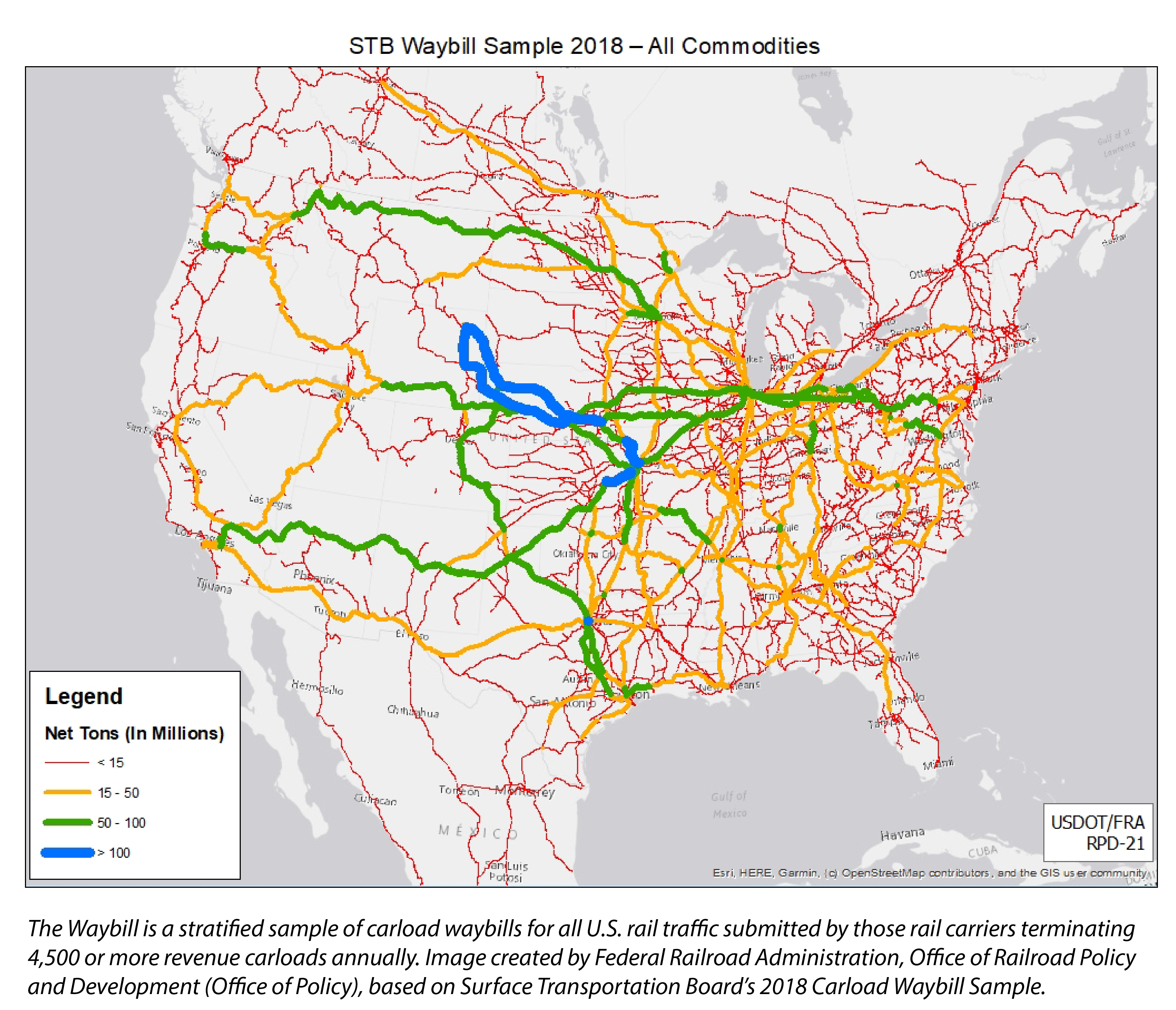

What's getting moved so heavily from Wyoming to KC?ldai_phs wrote: ↑Jul 20, 2020Map of US rail traffic coded by net millions of tons of cargo carried in 2018.

No - it just get's divided and sent different directions / power plants from there. It's a de facto hub and spoke system of routes.
The coal coming out of Wyoming is from the Powder River Basin & the large strip mines (cheaper to mine) is known for its low Sulphur content and thus preferable in electric domestic production. I believe both St. Louis based Peabody and Arch have large mining operations in Wyoming and will control a significant amount of production if they merge
As Chaiftez10 noted, BNSF and UP mostly send it to KC and then heads in different directions because of the rail network itself. Its also one of the reasons why KC by tonnage is either the first and second busiest rail hubs in the country. Someone can correct me but believe more rail cars go through Chicago on any given day but KC leads in tonnage on any given day.
I believe that's correct. It's certainly what I've been hearing for fifteen or twenty years now. KC benefits from a lot of unit trains passing through. They're no slouch in sorting capacity either, having several mammoth classification yards. And the junction flows fairly well, since they modernized it about twenty years ago now with a big flyover eliminating a lot of diamonds. Railroads prefer to avoid Chicago and to a lesser extent St. Louis, if possible, since there is a lot of slow track and a lot of busy junctions. But I've not heard that complaint about Kansas City in a long time. Busy town, but very free flowing. Because they built what amounts to the railroad equivalent of the country's first "stack" interchange. The TRRA has been trying to modernize since the 70s. They've never been able to get the support for it. (To be fair, that's partly because they're owned by a bunch of railroads that compete with each other and have absolutely zero incentive to help one another. Might seem like a standard "St. Louis" thing, but I don't believe it really is.)
There's a little more to it than that, of course. There's a lot of very complicated history involved. (Rate territories, and mergers, and even a little bit of Jay Gould.) But the biggest part of the story probably boils down to KC's network being the most modern and fluid of the major junctions where the eastern and western roads meet. And they can mostly sort things themselves there, without relying on an intermediary like TRRA or Belt Railway of Chicago.
There's a little more to it than that, of course. There's a lot of very complicated history involved. (Rate territories, and mergers, and even a little bit of Jay Gould.) But the biggest part of the story probably boils down to KC's network being the most modern and fluid of the major junctions where the eastern and western roads meet. And they can mostly sort things themselves there, without relying on an intermediary like TRRA or Belt Railway of Chicago.
That is interesting to hear. The Argentine Connection (flyover on the Westside of Downtown) has 3 separate levels of trains. The flyover itself connects BNSF’s Argentine Yard (their largest classification yard) into the terminal railway by Union Station. Union Pacific (lines on the ground) and BNSF formed a JV to pay for it with Wyco-KCK issuing the bonds. There is a second, slightly older, fly over on the east side of downtown that one sees when taking the Missouri River Runner. The choke point now is the KC Terminal Railway which only has 3-4 tracks along the Union Station corridor. Estimates are in the $1 billion range to expand that segment of rail. Traffic at all of the above places are controlled by KC Terminal RR though.symphonicpoet wrote:I believe that's correct. It's certainly what I've been hearing for fifteen or twenty years now. KC benefits from a lot of unit trains passing through. They're no slouch in sorting capacity either, having several mammoth classification yards. And the junction flows fairly well, since they modernized it about twenty years ago now with a big flyover eliminating a lot of diamonds. Railroads prefer to avoid Chicago and to a lesser extent St. Louis, if possible, since there is a lot of slow track and a lot of busy junctions. But I've not heard that complaint about Kansas City in a long time. Busy town, but very free flowing. Because they built what amounts to the railroad equivalent of the country's first "stack" interchange. The TRRA has been trying to modernize since the 70s. They've never been able to get the support for it. (To be fair, that's partly because they're owned by a bunch of railroads that compete with each other and have absolutely zero incentive to help one another. Might seem like a standard "St. Louis" thing, but I don't believe it really is.)
There's a little more to it than that, of course. There's a lot of very complicated history involved. (Rate territories, and mergers, and even a little bit of Jay Gould.) But the biggest part of the story probably boils down to KC's network being the most modern and fluid of the major junctions where the eastern and western roads meet. And they can mostly sort things themselves there, without relying on an intermediary like TRRA or Belt Railway of Chicago.
KC government and construction groups played a big role in getting the flyovers built. STL has an opportunity with their strong Port Authority to do the same I’d think.
I think the rebuild of Merchants rail bridge will play a big part for St. Louis as it essentially takes a slow one track bridge and brings it back to dual track at better speeds as it was originally intended. Beyond that, I think the region has kinda of a mini version of Chicago CREATE program with a group of small rail projects that make incremental improvement but not under one umbrella as Chicago's plan to improve rail plan. Some of the projects have gotten some funding and grants to more forward and others not.
Believe Gone Corporate has posted a regional priority infrastructure list that has the rail projects on it. Just don't have the time right now to locate and post the most recent
Believe Gone Corporate has posted a regional priority infrastructure list that has the rail projects on it. Just don't have the time right now to locate and post the most recent
The cargo flowing from Wyoming through KC is likely decreasing in lockstep with the rapid declines in Wyoming coal production as electricity generation shifts to other inputs.ldai_phs wrote: ↑Jul 20, 2020Map of US rail traffic coded by net millions of tons of cargo carried in 2018.
^ Yep, Especially if a few more transmission lines get developed & approved to carry more wind power east from the plains, as more power lines get developed to bring hydro power into Northeast from Quebec, as more offshore turbines get added and finally, as a few gas pipelines clear environmental hurdles to bring shale gas across the Appalachia. A lot of things happening that fundamentally reducing the need for coal for decades to come, hopefully forever, especially coal out of Wyoming going south and east to power electric plans.
^While that's not impossible, I wouldn't bet on it, as they also see a lot of unit train petroleum and chemical traffic between the Gulf Coast and Canada. They're not really a one-trick pony. In the days before run-through power you might have had more need to hand off a train in a place like Chicago or St. Louis, where both the eastern and western roads have terminals. But these days you can probably make the handoff about anywhere you want, so long as the crews are familiar with both host roads and their territories and operating procedures.
KC is probably a better facility for both UP and BNSF. There's another part of it that probably comes down to the cost and ease of modernizing a terminal. UP's North Platte yard is almost certainly one of the largest railroad gateways in the country all by its lonesome thanks to the fact that it's central to their system and land is dirt cheap, so they can lay track as far as they want in as dizzying an array of configurations as you can imagine. That single yard might well be able to hand more cars in an hour than the entire St. Louis gateway combined. They have special tracks to service unit trains six thousand feet long without so much as disconnecting the power. And there's nothing that would prevent them from lengthening the track to handle ten mile trains. Dupo might be the only yard in St. Louis where you could even yard a six thousand foot unit train without splitting it.
Argenitine, by the way, should have no problem with a six thousand foot train. Nor should UP's Neff and Armourdale, nor KCS's Joint Agency Yard.
Rebuilding the Merchant's Bridge will help. We need it. But it's not going to magically bring the traffic back. It might help stop the hemorrhaging. But to really make the gateway work . . . we'd probably need modern yards. Large, efficient yards capable of handling more than merely local traffic. St. Louis's yards date to an era when a dozen railroads handled four thousand foot mixed freights in and out of town, handing freight to other railroads by the carload. That's not really the business model anymore. Now it's frequently six thousand foot unit trains handed off intact, moving from end to end unsorted. And that's not just coal. It's chemicals. It's petroleum. It's grain. It's aggregate. It's intermodal. It's the way it's done now. Load an entire train of raw material at a collection point near the source, move it untouched to the processing center a half a continent or a continent away.
Anyway, don't mind me. But KC is pretty set for now. I don't think losing Powder River coal is going to hurt them especially. They're still squarely astride BNSF's primary route LA to Chicago, and they will still be a great place for UP and BNSF to hand trains to KCS and NS. They're functionally convenient to the chemical coast and in the middle of grain train country.
If anyone gets the chance to hit the Barriger library out at UMSL (part of the Mercantile Library collection) you can look over TRRA's grand plan to fix this problem. At some point in the seventies they proposed closing three quarters of the yards in town and combining them into a mammoth east side super-yard with subsidiary bits for each tenant railroad and an enormous classification yard. Was this insane Y shaped thing with receiving, classification, and departure all separated out. It would have eliminated nearly all the east side junctions and their headaches. Would have reduced the volume of restricted speed trackage in the area. Would have increased sorting capacity considerably. And it would have cost a fortune . . . paid for on a per share basis by the tenants. It was probably a fantasy from the first moment, but the maps and studies are sure pretty. Lots of flow charts and graphs and geeze that study made some consultant a lot of money. Shame we never did it. Of course . . . it probably would have required the demolition of half the east side.
KC is probably a better facility for both UP and BNSF. There's another part of it that probably comes down to the cost and ease of modernizing a terminal. UP's North Platte yard is almost certainly one of the largest railroad gateways in the country all by its lonesome thanks to the fact that it's central to their system and land is dirt cheap, so they can lay track as far as they want in as dizzying an array of configurations as you can imagine. That single yard might well be able to hand more cars in an hour than the entire St. Louis gateway combined. They have special tracks to service unit trains six thousand feet long without so much as disconnecting the power. And there's nothing that would prevent them from lengthening the track to handle ten mile trains. Dupo might be the only yard in St. Louis where you could even yard a six thousand foot unit train without splitting it.
Argenitine, by the way, should have no problem with a six thousand foot train. Nor should UP's Neff and Armourdale, nor KCS's Joint Agency Yard.
Rebuilding the Merchant's Bridge will help. We need it. But it's not going to magically bring the traffic back. It might help stop the hemorrhaging. But to really make the gateway work . . . we'd probably need modern yards. Large, efficient yards capable of handling more than merely local traffic. St. Louis's yards date to an era when a dozen railroads handled four thousand foot mixed freights in and out of town, handing freight to other railroads by the carload. That's not really the business model anymore. Now it's frequently six thousand foot unit trains handed off intact, moving from end to end unsorted. And that's not just coal. It's chemicals. It's petroleum. It's grain. It's aggregate. It's intermodal. It's the way it's done now. Load an entire train of raw material at a collection point near the source, move it untouched to the processing center a half a continent or a continent away.
Anyway, don't mind me. But KC is pretty set for now. I don't think losing Powder River coal is going to hurt them especially. They're still squarely astride BNSF's primary route LA to Chicago, and they will still be a great place for UP and BNSF to hand trains to KCS and NS. They're functionally convenient to the chemical coast and in the middle of grain train country.
If anyone gets the chance to hit the Barriger library out at UMSL (part of the Mercantile Library collection) you can look over TRRA's grand plan to fix this problem. At some point in the seventies they proposed closing three quarters of the yards in town and combining them into a mammoth east side super-yard with subsidiary bits for each tenant railroad and an enormous classification yard. Was this insane Y shaped thing with receiving, classification, and departure all separated out. It would have eliminated nearly all the east side junctions and their headaches. Would have reduced the volume of restricted speed trackage in the area. Would have increased sorting capacity considerably. And it would have cost a fortune . . . paid for on a per share basis by the tenants. It was probably a fantasy from the first moment, but the maps and studies are sure pretty. Lots of flow charts and graphs and geeze that study made some consultant a lot of money. Shame we never did it. Of course . . . it probably would have required the demolition of half the east side.