

I hope McKee's plan revitalizes North St. Louis, but it's hard to forgive him for destroying so many buildings when a lot of them could have been saved.

Paul McKee manages to get his credits doubled in state legislature.
Another case of the filthy rich getting what the want.
link: http://www.stltoday.com/stltoday/busine ... enDocument
Like I said before, Paul McKee is going to do what he feels. The best we can do now is just go forward with an open mind and work for a productive outcome.
Another case of the filthy rich getting what the want.
link: http://www.stltoday.com/stltoday/busine ... enDocument
Like I said before, Paul McKee is going to do what he feels. The best we can do now is just go forward with an open mind and work for a productive outcome.
The scale of whatever he's doing, stretching from Downtown West through JeffVanderLou, has to be recognized for its scale. As far as developers go, he seems like a master chessplayer, patiently building his positions until he can make strategic strikes.
It's a given, he's been a ripe SOB for neglecting properties so blatantly (at the meagerest amount lawn care).
Same time, if he can create a renewed North Side, and one that helps bring economic revitalization to the empoverished constituents there while drawing new long-term growth to StL, then we all better give him the credit.
Let's patiently wait until we know more of what's at hand. Then, when we're better knowledgeable, let's have at it.
It's a given, he's been a ripe SOB for neglecting properties so blatantly (at the meagerest amount lawn care).
Same time, if he can create a renewed North Side, and one that helps bring economic revitalization to the empoverished constituents there while drawing new long-term growth to StL, then we all better give him the credit.
Let's patiently wait until we know more of what's at hand. Then, when we're better knowledgeable, let's have at it.
^ Paul McKee has a lot of money and he's neglected many of his properties - that's all that some people need to know to conclude they don't like what's happening. Who would their ideal developer be? A guess a penniless person who took immaculate care of the one property that they inherited would be just about perfect.

Grover wrote:^ Paul McKee has a lot of money and he's neglected many of his properties - that's all that some people need to know to conclude they don't like what's happening. Who would their ideal developer be? A guess a penniless person who took immaculate care of the one property that they inherited would be just about perfect.
Their ideal developer may very well be Paul McKee -- taking care of his properties.
Grover wrote:^ Paul McKee has a lot of money and he's neglected many of his properties - that's all that some people need to know to conclude they don't like what's happening. Who would their ideal developer be? A guess a penniless person who took immaculate care of the one property that they inherited would be just about perfect.
He has a lot of money, yes, and wants a lot of the project to be financed by the public.
The same public that saw their neighborhood brick rustled.
It's not simply neglect. This was a coordinated effort to depopulate the area, remove viable buildings, so that he could remake this part of the North Side in his vision. It does not matter if it's "urban," "green," or "sustainable." Repeating slum clearance, urban renewal, and divisively racist housing policies such as these cannot be excused for whatever outcome happens. The potential of what could have occurred if he worked with existing residents to implement a wide scale infill and rehabilitation program will never be reached by his clear cutting, under-the-table tactics. He won't be able to rebuild trust beyond buying the acceptance of the push over public officials that support his agenda.
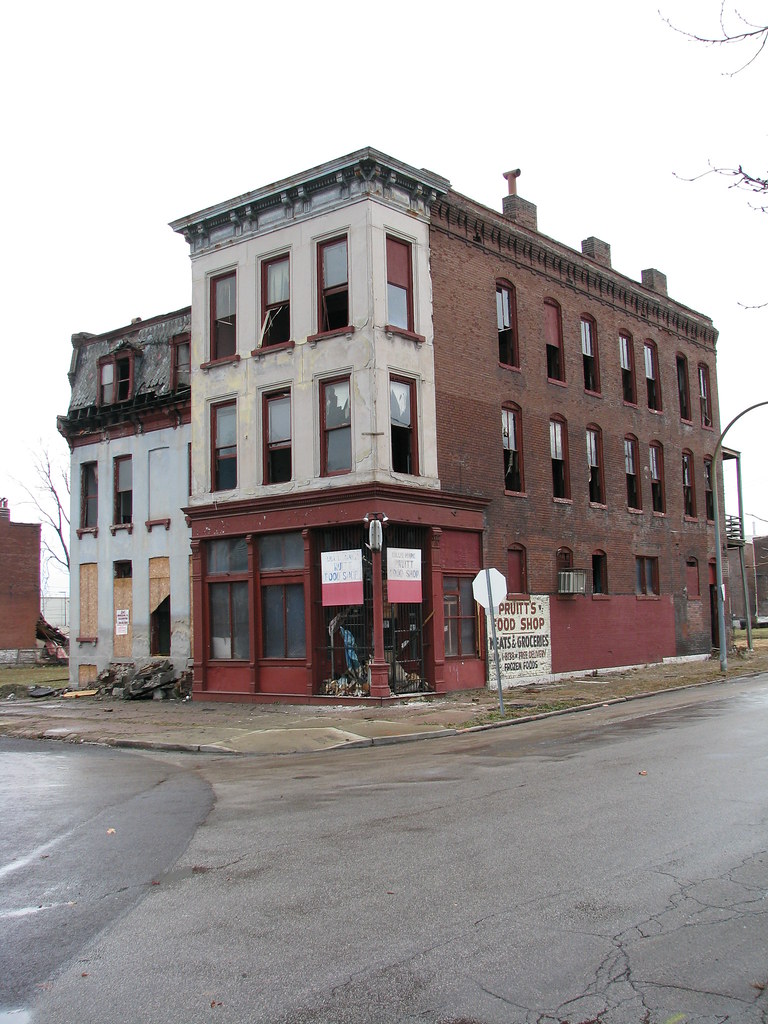
Urbanists should not accept replacing entire blocks of previously in tact housing, or wonderful buildings like those at Glasgow and St. Louis Avenue!!!
Glasgow and St. Louis:
1900 Wright Teddy Bear:

How can we trust an individual who has such disrespect for our residents, historic architecture, and the democratic process? Why are we doing business with such an individual, in an area which has been mistreated enough and only abused further under his tenure?
Could we not find other developers who have a proven record working within our City in a manner that respects existing residents and infrastructure?
You guys go ahead and plan for the future. Yet these questions need to be answered and we must not forget his egregious affronts to our City. We can't keep repeating these mistakes every 20-30 years or we won't have any sense of our City left!
The past is the past, Doug. Keep in mind that McKee is guilty of no crime and owns hundreds of parcels. Are you going to blame him for your family moving to St. Charles? What practical outcome are you looking for?
I would like to know how many homes/buildings McKee has had demolished. Does anyone have this number?
^I am going to ask this Thursday. I want to know how many former residents have left the neighborhood and the City. Probably impossible to know for sure.
Excuse me? He is not only in violation of local City Ordinances, but the Fair Housing Act. Moreover, the buildings he acquired were mostly likely under undue influence, thus making the sale of these homes illegal as contracts are null and void under such circumstances. When someone essentially implements a terror campaign residents are going to sell, but there's nothing legal about brick rustling buildings so neighbors unload their property.
Ideally he would be fined heavily, face criminal charges, and his holdings would be given to several developers with a proven record of respecting our City and its residents.
Keep in mind that McKee is guilty of no crime and owns hundreds of parcels. Are you going to blame him for your family moving to St. Charles? What practical outcome are you looking for?
Excuse me? He is not only in violation of local City Ordinances, but the Fair Housing Act. Moreover, the buildings he acquired were mostly likely under undue influence, thus making the sale of these homes illegal as contracts are null and void under such circumstances. When someone essentially implements a terror campaign residents are going to sell, but there's nothing legal about brick rustling buildings so neighbors unload their property.
Ideally he would be fined heavily, face criminal charges, and his holdings would be given to several developers with a proven record of respecting our City and its residents.
innov8ion wrote:The past is the past, Doug.
so don't bother saving what hasn't yet been demolished? what?
innov8ion wrote:Keep in mind that McKee is guilty of no crime and owns hundreds of parcels.
he has not been charged with any crimes yet. all that brick rustling sure is a coincidence though. actually, isn't it against the law to neglect your property? a friend of mine in S. STL was fined for not painting her house fast enough. i wonder why McKee hasn't been fined for any of his properties...
innov8ion wrote:Are you going to blame him for your family moving to St. Charles?
this is solid reasoning for why doug shouldn't be concerned about STL city.
innov8ion wrote:What practical outcome are you looking for?
try any of the rehabilitated examples throughout the city.
why are people making excuses for McKee? if he were doing this out of a concern for people, instead of for profit, then he would at least have my respect if not necessarily my agreement. since he is handling this like a business matter (neglect = externalization), he gets no such respect from me and, in my opinion, deserves no special treatment or pardons.

Doug wrote:^I am going to ask this Thursday. I want to know how many former residents have left the neighborhood and the City. Probably impossible to know for sure.
Keep in mind that McKee is guilty of no crime and owns hundreds of parcels. Are you going to blame him for your family moving to St. Charles? What practical outcome are you looking for?
Excuse me? He is not only in violation of local City Ordinances, but the Fair Housing Act. Moreover, the buildings he acquired were mostly likely under undue influence, thus making the sale of these homes illegal as contracts are null and void under such circumstances. When someone essentially implements a terror campaign residents are going to sell, but there's nothing legal about brick rustling buildings so neighbors unload their property.
Ideally he would be fined heavily, face criminal charges, and his holdings would be given to several developers with a proven record of respecting our City and its residents.
What provisions of the Fair Housing Act? I'm genuinely curious.
I see your charge that he "most likely" used undue influence, but that isn't enough to convict someone. Bad property manager? Most certainly. Darth Vader in a hard hat? I'm just not convinced when his biggest hater can only muster up a "most likely" charge.
In your ideal world, you would see property taken from someone you don't like and be given to someone you do like? In this ideal world, 1) what would be the incentive for a developer to invest capital rather than wait for you to award it to them for free, and 2) what would someone have to pay to be on your good side?
What provisions of the Fair Housing Act? I'm genuinely curious.
I see your charge that he "most likely" used undue influence, but that isn't enough to convict someone. Bad property manager? Most certainly. Darth Vader in a hard hat? I'm just not convinced when his biggest hater can only muster up a "most likely" charge.
In your ideal world, you would see property taken from someone you don't like and be given to someone you do like? In this ideal world, 1) what would be the incentive for a developer to invest capital rather than wait for you to award it to them for free, and 2) what would someone have to pay to be on your good side?
Those against blockbusting, which isn't the same as it was in the 1960's, as McKee isn't telling whites that blacks are moving in the area. It's called planned shrinkage and we implemented it under Team Four. McKee is fulfilling that idea being that to coerce poor non-white residents from living in cities. Blockbusting charges are investigated through complaints so unless their are filed with HUD nothing occurs.
Undue influence could be determined by speaking to those who sold and asking them why. If the home is one's primary investment, it's not hard to make the conclusion that the dismantling of neighboring structures compelled residents to sell. Many people move for less serious reasons.
It's not about my preference against McKee. I don't like things that John Steffen did, but I never suggested his property be taken by City Government. McKee is breaking the law, destroying entire blocks of our City. The Clemens Mansion sits severely damaged with the most egregious negligence under his ownership.
In my ideal world we would recognize that our City has merit, that it's inherently desirable, and that if we must give subsidy then we ensure historic preservation and the personal property of residents be of utmost importance. Any subsidy would beholden a project to urban design guidelines, form based zoning, and preservation assurances as a minimum standard of acceptability. Other cities have done this like Vancouver, while we have not changed or zoning since 1947 and lack citywide preservation review.
We don't have to pay developers to be on our good side. We need to realize that St. Louis happens to be a desirable market. We have existing mechanisms for redevelopment. We did not need $100,000,000 for a one man blockbusting urban renewal monopoly.
If we feel the need to spend money then give $100,000,000 to neighborhood organizations like ONSL, stimulate the creation of similar programs in JVL (which had a strong organization in the 1980's doing housing), subsidize the projects of proven developers like Millennium Restoration, the Gills, LoftWorks, etc, or even finally increase the Healthy Home Repair Program thereby empowering residents themselves to fix their property.
These are not radical ideas. Supporting McKee, given his years of damage, happens to be lunacy.
Doug wrote:
I am going to ask this Thursday. I want to know how many former residents have left the neighborhood and the City. Probably impossible to know for sure.
Whatever the numbers are, they are tiny compared to the numbers of people who have left and the buildings that have vanished over the last 50 years.
McKee is coming in at the very end of a long, brutal slide. He's a sympton, not a cause. If you're going to start nabbing all the people responsible for the decline of the North Side, you're going to need to build a much bigger jail. (I'm near the end of Colin Gordon's Mapping Decline, and, as it turns out, it's not about Paul McKee.)
The State of Missouri have blessed the project (twice now). So has the City of St. Louis (implicitly, at least). Sorry, but I don't think there's going to be any punishment or day of reckoning.

http://www.stlbeacon.org/development/mckee
^ Full story at the link.
-RBB
Posted 12:21 p.m. Mon., May 18- Some of the mystery is being lifted concerning the long-rumored redevelopment of large tracts of land in north St. Louis, but don't expect to see buildings going up any time soon.
After years of mistrust and suspicion about the so-called Blairmont project, a public meeting is scheduled for next Thursday night. That follows a presentation this past Monday that was open to a more limited audience, primarily those who live in the area that will be included.
But April Ford-Griffin (right), the alderwoman who says her 5th Ward contains 90 percent of the property affected by the project, says that the Board of Aldermen won't be considering anything connected to the redevelopment until this fall -- if other pieces of the complicated puzzle fall into place before then.
One reason that the long-discussed project is suddenly shifting into a higher gear is that money for such work is available from Washington as part of the federal stimulus package, she said.
"You've got billions of dollars in stimulus money out there," she said, "and we don't want to be passed over.
"If St. Louis does not apply for those dollars and fit into the silos that the federal government have for stimulus money, we'll be left behind. We have to be in position to get some of the stimulus money to develop our city."
^ Full story at the link.
-RBB
Roy314 wrote:
Whatever the numbers are, they are tiny compared to the numbers of people who have left and the buildings that have vanished over the last 50 years.
So we should be OK with illegal activities against an already downtrodden, oppressed, and maligned population which has delt with inferior public services for the past 30 years yet still stayed tax payers for that time? We should forget that these practices undermine the very fabric our out social contract with government thus their inherhent obligation to protect the population from these types of heinous infringments upon liberty and property?
You're advocating tyrannny of the majority, with a side of oligarchy.
Roy314 wrote:
McKee is coming in at the very end of a long, brutal slide. He's a sympton, not a cause. If you're going to start nabbing all the people responsible for the decline of the North Side, you're going to need to build a much bigger jail. (I'm near the end of Colin Gordon's Mapping Decline, and, as it turns out, it's not about Paul McKee.)
Colin Gordon is no authority nor are his ideas original. McKee will be documented in the future.
Roy314 wrote:
The State of Missouri have blessed the project (twice now). So has the City of St. Louis (implicitly, at least). Sorry, but I don't think there's going to be any punishment or day of reckoning.
In our City racially restrictive covenants, segregated busses, and lynchings were common. They are actually the product of instutitional racism. Acceptance due to ignorance, corruption, or wide ranging support does not justify a wrong act. We do have morals beyond the political whims of our elected officials!
Lynching in St. Louis City?
When in 1843?
My grandfather grew up in the Mill Creek Valley neighborhood you talk about so much and he never mentioned any lynchings.
He always said St. Louis was a racist town, but so was Chicago, so was Cleveland, so was Detroit and Philadelphia. The racial segregation/hostility in St. Louis was much more similar to that of its northern counterparts, nothing like that devastating racism below the Mason-Dixon line.
I don't know why people always say St. Louis was this turbulently racist and out of control town in the 40s, 50s, 60s. When in all honesty St. Louis was one of the safest cities to be in that time period, because we never experienced the major race riots that were prevalent in other industrialized cities and a Black person could walk the streets without fear of being attacked by an angry White mob (unlike much of the South).
Keep in mind Doug that many Blacks fled the South and came to St. Louis, because it was a much more tolerable atmosphere than say Arkansas, Tennessee, and Mississippi.
My grandfather would always talk about racist cops that would rough black guys up in an alley or shoot them in the back, but don't make it sound like St. Louis was Mississippi Burning, because these practices were also very common in New York City, Chicago, Philadelphia, Baltimore, Los Angeles, and pretty much ever other major city you could name. It was just a different time back then, although some argue that the cops are still that crooked.
The fact that you said lynchings in St. Louis were common is almost laughable too and really discredits your claims. St. Louis had a population density similar to present day San Francisco in 1950. Where would you lynch someone? From a streetlight?
St. Louis was a city of ethic enclaves and Blacks just happened to be one of them. St. Louis was very balkanized (even among whites) and if a White person would have came to Mill Creek Valley in the 1950s with rope in hand, he probably would have been the one to get lynched and that's just a fact.
America has a nasty past and a lot of things were done that couldn't even be justified today. Now I don't know if you were a Black man in your past life Doug, but you reminisce about the social injustices of the civil rights era more than my grandfather and he lived it first hand. In all honesty Doug, you really need to STOP!
When in 1843?
My grandfather grew up in the Mill Creek Valley neighborhood you talk about so much and he never mentioned any lynchings.
He always said St. Louis was a racist town, but so was Chicago, so was Cleveland, so was Detroit and Philadelphia. The racial segregation/hostility in St. Louis was much more similar to that of its northern counterparts, nothing like that devastating racism below the Mason-Dixon line.
I don't know why people always say St. Louis was this turbulently racist and out of control town in the 40s, 50s, 60s. When in all honesty St. Louis was one of the safest cities to be in that time period, because we never experienced the major race riots that were prevalent in other industrialized cities and a Black person could walk the streets without fear of being attacked by an angry White mob (unlike much of the South).
Keep in mind Doug that many Blacks fled the South and came to St. Louis, because it was a much more tolerable atmosphere than say Arkansas, Tennessee, and Mississippi.
My grandfather would always talk about racist cops that would rough black guys up in an alley or shoot them in the back, but don't make it sound like St. Louis was Mississippi Burning, because these practices were also very common in New York City, Chicago, Philadelphia, Baltimore, Los Angeles, and pretty much ever other major city you could name. It was just a different time back then, although some argue that the cops are still that crooked.
The fact that you said lynchings in St. Louis were common is almost laughable too and really discredits your claims. St. Louis had a population density similar to present day San Francisco in 1950. Where would you lynch someone? From a streetlight?
St. Louis was a city of ethic enclaves and Blacks just happened to be one of them. St. Louis was very balkanized (even among whites) and if a White person would have came to Mill Creek Valley in the 1950s with rope in hand, he probably would have been the one to get lynched and that's just a fact.
America has a nasty past and a lot of things were done that couldn't even be justified today. Now I don't know if you were a Black man in your past life Doug, but you reminisce about the social injustices of the civil rights era more than my grandfather and he lived it first hand. In all honesty Doug, you really need to STOP!
Oh yeah my Grandpa called me up yesterday and said that Blairmont sounds like one of the best things that could happen to North St. Louis. For the record my Grandfather is liberal, represented city employees for St. Louis City (Union man for AFSCME), lived through segregation and urban renewal, grew up in the slums and St. Louis all his life. Still thinks Paul McKee is doing the city a favor, can you believe that 
This conversation is getting off-topic. The important issue at hand now is what McKee wants from the city. He is not proposing using his own money to develop his own land -- otherwise, best of luck and we'll wait and see.
According to representatives last week, McKee plans to request:
- Redevelopment rights via an ordinance passed by the Board of Aldermen that would set boundaries for the project and include existing residences and businesses
- Chapter 99 condemnation rights
- Tax Increment Financing (up to $400 million, according to some)
- Purchase of all necessary city-owned land
- Rights to charter private utility and transportation districts
- Indenture on all property that becomes part of the project that requires an annual assessment paid to a private entity that will own parks and infrastructure throughout the area
These are heavy instruments, and they are on the table. Whatever one thinks about the acquisition tactics that McKee used, or how pretty you think the renderings are, the big issue facing us is the form of municipal legislation that will soon be on the table.
What do people think about the things outlined above? Does a project that is far from shovel-ready deserve such powers? What should be included in the redevelopment ordinance (preservation, requirement of property maintenance, sale of Old North holdings, exclusion of blocks whose residents don't want to be encompassed by the "utility district")?
According to representatives last week, McKee plans to request:
- Redevelopment rights via an ordinance passed by the Board of Aldermen that would set boundaries for the project and include existing residences and businesses
- Chapter 99 condemnation rights
- Tax Increment Financing (up to $400 million, according to some)
- Purchase of all necessary city-owned land
- Rights to charter private utility and transportation districts
- Indenture on all property that becomes part of the project that requires an annual assessment paid to a private entity that will own parks and infrastructure throughout the area
These are heavy instruments, and they are on the table. Whatever one thinks about the acquisition tactics that McKee used, or how pretty you think the renderings are, the big issue facing us is the form of municipal legislation that will soon be on the table.
What do people think about the things outlined above? Does a project that is far from shovel-ready deserve such powers? What should be included in the redevelopment ordinance (preservation, requirement of property maintenance, sale of Old North holdings, exclusion of blocks whose residents don't want to be encompassed by the "utility district")?

^^
Heavy instruments indeed.
In some ways, I find Paul McKee's ability to make this plan come to fruition somewhat sad. McKee is going to come into the city and, literally, strong arm the rest of the properties around his current investments via eminent domain. Then, he's going to somehow create a city within a city, a McKee'sville if you will, in which he will directly benefit by essentially taxing (or assessing) the parks, amenities, transportation, and utilities his mini-city creates/uses. With this project, McKee is hands down creating/providing every public amenity a fully functioning city should already be providing its citizens; jobs, transportation, green space, etc. McKee, and here's the sad part, has even more leverage because our civic leadership is unable to provide these amenities stand alone, especially in an area that for years has remained dilapidated and desolate.
Matt Drops the H and all of you preservationists out there. This is it. This is what it looks like when an entity, be it a city, a person, an evil genius, a whatever, successfully uses business, or generation of (tax) revenues, to improve, to advance, to preserve, to move forward - I know, my typical stance. Historic Tax credits have effectively given the city of St. Louis a five block strip affectionately called the loft district and a smattering of other urban projects. Paul McKee Jr. is about to unveil a plan to create a mini-city roughly quadruple the size of Downtown. This is money walking, brother.
This is actually pretty crazy-cool and crazy-scary at the same time.
Heavy instruments indeed.
In some ways, I find Paul McKee's ability to make this plan come to fruition somewhat sad. McKee is going to come into the city and, literally, strong arm the rest of the properties around his current investments via eminent domain. Then, he's going to somehow create a city within a city, a McKee'sville if you will, in which he will directly benefit by essentially taxing (or assessing) the parks, amenities, transportation, and utilities his mini-city creates/uses. With this project, McKee is hands down creating/providing every public amenity a fully functioning city should already be providing its citizens; jobs, transportation, green space, etc. McKee, and here's the sad part, has even more leverage because our civic leadership is unable to provide these amenities stand alone, especially in an area that for years has remained dilapidated and desolate.
Matt Drops the H and all of you preservationists out there. This is it. This is what it looks like when an entity, be it a city, a person, an evil genius, a whatever, successfully uses business, or generation of (tax) revenues, to improve, to advance, to preserve, to move forward - I know, my typical stance. Historic Tax credits have effectively given the city of St. Louis a five block strip affectionately called the loft district and a smattering of other urban projects. Paul McKee Jr. is about to unveil a plan to create a mini-city roughly quadruple the size of Downtown. This is money walking, brother.
This is actually pretty crazy-cool and crazy-scary at the same time.
ecoabsence wrote:
- Tax Increment Financing (up to $400 million, according to some)
Almost a moot discussion topic, and maybe just icing on the cake for McKee. $400M is a mere 6.67% of a project estimated to hit $6 BILLION dollars.
ttricamo wrote:ecoabsence wrote:
- Tax Increment Financing (up to $400 million, according to some)
Almost a moot discussion topic, and maybe just icing on the cake for McKee. $400M is a mere 6.67% of a project estimated to hit $6 BILLION dollars.
Yes, but the big question is whether the TIF will apply to part of the project or the whole. If the whole, the $400 million is a drop in the bucket and issuance up front makes little sense especially because the area is a ways off before taxes will be generated with the property. Why would the developer not wish to TIF each component piece? That's the smart way to go -- not a total up-front package 15 years ahead of projected completion.
I seriously doubt that $6 billion would build the plan unveiled last week. A zero must be missing.
ttricamo wrote:^^
Heavy instruments indeed.
In some ways, I find Paul McKee's ability to make this plan come to fruition somewhat sad. McKee is going to come into the city and, literally, strong arm the rest of the properties around his current investments via eminent domain. Then, he's going to somehow create a city within a city, a McKee'sville if you will, in which he will directly benefit by essentially taxing (or assessing) the parks, amenities, transportation, and utilities his mini-city creates/uses. With this project, McKee is hands down creating/providing every public amenity a fully functioning city should already be providing its citizens; jobs, transportation, green space, etc. McKee, and here's the sad part, has even more leverage because our civic leadership is unable to provide these amenities stand alone, especially in an area that for years has remained dilapidated and desolate.
Matt Drops the H and all of you preservationists out there. This is it. This is what it looks like when an entity, be it a city, a person, an evil genius, a whatever, successfully uses business, or generation of (tax) revenues, to improve, to advance, to preserve, to move forward - I know, my typical stance. Historic Tax credits have effectively given the city of St. Louis a five block strip affectionately called the loft district and a smattering of other urban projects. Paul McKee Jr. is about to unveil a plan to create a mini-city roughly quadruple the size of Downtown. This is money walking, brother.
This is actually pretty crazy-cool and crazy-scary at the same time.
The crazy part about this is that it will probably be successful, the sad part is that it will most likely displace many unfortunate individuals. Remember in an earlier post when I mentioned "New Urbanist Community". That is exactly what McKee is planning. New Town just north of Downtown (like you said roughly 4 times the size of the loft district). Although he is going to use strong arm tactics to pull this off....we can not deny that this will only make downtown and the city as a whole, look more appealing to developers, conventions, companies and residents that otherwise wouldn't have consider the city.