

Ehh, I don't think the article was mean spirited. They seemed to have expressed slight disbelief at the numbers.beer city wrote: ↑Mar 31, 2017Growing faster than St. Louis seems to be a point of personal pride in KC -its the headline for the Star -
Of course I would wager that urban KC (the historic city south of the river) is probably losing people - not at the rate that of StL, and masked by rapid growth in suburban annexed areas
http://www.kansascity.com/news/local/ar ... 41529.html
This is a yearly estimate - which in the past have shown a wide degree of accuracy - though I don't think St. Louis metro is growing fast, I don't think its losing population either - For instance in 2009 the estimate showed a loss for the county - 2010 hard census actually had modest growth
The only true measure will be the 10 year census
That being said - North city is probably still hemorrhaging, the central corridor is probably still growing, and i would bet that losses on the south side have slowed to a trickle - if not neutral

I decided to whip up a map of the upper midwest showing % Population change between the 2010 census and the ACS population estimates for July of 2016:
![]()
If there is interest I could attempt to throw the data in a Google Fusion Table to make it more interactive.

If there is interest I could attempt to throw the data in a Google Fusion Table to make it more interactive.

Something tell's me just because St.Louis is the most prominent city the state Missouri could give 2 cents of caring in that regard i don't feel like theres an exodus of people leaving St.Louis in fact i feel like theres a decent amount of people that are moving into the region probably not like half the other cities, but theres people moving here though thats part of me being naiveChalupas54 wrote: ↑Mar 31, 2017Not entirely. I recently corresponded with the STLRC to see if they had any change or response to recent numbers, and their response was pretty much 'we have no evidence that indicates the St Louis metro lost population'. In fact, they expressed that they had seen indications that the region grew in population, yet did not cite what those were. Either way, if St Louis is bleeding population, this is a problem for the State of Missouri, as not only is St Louis the most prominent city, it's also the largest tax base.

19,000 since 2010 is nothing to rave about however if the region can increase our current growth rate close to 35,000 even 50,000 by 2020 i know rather ambitious however thats what this region needs is a net positive gain and a much needed boost i mean its embarrassing that we're getting out hustled by places like Des Moines Omaha Tulsa even Kansas Citians are taking jabs at us every chance they get

Anyways Does the Kansas City proper consist of 4 counties as where St.Louis County and City are land locked? This is why its ever more important for both to combine and merge don't 998,000 and 312,000 sound much better being a little over 1.3 Million??
I like to say Saint Louis is three cities in one - a decaying north, a growing central and a mixed South. While this map on property values by Paul Fehler uses '97-'17 data, it still pretty much is an encapsulation of what's going on.
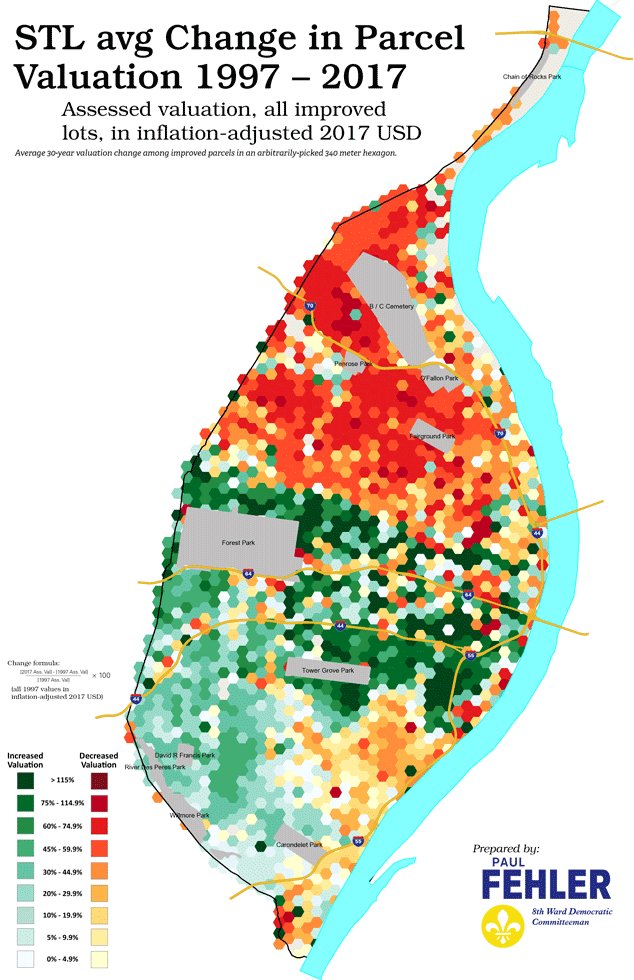
In terms of regional migration, north city continues to bleed population to other areas of the region, the Central corridor is gaining people from the region and South City is doing some of both.
ebsy, nice map of Upper Midwest.
Here's a good map on deaths-births...
![]()
it's interesting to me b/c it shows where places like Western Pennsylvania have a particularly difficult time with growth. I think Pittsburgh is doing a pretty good job on becoming a modern, vibrant city but the region's age demographic is a challenge to getting strong population growth.
Here's a good map on deaths-births...

it's interesting to me b/c it shows where places like Western Pennsylvania have a particularly difficult time with growth. I think Pittsburgh is doing a pretty good job on becoming a modern, vibrant city but the region's age demographic is a challenge to getting strong population growth.
Great maps everyone,
^ I grew up in one of the Minnesota red counties along the MN/ND border with more deaths then births. The population loss was easy to explain in my rural world. Farm families bought out other farm families to make monster size farms, the machines got bigger and what labor their was involved in the local sugar beet fields was taken over with mechanization all while I was growing up.
Most of us who didn't grew up on a farm/in town and went onto college or the Twin Cities never came back, a few like a good friend of mine stuck around and took the farm hand jobs/truck driving jobs that are still needed, and a few that stayed I have no idea but the jobs left were not very good. To top it off, the county I grew up in was all farm fields and no lakes so no influx of retirees returning as well as the families got smaller so school class sizes dropped considerably from the day that my parents were teachings. Which means even less jobs for teachers, services, and the likes
^ I grew up in one of the Minnesota red counties along the MN/ND border with more deaths then births. The population loss was easy to explain in my rural world. Farm families bought out other farm families to make monster size farms, the machines got bigger and what labor their was involved in the local sugar beet fields was taken over with mechanization all while I was growing up.
Most of us who didn't grew up on a farm/in town and went onto college or the Twin Cities never came back, a few like a good friend of mine stuck around and took the farm hand jobs/truck driving jobs that are still needed, and a few that stayed I have no idea but the jobs left were not very good. To top it off, the county I grew up in was all farm fields and no lakes so no influx of retirees returning as well as the families got smaller so school class sizes dropped considerably from the day that my parents were teachings. Which means even less jobs for teachers, services, and the likes
Here's a map I made of the percentage change in registered voters from March 2013 to March 2017:
![]()

^Interesting. Looks more indicative of growth in South St. Louis than I would have expected.
I'm not certain whether population change or other factors with voter participation (end of the Obama error, lack of a black candidate on the November ballot) is the primary driver. It's hard to make a real causal with the evidence we currently have.

I could see how this may not be a strong indicator in overall population numbers. One could be removal of registered voters who moved away or died some time before and wasn't cleaned up. Another is it wouldn't pick up children and non-citizens at all. Unfortunately the map doesn't have as a reflection how many people were in each area to start with since big swings one way or another could be a net difference of not that many if there were few voters to start with, and some areas are likely this due to being areas that for example are primarily industrial in nature.
All the red in North City combines for a drop of over 20,000 voters.imperialmog wrote: ↑Apr 03, 2017I could see how this may not be a strong indicator in overall population numbers. One could be removal of registered voters who moved away or died some time before and wasn't cleaned up. Another is it wouldn't pick up children and non-citizens at all. Unfortunately the map doesn't have as a reflection how many people were in each area to start with since big swings one way or another could be a net difference of not that many if there were few voters to start with, and some areas are likely this due to being areas that for example are primarily industrial in nature.
Are there any data out there that shows how St. Louis is doing with younger people? 35 and below, specifically. Both on absolute terms and relative to other cities.
The American Community Survey has that data. ACS 5 year estimates for 2015 put the population under 35 at 50.5% (skewed towards 18-35) for the City of St. Louis. It's 46.5% in St. Charles County (more heavily skewed towards children) and 43.9 for St. Louis County (with a fairly level distribution). If you want to look at other cities, go to American Factfinder and choose the American Community Survey under Topics and navigate to the geographies you want to look at under Geographies. Hope this helps.
Post-Dispatch has an excellent article on local immigration and some of the challenges ahead in that regard:
St. Louis looks to immigrants for population, workforce boost
http://www.stltoday.com/business/local/ ... cee10.html
It also contained this: "Natives who leave the area are the biggest weight on the region’s lackluster population growth, a trend occurring across the Midwest as people move south and west."
St. Louis looks to immigrants for population, workforce boost
http://www.stltoday.com/business/local/ ... cee10.html
It also contained this: "Natives who leave the area are the biggest weight on the region’s lackluster population growth, a trend occurring across the Midwest as people move south and west."
We *could* look at why those natives leave (hint: they're young, and it's because of jobs), but I guess it's easier to kind of sidestep the jobs problem and try to plug the leaks with immigrants.
Anecdotal, but I've known so many talented young people that have left, not because of climate or sports teams or even crime, but because of job offers. St. Louis companies are either unwilling or unable to offer salaries that are competitive with other cities. Say that it is offset by lower cost of living? Maybe true. But it doesn't change what is happening.
We will not start actually growing until we offer jobs. Anything else will result in us keeping pace, at best.
Anecdotal, but I've known so many talented young people that have left, not because of climate or sports teams or even crime, but because of job offers. St. Louis companies are either unwilling or unable to offer salaries that are competitive with other cities. Say that it is offset by lower cost of living? Maybe true. But it doesn't change what is happening.
We will not start actually growing until we offer jobs. Anything else will result in us keeping pace, at best.

Jobs is a big one but people place a lot of value on what they are going to do after work and on the weekends. Some people just want/need a change of scenery. I grew up in STL and went to Mizzou, then moved to Scottsdale Arizona just to do something completely different. Now I'm in Dallas because of a job. I love STL but there are some things I've noticed in both these cities that I find appealing.Aesir wrote: ↑Apr 04, 2017We *could* look at why those natives leave (hint: they're young, and it's because of jobs), but I guess it's easier to kind of sidestep the jobs problem and try to plug the leaks with immigrants.
Anecdotal, but I've known so many talented young people that have left, not because of climate or sports teams or even crime, but because of job offers. St. Louis companies are either unwilling or unable to offer salaries that are competitive with other cities. Say that it is offset by lower cost of living? Maybe true. But it doesn't change what is happening.
We will not start actually growing until we offer jobs. Anything else will result in us keeping pace, at best.
I would love to see a population gain, no matter how small for 2020. I think its a psychological hurdle we need to make, and then experience some moderate growth the next decade.
Something to consider is that Missouri's population is up 1.7% 2000-2016. That's 37th. The country is up 4.66%.

Where is everyone moving to?quincuenx wrote: ↑Apr 08, 2017Something to consider the Hydromax X30 is that Missouri's population is up 1.7% 2000-2016. That's 37th. The country is up 4.66%.
Part of it is that the working class is moving to the county as the middle class moves around the county or to St. Charles County.
Part of it is people moving to the county because of 4-Family to 2-Family (and 2 to 1) conversions.
Part of it might be loss to the coasts and other growing regions (although the region's population isn't declining).
But primarily it's just that people just move around. The problem is that people aren't moving in as fast as they're moving out. If the city had better schools, transit, and safety, any families that did want to move into the county would be replaced by newly weds, first time home buyers, empty nesters, couples with one or two children, etc. And the working class wouldn't still have this false vision of buying a car and living in the suburbs as being prosperous. As with transit, there's an outdated view that we need to attract those that choose to live in the city and just assume the working class has no choice. In my opinion, as with transit, the more you do to retain residents or passengers, numbers will naturally continue to grow. Our downtown (proper) actually sucks compared to a lot of our peer cities and yet people want to live there. Imagine if it was actually a nice place to be. The same goes for the city, it's in demand, it just has a lot of problems.
Established people with families move to the county or St. Charles. Don't want to leave the area because of kids, but also don't want to live in the city because of kids.
Young people move to bigger cities or to rapidly growing cities. Cuts across socioeconomic lines; I've seen richer whites leave for Portland, California, Denver, and Chicago. I've known poorer blacks who are now in Philly and Houston. Muslim immigrants now in Nashville. Only 1 or 2 have returned. All were due to jobs.
Kids? County and St. Charles. No kids? City with an abundance of jobs.
Young people move to bigger cities or to rapidly growing cities. Cuts across socioeconomic lines; I've seen richer whites leave for Portland, California, Denver, and Chicago. I've known poorer blacks who are now in Philly and Houston. Muslim immigrants now in Nashville. Only 1 or 2 have returned. All were due to jobs.
Kids? County and St. Charles. No kids? City with an abundance of jobs.
Top outflows moving out of STL to following markets 2010 to 2014..
Chicago-Naperville-Elgin, IL-IN-WI Metro Area 4,182
Columbia, MO Metro Area 3,872
Springfield, MO Metro Area 3,496
Kansas City, MO-KS Metro Area 3,164
Cape Girardeau, MO-IL Metro Area 1,765
Dallas-Fort Worth-Arlington, TX Metro Area 1,595
Jefferson City, MO Metro Area 1,344
Phoenix-Mesa-Scottsdale, AZ Metro Area 1,241
New York-Newark-Jersey City, NY-NJ-PA Metro Area 1,175
Indianapolis-Carmel-Anderson, IN Metro Area 1,046
Los Angeles-Long Beach-Anaheim, CA Metro Area 1,033
Houston-The Woodlands-Sugar Land, TX Metro Area 917
Washington-Arlington-Alexandria, DC-VA-MD-WV Metro Area 892
Nashville-Davidson--Murfreesboro--Franklin, TN Metro Area 820
Miami-Fort Lauderdale-West Palm Beach, FL Metro Area 775
Champaign-Urbana, IL Metro Area 768
Tampa-St. Petersburg-Clearwater, FL Metro Area 749
Peoria, IL Metro Area 693
Springfield, IL Metro Area 691
Jacksonville, FL Metro Area 679
Philadelphia-Camden-Wilmington, PA-NJ-DE-MD Metro Area 664
Orlando-Kissimmee-Sanford, FL Metro Area 653
Minneapolis-St. Paul-Bloomington, MN-WI Metro Area 651
Carbondale-Marion, IL Metro Area 644
Memphis, TN-MS-AR Metro Area 633
Denver-Aurora-Lakewood, CO Metro Area 628
San Francisco-Oakland-Hayward, CA Metro Area 620
St. Joseph, MO-KS Metro Area 612
Cincinnati, OH-KY-IN Metro Area 595
Charlotte-Concord-Gastonia, NC-SC Metro Area 581
Seattle-Tacoma-Bellevue, WA Metro Area 561
Cape Coral-Fort Myers, FL Metro Area 532
Boston-Cambridge-Newton, MA-NH Metro Area 521
Austin-Round Rock, TX Metro Area 469
Colorado Springs, CO Metro Area 468
Atlanta-Sandy Springs-Roswell, GA Metro Area 467
San Diego-Carlsbad, CA Metro Area 456
Columbus, OH Metro Area 451
Des Moines-West Des Moines, IA Metro Area 449
Salt Lake City, UT Metro Area 420
Virginia Beach-Norfolk-Newport News, VA-NC Metro Area 413
Top inflows moving into STL from 2010 to 2014
Chicago-Naperville-Elgin, IL-IN-WI Metro Area 4,759
Kansas City, MO-KS Metro Area 2,669
Columbia, MO Metro Area 1,949
Springfield, MO Metro Area 1,870
Dallas-Fort Worth-Arlington, TX Metro Area 1,413
Washington-Arlington-Alexandria, DC-VA-MD-WV Metro Area 1,280
Atlanta-Sandy Springs-Roswell, GA Metro Area 1,107
New York-Newark-Jersey City, NY-NJ-PA Metro Area 1,063
Springfield, IL Metro Area 1,010
Los Angeles-Long Beach-Anaheim, CA Metro Area 788
Jefferson City, MO Metro Area 725
Detroit-Warren-Dearborn, MI Metro Area 711
Miami-Fort Lauderdale-West Palm Beach, FL Metro Area 684
Phoenix-Mesa-Scottsdale, AZ Metro Area 679
San Antonio-New Braunfels, TX Metro Area 667
Cape Girardeau, MO-IL Metro Area 663
Seattle-Tacoma-Bellevue, WA Metro Area 632
Carbondale-Marion, IL Metro Area 614
Indianapolis-Carmel-Anderson, IN Metro Area 614
Houston-The Woodlands-Sugar Land, TX Metro Area 573
Minneapolis-St. Paul-Bloomington, MN-WI Metro Area 565
Virginia Beach-Norfolk-Newport News, VA-NC Metro Area 561
Portland-Vancouver-Hillsboro, OR-WA Metro Area 552
Milwaukee-Waukesha-West Allis, WI Metro Area 549
Anchorage, AK Metro Area 523
Joplin, MO Metro Area 514
Philadelphia-Camden-Wilmington, PA-NJ-DE-MD Metro Area 505
Denver-Aurora-Lakewood, CO Metro Area 494
Boston-Cambridge-Newton, MA-NH Metro Area 485
Tampa-St. Petersburg-Clearwater, FL Metro Area 479
Omaha-Council Bluffs, NE-IA Metro Area 472
Columbus, OH Metro Area 470
Nashville-Davidson--Murfreesboro--Franklin, TN Metro Area 444
Wichita, KS Metro Area 435
Peoria, IL Metro Area 417
Baltimore-Columbia-Towson, MD Metro Area 405
Oklahoma City, OK Metro Area 402
Source:
https://www.census.gov/data/tables/2014 ... ation.html
Here is KC..
http://kcrag.com/viewtopic.php?f=1&t=19 ... on#p562537
TAMU has updated metro migration history with 2016 stats.
STL minor loss just over 1K, fairly significant domestic loss but offfset some with international gain...
https://www.recenter.tamu.edu/data/popu ... s%2C_MO-IL
Cincy had about a 10K net gain...
https://www.recenter.tamu.edu/data/popu ... C_OH-KY-IN
Cleveland still in a downward spiral losing over 4K overall...
https://www.recenter.tamu.edu/data/popu ... yria%2C_OH
KC gains 20K but not its highest peak...
https://www.recenter.tamu.edu/data/popu ... y%2C_MO-KS
Indianapolis had a 17K overall gain...
https://www.recenter.tamu.edu/data/popu ... rson%2C_IN
Columbus 21K gain...
https://www.recenter.tamu.edu/data/popu ... mbus%2C_OH
STL minor loss just over 1K, fairly significant domestic loss but offfset some with international gain...
https://www.recenter.tamu.edu/data/popu ... s%2C_MO-IL
Cincy had about a 10K net gain...
https://www.recenter.tamu.edu/data/popu ... C_OH-KY-IN
Cleveland still in a downward spiral losing over 4K overall...
https://www.recenter.tamu.edu/data/popu ... yria%2C_OH
KC gains 20K but not its highest peak...
https://www.recenter.tamu.edu/data/popu ... y%2C_MO-KS
Indianapolis had a 17K overall gain...
https://www.recenter.tamu.edu/data/popu ... rson%2C_IN
Columbus 21K gain...
https://www.recenter.tamu.edu/data/popu ... mbus%2C_OH
Now that Census released 2016 population estimates for all cities. we can now compare Saint Louis (which we already knew dropped to 311.000 b/c of its independent county status.)
Turns out we had the 5th highest raw total drop and the edged Baltimore for highest percentage loss among bigger cities.
![]()
Turns out we had the 5th highest raw total drop and the edged Baltimore for highest percentage loss among bigger cities.

One question on this I was wondering. is there a possible effect of the NGA development in this? Since i'm not sure how many were displaced and when but that is possibly something that could impact things.
No. Hardly anyone lived there. People are leaving the city en masse due to crime. Northside neighborhoods are bleeding residents.imperialmog wrote:One question on this I was wondering. is there a possible effect of the NGA development in this? Since i'm not sure how many were displaced and when but that is possibly something that could impact things.
Sent from my iPhone using Tapatalk