4,489
Super ModeratorSuper Moderator
4,489

PostOct 12, 2012#76

Positive investment, true. It's sad, but this is a terrible design. Except for manufacturing and research, the single campus model appears to be on its way to becoming a relic all across this country.

RGA is a prominent F500 financial firm. If it insists on building a suburban campus, shouldn't RGA want signature buildings on its campus? These are not "signature". Awful. They look like Maryville Centre buildings. The base of the building looks like a ripoff from the base of H&R Block's HQ's in downtown Kansas City.

I could be wrong, but my hunch is that RGA used local and older architects, who are more likely to be conservative in design in my opinion, and the design is likely limited by Chesterfield's strict height restrictions.

It's great that jobs are going to be created by RGA; and RGA, no doubt, is showing its commitment to STL, however, this design appears not to be too distinguished from any of those late 90's - early 2000's era buildings in Chesterfield.

They are terrible. Step it up, St. Louis!

1,093
Expert MemberExpert Member
1,093

PostOct 13, 2012#77

stlhistory wrote:As much as I would love to see RGA build in the city or in Clayton, it already is located in West County, and probably a lot of senior management (decision makers) live in Wildwood, Chesterfield, Clarkson Valley, et al. It's a long drive from Wildwood to downtown or Clayton, but it's a hop to a cornfield nearby. I see why they did it, and I doubt that RGA didn't even consider building in the city or Clayton (it's a big project, they likely ran the numbers). It's just that on the whole, what's less work for them and their employees? I also would point out that it's a reinsurance company (not even retail insurance, these people actually sell insurance policies to other insurance companies), so I'm not wholly surprised they went with a traditional suburban campus with an unobtrusive design rather than with a cutting-edge new building or a renovation of a century-old warehouse.
You'd be surprised at how many dont run the numbers. They already owned the land, its close to home, and like you said, its not a retail insurance company so the added benefit of visibility from being located in a downtown doesn't apply to them.

But I still think they should've built in downtown Clayton (I can think of two locations they could've purchased to build on) and the SLCEC should've done everything they could to have made that happen. Increase in property values and sales taxes would've made whatever incentives they would've thrown at RGA way worth it. And the funny part is, RGA will probably still get incentives.

PostOct 13, 2012#78

arch city wrote:I could be wrong, but my hunch is that RGA used local and older architects, who are more likely to be conservative in design in my opinion, and the design is likely limited by Chesterfield's strict height restrictions.
The architects are Forum Studio & Gensler. "Old" in the sense of they've been around awhile and but not "old" as in "stodgy".

PostOct 13, 2012#79

dredger wrote:The bigger question in all this, how do you get a corporate HQ to move into downtown when its executive base is firmly planted in the suburbs or exburbs? Do you even try as you spent precious resources on something that is not a gain for the region at the end of the day? St. Louis region certainly has its share of campus/corporate expansion lately including

Edward Jones,
Express Scripts,
Scottrade
Mastercard
now RGA

I don't think you can find a good answer other then a corporate relocation from the outside or convince smaller startups in the downtown core to begin with. Nor can you argue the city has been left out as of late with some very solid and expanding companies committed downtown.

Ralcorp
Peabody
Stifel Nichol
Wells Fargo Securities firmly planting its flag
Nestle/Purina signing more space downtown

At the same time, you certainly don't need more of what you saw with Centene playing the city to get its desired property in Clayton or law firms following their clients.
To get a large, more established company to relocate, there needs to be a superior net benefit. STL is a very conservative place. If the city can prove to whatever company that their bottom line will improve drastically then im sure the company will consider. But from the ones you named, they have made significant investments to their current locations that I highly doubt they will relocate to the city.

12K
Life MemberLife Member
12K

PostOct 13, 2012#80

I don't understand all the negative reaction to the design. As far as suburban corporate architecture goes, I find this rather handsome.

2,430
Life MemberLife Member
2,430

PostOct 13, 2012#81

^Agreed.

The issue is not the design. The issue is RGA leadership either not seeing or not caring about the relationship between St. Louis' lackluster growth and their locational decision. St. Louis will never reach its world class potential as long as reginal business leaders make such choices.

4,489
Super ModeratorSuper Moderator
4,489

PostOct 13, 2012#82

The problem is the design.

All across this country cutting edge designs are going up - even in places such as Oklahoma City, Austin, Pittsburgh and Nashville - smaller regions than St. Louis. And I won't mention Charlotte and yes.........Kansas City. Cutting-edge designs get national and international press. Cutting-edge designs help people to view your city as hip and modern.

While people are certainly entitled to their own opinions and perspectives, I personally think anyone who doesn't see a problem with this simple shoe box design only helps to underscore why St. Louis tends to be a laggard in almost everything.

While other cities are pushing world-class designs and architecture, St. Louis is designing your standard shoe boxes and "traditional" designs. It drives me crazy.

It's just my opinion and observation.

2,772
Life MemberLife Member
2,772

PostOct 15, 2012#83

I work at an office in Creve Coeur with about 250 people. I know probably 150 of them on a first name basis. I can almost guarantee you that if you asked all 150 of them, 130 of them would not care in the least if we moved to the city, and those same 130 would probably prefer we stay in the county because that's where they live. I would rather work in the city in an office tower, myself. But you guys acting like the company is being inconsiderate of their employees is a tad laughable.

1,093
Expert MemberExpert Member
1,093

PostOct 15, 2012#84

juiceinkirkwood wrote:But you guys acting like the company is being inconsiderate of their employees is a tad laughable.
I dont think thats the case. I think it was more or less about attracting new talent, not about being considerate to current employees.

11K
Life MemberLife Member
11K

PostOct 15, 2012#85

stlien wrote:
juiceinkirkwood wrote:But you guys acting like the company is being inconsiderate of their employees is a tad laughable.
I dont think thats the case. I think it was more or less about attracting new talent, not about being considerate to current employees.
Right. I think the consensus is that current employees live in the county and want to stay there.

2,386
Life MemberLife Member
2,386

PostOct 15, 2012#86

This to me is about a much broader and more concerning issue regarding the future of the region as a whole. I do not doubt that most (90% or more even) of current employees at many companies in the county here in St. Louis would prefer to stay in the current location or would be indifferent to a move to the city.

What is concerning for me is that we are already behind and are in danger of being permanently left behind in the GLOBAL mega-trend of urban areas leading growth for metros. Once again, (shockingly to me) many of this forum do not appear concerned about where younger employees are locating, but people my age are choosing cities that "get it" over cities like St. Louis. Younger workers (for the most part) are much more urban oriented than their older counterparts, and the "best" workers are voting with their feet. A lack of options for these workers in St. Louis will result in a regional talent drain that will hurt existing companies in the future and further hamper St. Louis' chances on growing organically via new companies.

I have not done scientific studies and I may be way off, who knows. All I am trying to state here is my experience and convos with people my age who are for the most part well educated mid-20's workers at major companies throughout the country. St. Louis isn't on any of their radars. Doesn't even make a blip. I, for one, do not think that is a good thing.

2,430
Life MemberLife Member
2,430

PostOct 16, 2012#87

^Bingo. St. Louis companies do not understand that the region does not grow in population because it does not grow jobs and the region does not grow jobs because it is often perceived as backward (at best) or ignored (at worst) by people who create business and job opportunities. A word class new RGA hq designed by a great architect means far less than if it would locate in a normal office building in Clayton or downtown, thereby supporting more shopping, dining and retail within walking distance.

5,720
Life MemberLife Member
5,720

PostOct 16, 2012#88

^ Yes and no, I think you can't discount a couple of huge items on the list that stand out and why it more competitive than ever 1) Capital - growing businesses need access to money and a lot of it either it be banks, investors and so on. It is a big reason why Twitter, Square and many others are in Silicon Valley or the fact the NC Research Triangle has a lot going for it because of the huge banking presence in Charolette. St. Louis has been very very slow in leveraging its financial strengths and wealth for start ups. 2) Airport - TWA going under and St. Louis finally losing hub status hurts any way you look at it, it is a big reason why InBev moved its executives to New York, Atlanta has done well and a big part of why Chicago is probably the only true global city in the midwest. HSR to Chicago will help as well as not losing sight that physical connections matter for St. Louis

2,386
Life MemberLife Member
2,386

PostOct 16, 2012#89

^Definitely agree here. Connections are extremely important and continued investment in Lambert and HSR to CHI would do wonders for the region. Additionally, our direct investment in expanding metro-link is critical as well.

I'm not saying RGA's decision to build on a cornfield in Chesterfield is the reason the region isn't even keeping up with peer growth, but I don't think anyone can deny that the way the job market in St. Louis is currently situated is a significant impedement to future growth. Every decision like this reinforces the status quo, which is not working.

2,940
Life MemberLife Member
2,940

PostOct 17, 2012#90

Regarding the building design, it looks like pure mid-60s, retro-modernism. It’s midrise, not overly ostentatious, and unoriginal. This is probably part of RGA’s message to its market base, that it is both highly professional yet low-cost in the sense that it monitors the bottom line as a high priority. If they were to put up a grandiose building in one of the Central Business Districts, it could come off as indulgent. Doubtful, but possible…

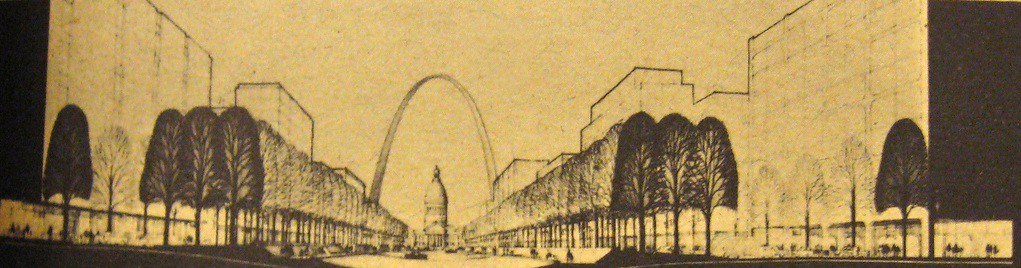
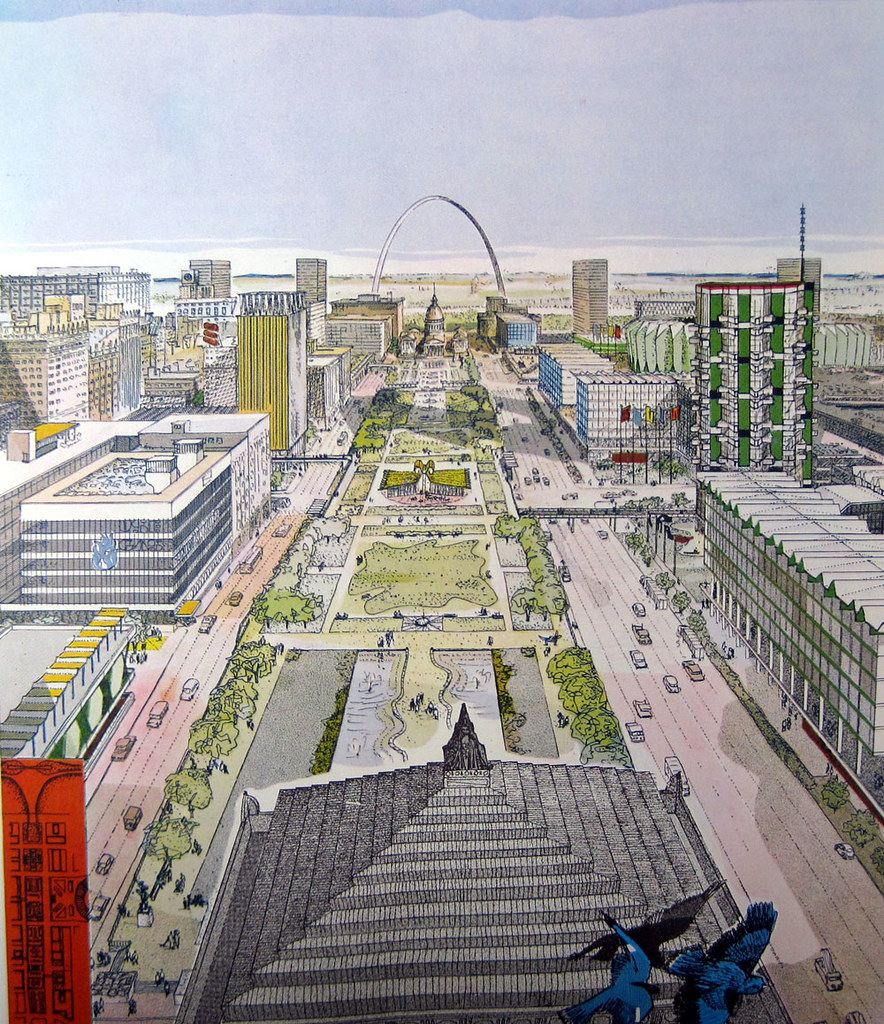
But what I find fascinating about it is that its modernist design would’ve fit in 100% perfectly in the original concept for the Gateway Mall. When the Arch was being built, the “powers that be” tore up much of what Downtown STL used to be to build both the Arch Grounds and the Gateway Mall. While the Arch Grounds are home to our iconic national landmark, the goal was to have the Paris-esque Gateway Mall so new businesses would line their corporate HQs along either side, and as the renderings show doing so in a way that would be a pure modernist haven.

Where was once envisioned this…

And this…

We could’ve had this:

But, because business leaders don’t want to put their new corporate HQs in the City and the Central Business District (for reasons varying from the City Corporate Tax to shorter commutes for key executives), we are witnessing a truly bizarre twist to STL’s history: new uber-modernist construction, of the type originally sought to compliment the Gateway Mall, being planned in a green field 25 miles west of Downtown. Doing such eschews Downtown as a whole and particularly negates the Gateway Mall’s intended purpose.

It’s not RGA’s responsibility to locate in the City, far from it. But, was it even an option?

8,923
Life MemberLife Member
8,923

PostApr 22, 2014#91

Construction is coming along.

Here is the webcam
http://oxblue.com/open/clayco/rga

9,659
Life MemberLife Member
9,659

PostAug 08, 2014#92

They will be adding another building to the site

1,093
Expert MemberExpert Member
1,093

PostAug 08, 2014#93

Dooley would've won if he could've convinced RGA to build in downtown Clayton.

9,659
Life MemberLife Member
9,659

PostAug 08, 2014#94

45,000 vote swing because of 10 miles? doubtful

8,155
Life MemberLife Member
8,155

PostAug 08, 2014#95

I know Stenger made a line of attack on Dooley for jobs loss, but I think while not out of bounds it was somewhat unfair... the recession wiped out jobs all across the country (particularly in the Rust Belt) and I believe most regions in the US continue to have fewer jobs than at their pre-recession peak; meanwhile, there have been some pretty good corporate office expansions and biotech and other research growth here and Dooley must have had some kind of successful threat to companies if they dared to relocate to downtown (just kiddin!). He certainly was able to play Slay (not kiddin!).

Stream will make the argument that only he as a Republican leader can grow jobs but Stenger will actually benefit from a relatively decent job performance during Dooley's reign, and apparently there is some major news that will be coming out of North Park in a few weeks.

10K
AdministratorAdministrator
10K

PostAug 08, 2014#96

^
And a major component of STL County's job loss figures - and job loss figures for the region as a whole - is the closing of the Chrysler plant. It will take a LONG time to recover from that.

5,720
Life MemberLife Member
5,720

PostAug 08, 2014#97

^ Don't forget about the FORD plant, not as big as Chrysler essentially having two auto plants but the combination was devastating.

8,155
Life MemberLife Member
8,155

PostAug 08, 2014#98

^ I believe the region has already recovered peak office jobs but we're still projected to take a few more years to get to overall job numbers.... certainly manufacturing was a major driver of loss and has a ways to go.

1,093
Expert MemberExpert Member
1,093

PostAug 09, 2014#99

dbInSouthCity wrote:45,000 vote swing because of 10 miles? doubtful
It wouldn't have been a swing.

1,868
Never Logs OffNever Logs Off
1,868

PostAug 09, 2014#100

stlien wrote:Dooley would've won if he could've convinced RGA to build in downtown Clayton.
That would be a hard sell, I think most of RGA's employees live pretty far out from the city. In Clayton it would be harder for them to find parking for their pickup trucks.

Read more posts (22 remaining)