
I think the only other place they have high rises, is in Minneapolis, their headquarters.
I don't know. Eventually, I suppose they would go downtown, but the CWE seems to be the hot new residential market - Metro Lofts, Highlands Lofts, Park East, 4545, Opus II, 6 North, etc.DeBaliviere wrote:And hopefully their success will prompt them to be among the first developers of new residential buildings downtown. It's definitely good to have them here!
Maybe Opus could (co)develop housing in the Bottle District?
- 10K

True, but it's just a matter of time before all the available historic buildings downtown have been converted to residential uses. If the demand is still there, someone's going to step up and take on new construction projects - I just hope it's someone like Opus.
^I agree 100%. I think developers like Opus still may be skitish about downtown despite all of the progress. The CWE is less risky apparently.
In my opinion, developers should be jumping all over downtown now. It's inevitable that new residential is going to be needed. I have no doubts. I'm not a developer, but why wait for all of the old buildings to be rehabbed to build new?
I'm sure there are people that would love to get in a new tower downtown. I guess I should be content that new residential is at least being planned downtown.

In my opinion, developers should be jumping all over downtown now. It's inevitable that new residential is going to be needed. I have no doubts. I'm not a developer, but why wait for all of the old buildings to be rehabbed to build new?
I'm sure there are people that would love to get in a new tower downtown. I guess I should be content that new residential is at least being planned downtown.

A friend of mine works for Opus and he said they have condo highrises under construction or in the design phase in Denver, Phoenix, St. Petersburg, Portland, Chicago and Seattle (plus a few others). Hopefully the trend will continue here.
- 182

Here is a list of websites for residential buildings Opus' Northwest divison is developing or trying to develop right now...
www.harborsquarecondominiums.com
www.dexterlakeunion.com
www.thecarlylelife.com
www.grantparkhomes.com
www.bridgesatarborlakes.com
www.parkeasttower.com
www.theplazairvine.com
www.1521second.com
www.mstreetseattle.com
www.ThePinnacleCPS.com
www.harborsquarecondominiums.com
www.dexterlakeunion.com
www.thecarlylelife.com
www.grantparkhomes.com
www.bridgesatarborlakes.com
www.parkeasttower.com
www.theplazairvine.com
www.1521second.com
www.mstreetseattle.com
www.ThePinnacleCPS.com
- 1,054

The luxury building they're building in Irvine, CA looks like a suburban office building and does not offer any retail or good connection to the street and sidewalk. The Carlyle is the best, but they're building a rad glass building in Seattle. Thanks for the find.

I'd take that too, at least something of that height. That would be incredible.
look for an article tomorrow morning
martinvanderwerf (you know who im talking about) interviewed john pitcher about this project
martinvanderwerf (you know who im talking about) interviewed john pitcher about this project
He would be talking about this column from Der Werf:
http://www.stltoday.com/stltoday/busine ... enDocument
And it seems like some good news. 26 stories for a second tower. And maybe two other project. Thats alot of development for the CWE and should really make the area thrive.
http://www.stltoday.com/stltoday/busine ... enDocument
And it seems like some good news. 26 stories for a second tower. And maybe two other project. Thats alot of development for the CWE and should really make the area thrive.
You know, when it comes to residential, it looks like the Central West End is starting to kick Clayton's ass!
SO ...
Then this is great great news.
This new highrise will be beautiful I am sure!
Then this is great great news.
This new highrise will be beautiful I am sure!
I think the developers have to be careful about rising interest rates especially with new towers. Even if someone pays the 5% down today to lock-in appreciation, they are still subject to rising interest rates between now and the closing for purposes of their mortgage loan. In the next two years it would not surprise me to see our 5.5% mortgage rates go to 7 or even 7.5%. This will increase the monthly payment substantially and drive a lot of the younger buyers out of the market for a new condo. Without those buyers I don't know if you can sell all these units. How many people want to live in these towers when maintenance can be as high as $2,000 a month--and that's in addition to your monthly mortgage payments. Don't get me wrong, I think the Park East Tower is going to be great for the CWE but can the CWE sustain multiple towers as interest rates go up?
Perhaps Opus will add floors like they did to Park East Tower, which was originally planned for between 18-23 floors, but then grew to the current twenty-six.
Adding four or five floors would definitely make it the tallest in the CWE and one of the tallest in the region. Here is a new 31-story condo tower planned for downtown Denver, One Lincoln Park.
![]()
Adding four or five floors would definitely make it the tallest in the CWE and one of the tallest in the region. Here is a new 31-story condo tower planned for downtown Denver, One Lincoln Park.
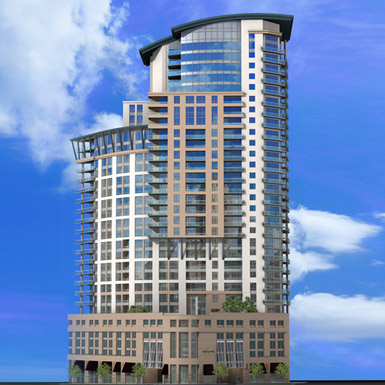
Don't know, but there is apparently a pent up demand for high-rise living in St. Louis because every tower that has been built in Clayton and the CWE has sold pretty well. I think St. Louis is underbuilt with new condo high-rises.dashalove wrote:How many people want to live in these towers when maintenance can be as high as $2,000 a month--and that's in addition to your monthly mortgage payments. Don't get me wrong, I think the Park East Tower is going to be great for the CWE but can the CWE sustain multiple towers as interest rates go up?
-Park East is 75% sold.
-Maryland Walk sold over something like 60% of its unit the first day and that was like a year or two ago.
-The Plaza in Clayton is more ritzy and expensive, and although it still has some units left, it sold well considering its prices.
In my opinion, the CWE and Clayton each should be fine with several new residential tower additions. I certainly don't think Opus would be planning new additions if they felt potential hurdles (buyers, interest rates, glut) were hard to clear.
I was driving down Lindell along Forest Park towards Kingshighway today, and I realised that the new Lindell/Euclid tower will make quite an impact visually, rising above the "horizon", capping the space between the two rows of trees on either side of Lindell.
Pretty cool.
Pretty cool.
what about the lot on the southwest side of Lindell and Euclid? More importantly, are any plans in motion for Kingshighway and Lindell? I know one of the major owners of the property is FINALLY finishing another property in the CWE.. after 25 years of letting it sit vacant..

Hopefully Opus will continue building in St. Louis City, hopefully some impressive towers Downtown. Our skyline would just be so much more impressive if it wasn't spread it out like is. Imagine Clayton, the CWE, and Downtown all bunched together. It'd do wonders for peoples' perception of our city.
- 1,610

What St. Louis really needs to stop speculators and parking lots is a property tax that actually taxes land more so than improvements like today's assessments. Then, the lot at Lindell and Kingshighway would be taxed more closely like its Chase neighbor across the street.
Under such policy, the owner would have the option to charge more rent for parking (not likely successfully in the Lou), pay the taxes as a loss or absorb the costs in his greater portfolio, sell to someone else willing to make the numbers black, or develop the property into a denser use attracting more rent.
Instead of just charging flat rates based on acreage, locational factors such as surrounding density, area appreciation and infrastructure (higher for corner lot, highway or transit access) would be considered in the larger land portion of the assessment. Thus with a variable rate, the potential regressivity of such a tax policy could be minimized to low-income homeowners and renters living outside prime locations.
Under such policy, the owner would have the option to charge more rent for parking (not likely successfully in the Lou), pay the taxes as a loss or absorb the costs in his greater portfolio, sell to someone else willing to make the numbers black, or develop the property into a denser use attracting more rent.
Instead of just charging flat rates based on acreage, locational factors such as surrounding density, area appreciation and infrastructure (higher for corner lot, highway or transit access) would be considered in the larger land portion of the assessment. Thus with a variable rate, the potential regressivity of such a tax policy could be minimized to low-income homeowners and renters living outside prime locations.
Interesting idea, but I wonder how that would go over in St. Louis.
If memory severs me this structure is fairly common in other countries- I want to say Australia. I also know that land tax has been used extensively in Pennsylvania as a redevelopment tool in probably 15 to 20 towns- but notably Phila. did not pass it.
I posted this somewhere else on this site a few months back, but it is basicly what you are talking about. The only thing i would say now is that this is not something i think the city should adopt now (since other methods are getting growth) but if development stalled I think it could be useful.
With the upswing in development that the city has experienced in recent years, maybe the time is right for a change in the structure of the city?s property tax. There is an economic theory that suggests property taxes should be structured to tax only the land, not the improvements on it. This theory is generally associated with 19th century economist Henry George. This theory has given rise to the notion of a graduated property tax, where when taxing property, with land taxed far more heavily than buildings. Pittsburgh has adopted this taxing structure and some attributed it too the surge in development in the city during the 1980?s and 1990?s.
Such a system, even if is not as drastic as George?s suggestion of zero tax on buildings, could help spur development in the city. This tax structure makes it far more expensive to hold vacant property for speculative purposes. Moreover, such a policy also tends to encourage improvements on property. When applied to a large area, such a policy can also make land cheaper as it the new tax is capitalized into prices. All of this could combine into a very effective policy to encourage development in the city, while costing the city no revenue. At the least think about all the lots in downtown, where buildings have been removed because it makes more economic sense to simply open the lot to parking. Such a tax structure would make it far less profitable to run such lots, perhaps even forcing some owners to try and see them developed.
Just keep in mind though that higher taxes may only lead to higher parking fees and if they do get rid of a parking lot they may also surely get rid of anything else that doesn't generate a hefty profit, like maybe your local antique store or a Mom & Pop shop that just gets by. You might encourage development, but at what cost. Keep this in mind, imagine if we applied the same kind of tax to farm land--farms are obviously not the best use of land per acre, an office building will always generate more revenue. Now I know that's a silly comparison since we are talking about an area specific to the city, but guess what, for a while the Federal Estate Tax attempted to value a farm based on the land's best use, and the best use was never to grow apples or raise lamas. The best use was always to become the next Ladue. I know parking lots are unsightly but forcing owners to make better use of their properties by raising taxes isn't going to lead to more skyscrapers. Porn stores maybe, but not skyscrapers. OPUS will build towers based on demand. The cost of land may be a significant factor but it isn't going to drive the project. In my humble opinion, I think community demand will spur development and not the other way around. As soon as the landlord feels he can make more money doing something else with the space he would be silly not to make a change. But I'll admit I'm very biased, I'm very wary of using taxation for any social goal--so much abuse.