
- Yes.
- Still advocating for the cool lake.
- 1,627
- 940

https://gatewaysouthstl.com
They have a website. I also think this is the most transformative project downtown has seen in a long time.
Has anyone seen any movement at all? I know the plan was to start with the rehabs.
They have a website. I also think this is the most transformative project downtown has seen in a long time.
Has anyone seen any movement at all? I know the plan was to start with the rehabs.

This is the most detailed site plan I have seen to date. Apologies if posted above.
https://www.loopnet.com/Listing/Gateway ... /33547823/
https://www.loopnet.com/Listing/Gateway ... /33547823/

- 2,643
The warehouses surrounding the project really seem to wall it off from future southward expansion. Was also hoping they would turn the land between Chouteau, 1st Street, and the flood wall into a cool urban park and extension of the riverfront.
Yeah, I am increasingly becoming skeptical of the mixed use vision. What is being marketed is more typical warehouse and distribution space. You can tell from the above site plan that these spaces weren’t the original vision.
I also find it hard to believe that anyone is going to want to live or work next to active and busy railroads, interstates, or distribution and shipping traffic.
Optimistic but I am starting to see signs that this a Trojan horse for distribution centers south of the arch.
I also find it hard to believe that anyone is going to want to live or work next to active and busy railroads, interstates, or distribution and shipping traffic.
Optimistic but I am starting to see signs that this a Trojan horse for distribution centers south of the arch.
- 99

Even if it all ends up being warehouses and distributions centers, I think it would be a great win because it would bring jobs to the downtown area (not subject to remote work) which would increase foot traffic, tax income, viability of restaurants and sense of security. Anything is better than vacant properties. Would residential and other manufacturing projects would be better? I think so, however there's no shortage of vacant properties not so far North that could be developed. Those developments would be more likely to happen if this one is proven successful.
This will basically end up being a major logistics center, some cool manufacturing and warehouse spaces, wouldn't be surprised if they even attract some big box stores down there. I think any future mixed use residential will have to be west of i-55. It would seem a little dangerous to build residential down there, unless it's some cool live-work loft styled units in the some of the old warehouses. I also think there is an opportunity for some unique commercial, event, nightclub, paces down there. I never saw this area becoming truly residential. I think the plus will be more workers, redevelopment of historic warehouses, and cleaning up the Infrastructure of a place that's been neglected far too long.addxb2 wrote: ↑Oct 29, 2024Yeah, I am increasingly becoming skeptical of the mixed use vision. What is being marketed is more typical warehouse and distribution space. You can tell from the above site plan that these spaces weren’t the original vision.
I also find it hard to believe that anyone is going to want to live or work next to active and busy railroads, interstates, or distribution and shipping traffic.
Optimistic but I am starting to see signs that this a Trojan horse for distribution centers south of the arch.
- 2,933
That they intend to have multiple container yards, including one adjacent to the river with multiple cranes, makes me as excited for this development as ever. This should lead to multiple spillover jobs that we can't even see yet. Housing? I'd rather see new developments coming in at the blocks around Broadway and closer to the Eat-Rite than in the middle of Gateway South. Lord knows this development could spur that into being.

This aerial view of the northern end of the Gateway South project's site in Chouteau's Landing shows the areas next to the Gateway Arch today.
Good Developments Group

By Nathan Rubbelke – Reporter, St. Louis Business Journal
Nov 6, 2024
Listen to this article5 min
The $1.2 billion Gateway South development has named the brokers who will market the project’s industrial space.
Commercial real estate firm Cushman & Wakefield and brokers Trip Hardin and Keith Ziercher have been hired by Gateway South developer Good Developments Group to attract industrial users to the project. The brokers will seek to find users for the project’s “flexible build-to-suit options,” with the development offering sites that range in size from 20,000 to 225,000 square feet.
Developers of Gateway South are seeking to create a new mixed-use, sustainable neighborhood in a historically underutilized industrial area south of the Gateway Arch. The 100-acre master-planned project has a goal of being an innovation district for the construction and design sectors. It is spearheaded by St. Louis-based Good Developments Group, with the development team also including Houston-based Vault Partners and Clayton-based Millstone Co.
Hardin in an interview said outreach has started to prospective industrial tenants. He said companies in the construction industry are getting immediate attention, but that the project could attract a wide range of users.
“When you really think about the number of industries that in some shape or form touch or interact with what we consider the general construction industry, there’s a lot of them,” Hardin said. “We think our potential list of prospects is pretty deep.”
Hardin said construction for industrial tenants could begin as early as spring 2025.
Marketing materials tout Gateway South’s proximity to major interstates, the Mississippi River and its access to the Union Pacific Railroad and Terminal Railroad Association switching lines, as well as a 15-year property tax abatement for the development. Building sizes, design, location, parking and configuration are “completely flexible depending on the users requirements,” per the property listing. A current conceptual design shows lots of varying sizes across the development site.
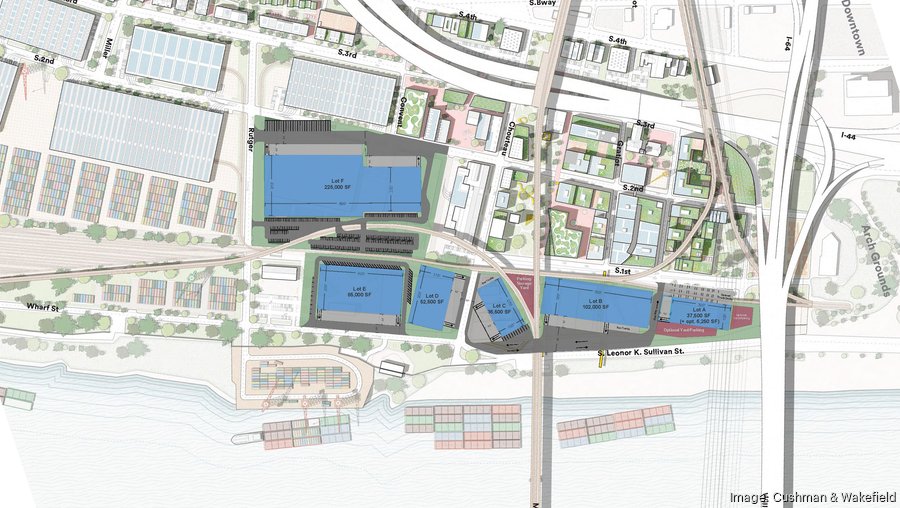
A conceptual plan for industrial sites at Gateway South
Cushman & Wakefield
The brokers are asking interested parties to submit requests for proposals to obtain pricing information. Interested parties could have the option to either lease or own their space at Gateway South, Hardin said.
Construction has yet to start on Gateway South. Good Developments Group CEO Greg Gleicher said the development team is “gearing up to see visible action in the near future,” though did not provide specifics on the construction timeline. The developers told the Business Journal earlier this year they reached key financing and development milestones, including a loan from Saint Louis Bank, for a $200 million first phase. The city's Land Clearance for Redevelopment Authority in June approved issuing up to $155 million in industrial revenue bonds for the project.
In addition to industrial tenants, Good Developments Group is seeking tenants for up to 500,000 square feet of Class A office space, along with flex, retail, research and development space, as part of the development’s plan to rehabilitate the historic Crunden-Martin industrial manufacturing complex at 760 S. Second St. into work space focused around the construction industry. Good Developments Group in June said it chose commercial real estate firm CBRE and broker Tom Ray to market the office space.
- 3,781
Is it the feds and the private railroad companies that are tasked with maintaining train bridges in our area? I have long complained about the general condition, unsightly rust and decay of the train bridges in the area, especially Downtown. The rusty, decayed bridges stick out like a sore thumb over the Gateway South site. I'd like to see these bridges repaired and cleaned up.
Don't like the patina?
I think all that is owned by the TRRA. I'm sure SP knows.
I think all that is owned by the TRRA. I'm sure SP knows.
- 3,781
Patina is one thing, lack of structural integrity is another...quincunx wrote: ↑Nov 08, 2024Don't like the patina?
I think all that is owned by the TRRA. I'm sure SP knows

- 6,140
Yeah, MacArthur is TRRA property now. They may have gotten a federal grant to do the work on it, though I seem to recall they did Merchant's with just private money. The city built MacArthur and owned it for years, but the railroads had long owned Eads, so they traded in the late eighties or early nineties. Anyway, they're working on it and have been for a couple of years now, but I don't think anyone much wanted to start heavy work on McA before Merchants was done and could handle the extra traffic. Believe it or not, Merchants was the one in greater need of work, so they did that first. (It was forty or fifty years older.) I'm not really party to the particulars. Just a railfan who knows a few railroaders (mostly retired.) I haven't been following this project as closely as the Merchants replacement, but I don't get the impression it's in any danger of failure just yet. Particularly now that they've reduced the dead load by . . . whatever the road deck weighed. A lot. Suffice it to say it's an ongoing project. They keep replacing bits one element at a time. DB or Dredger would probably know more than me, though.
^ I can't offer much else as I haven't really followed the workings of the MacArthur Bridge, either as another railfan and or from my construction career standpoint. It should be owned by TRRA and therefore the railroads responsibility to maintain and upkeep. TRRA being a terminal railroad formed by a group of private railroads to handle interchange traffic as well as local regional industrial base. Believe I got it right but most terminal railroads cost is split among the railroad pwners as a percent of traffic/carloads handle for each of the owning railroad. From a private owner standpoint really about the bones versus the appearance.
Merchants bridge project was a pretty significant undertaking within a pretty short timeline to execute so it got some pretty good press and following from construction trade magazines as well. Eads of course just has some great history whether your a railfan, an engineer or a builder in my opinion
Merchants bridge project was a pretty significant undertaking within a pretty short timeline to execute so it got some pretty good press and following from construction trade magazines as well. Eads of course just has some great history whether your a railfan, an engineer or a builder in my opinion
- 6,140
^Oh, that is absolutely true. Eads is one of the two local buildings I've seen most often in architecture texts. (The other being the Wainright, interstingly. I'm always pleasantly surprised when the wicket makes it. I figure its absence is mostly down to historians neglecting the new in all things.) Yes, the Eads is the true landmark among local bridges; the great bridge. I like some of the others, but that one is important.
And yes, the TRRA is owned jointly by five of the six class ones, though not, I believe completely equally, since each of the founding railroads had a share and a number of others bought in later, and the current class ones mostly own several. (Or in UP's case a lot.) I've seen the list somewhere in the past, but I don't have it to hand at present, so I'm not going to try to guess who had shares and who didn't.
Anyway, that has in the past reputedly led to problems for the TRRA getting things done, since NS doesn't want to pay to help UP or vice versa. There was this really rather incredible plan from the 70s I found in an archive that would have replaced every yard on the east side and combined them into the world's largest classification yard, save for Gateway, which was to be permitted to remain independent. But instead they just modestly expanded Madison. Crazy Y shaped monstrosity with quite complete plans and lots of flow charts and node network studies and so forth, with the idea that it could reduce local car dwell time from . . . a couple of weeks? . . . down to a day on average. (Getting cars from one railroad to another is a special sort of nuts, and there aren't many places where it happens easily. St. Louis is one of very few thanks to TRRA and A&S, with Chicago being another, thanks to Belt Railway of Chicago and Indiana Harbor Belt.)
But lately they seem to have come to the conclusion that it's vital infrastructure and it will break soon if they don't all do something, so they've ponied up.
And yes, the TRRA is owned jointly by five of the six class ones, though not, I believe completely equally, since each of the founding railroads had a share and a number of others bought in later, and the current class ones mostly own several. (Or in UP's case a lot.) I've seen the list somewhere in the past, but I don't have it to hand at present, so I'm not going to try to guess who had shares and who didn't.
Anyway, that has in the past reputedly led to problems for the TRRA getting things done, since NS doesn't want to pay to help UP or vice versa. There was this really rather incredible plan from the 70s I found in an archive that would have replaced every yard on the east side and combined them into the world's largest classification yard, save for Gateway, which was to be permitted to remain independent. But instead they just modestly expanded Madison. Crazy Y shaped monstrosity with quite complete plans and lots of flow charts and node network studies and so forth, with the idea that it could reduce local car dwell time from . . . a couple of weeks? . . . down to a day on average. (Getting cars from one railroad to another is a special sort of nuts, and there aren't many places where it happens easily. St. Louis is one of very few thanks to TRRA and A&S, with Chicago being another, thanks to Belt Railway of Chicago and Indiana Harbor Belt.)
But lately they seem to have come to the conclusion that it's vital infrastructure and it will break soon if they don't all do something, so they've ponied up.
TRRA would make a great subject for a model railroad; especially for those interested in urban modeling.
According to Wikipedia
https://en.m.wikipedia.org/wiki/Termina ... _St._LouisThe Terminal Railroad Association is owned by[2] BNSF Railway, Canadian National Railway (Illinois Central Railroad until 1999), CSX Transportation, Norfolk Southern Railway, and Union Pacific Railroad. All own one-seventh of the railroad except UP, which owns three-sevenths.
- 6,140
^They link to a TRRA page that isn't there anymore and TRRA doesn't specify the proportions. That number is . . . believable? But I couldn't confirm it. TRRA's own site says the following:
Anyway, it's a complicated corporate structure and ownership history, to say the least.
And Framer, yes, the TRRA is a remarkably attractive subject. I've got a virtual model railroad that mostly started out as that, though it's grown since. And there are some great HO railroads that draw inspiration from it. I'll pm you with a couple of my favorites. It does, honestly, seem to be a popular subject at least locally. (I suspect it would be even more so if Union Station weren't so absurdly enormous and ridiculously distinctive. You just don't see too many model railroads in any scale tackling passenger terminals with more than a dozen tracks, let alone more than three dozen.)
Iron Mountain was later merged into the MoP and folded into UP along with it. The Ohio and Mississippi is a B&O predecessor, which later merged with the C&O and the Family Lines to become a part of CSX. But L&N was one of the family lines and is now also CSX. The CCC&StL share would be complicated, since it would have gone to Pen Central, which went bankrupt before ConRail got its assets, which were then split between CSX and NS upon the dissolution of CR, with NS mostly getting the NYC System portion of Pen Central. I've generally seen it said that IC bought in, but I think so too did the Frisco and the CB&Q, the MKT, the M&O, the C&NW, the PRR, and the Alton Route, among others. I think that Wiki is probably right, but I wanted to hedge my bets a little. (Especially since I have vague memories of similar, but subtly different numbers. UP was still no. 1, but there was some variation beneath it.)The original railroads making up the Association were the Missouri Pacific Railway Company, the St. Louis, Iron Mountain and Southern Railway Company, Wabash Railroad Company, the Ohio and Mississippi Railway Company, the Louisville and Nashville Railroad Company, and the Cleveland, Cincinnati, Chicago and St. Louis Railway Company. Numerous other railroads were subsequently admitted to the Association in later years. These owner railroads, consistent with the entire railroad industry, have grown through mergers and acquisitions over the years.
Anyway, it's a complicated corporate structure and ownership history, to say the least.
And Framer, yes, the TRRA is a remarkably attractive subject. I've got a virtual model railroad that mostly started out as that, though it's grown since. And there are some great HO railroads that draw inspiration from it. I'll pm you with a couple of my favorites. It does, honestly, seem to be a popular subject at least locally. (I suspect it would be even more so if Union Station weren't so absurdly enormous and ridiculously distinctive. You just don't see too many model railroads in any scale tackling passenger terminals with more than a dozen tracks, let alone more than three dozen.)
- 2,643
What’s Next: You can expect “visible progress” at the site in the coming months, Gleicher says, with vertical construction also on track to begin this year.

Just having this site under construction is going to do a lot for perception of the city and Downtown
- 2,067
For real... coming up 55 from the south for baseball games is going to be crazy to see it after being vacant for so longGoHarvOrGoHome wrote: ↑Feb 12, 2025What’s Next: You can expect “visible progress” at the site in the coming months, Gleicher says, with vertical construction also on track to begin this year.
Just having this site under construction is going to do a lot for perception of the city and Downtown
- 940
^Has the chance to just be an authentically cool place in the US. The industrial history, the riverfront trail, mural mile, on the Mississippi, nextdoor to the Broadway music watering holes and Soulard, all in the shadow of the arch. If they can make a connection to downtown, this will be a premier place to experience for everyone eventually. Fits right into my Broadway streetcar dreams
It’s good to see them securing more tenants. They have a housing design competition at the site in late 2025 - I have been surprised they hadn’t started on the site yet considering all of the tenants they’ve secured and the competition. Great to see
I love how this project leverages the Mississippi. It has remnants of the type of project you would see in countries that have surpassed us in manufacturing technology
It’s also been a nice change to see the local media running with the momentum of the project. It seems like this project and the Brickline Greenway really promote positive discourse about our city, instead of the constant negativity (which we still see with many other projects that are moving along like At&t)
It’s good to see them securing more tenants. They have a housing design competition at the site in late 2025 - I have been surprised they hadn’t started on the site yet considering all of the tenants they’ve secured and the competition. Great to see
I love how this project leverages the Mississippi. It has remnants of the type of project you would see in countries that have surpassed us in manufacturing technology
It’s also been a nice change to see the local media running with the momentum of the project. It seems like this project and the Brickline Greenway really promote positive discourse about our city, instead of the constant negativity (which we still see with many other projects that are moving along like At&t)

They own over half of the parcels, one company owns the remaining parcels, they just announced their first tenant and are nearing multiple more deals with more tenants. Complete non-story for a project that will span the rest of this decade and well into the next.