8,904
Life MemberLife Member
8,904

PostAug 08, 2014#26

^Well It would be nice if the state of Missouri, like other states, provided monies for transit. Last year MODOT chipped in a whopping $400k to Metro. MODOT's budget was ~$250mil.

There's always the internet sales tax. You know, to even the playing field for the brick and mortars.

1,982
Never Logs OffNever Logs Off
1,982

PostAug 08, 2014#27

This idea has no traction as far as I can tell, but why not just collect online sales tax and mark 50% of that to go towards transit?

I believe that would raise a substantial amount of money. It wouldn't be really "raising" taxes on anybody as it's something that should already be getting collected logically. It wouldn't require a vote of the people. And it would leave another chunk of money to be put towards other needs.

9,529
Life MemberLife Member
9,529

PostAug 08, 2014#28

moorlander wrote:^Well It would be nice if the state of Missouri, like other states, provided monies for transit. Last year MODOT chipped in a whopping $400k to Metro. MODOT's budget was ~$250mil.

There's always the internet sales tax. You know, to even the playing field for the brick and mortars.
MoDOT Budget was $2,300,000,000 last year (statewide)
ive always heard that in places where the State has a substantially $ in transit, the city or the county doesn't.

bit outdated (I have the FY 2013 hard copy) but here is the FY 2010 pdf on how much each state supports transit and see page 16-17 on how its funded

http://scopt.transportation.org/Documents/SSFP-6.pdf

8,904
Life MemberLife Member
8,904

PostAug 08, 2014#29

dbInSouthCity wrote:
moorlander wrote:^Well It would be nice if the state of Missouri, like other states, provided monies for transit. Last year MODOT chipped in a whopping $400k to Metro. MODOT's budget was ~$250mil.

There's always the internet sales tax. You know, to even the playing field for the brick and mortars.
MoDOT Budget was $2,300,000,000 last year (statewide)
ive always heard that in places where the State has a substantially $ in transit, the city or the county doesn't.
What I read must have just listed the StL portion of the MODOT budget.

9,529
Life MemberLife Member
9,529

PostAug 08, 2014#30

^ that sounds about right... Construction budget in the STL District is anywhere from 200-300M a year depending on how much cites/counties bring to the table or private developers (example WashU/BJC paid $9m of $18 million for the I-64 work by Barnes)
MoDOT support (400K) for metro comes from non gas tax/user fee revenue, since it cant use the gas tax or other users fees on anything but roads/bridge work....I think changing that law needs to be a focus for transit advocates.

8,155
Life MemberLife Member
8,155

PostAug 08, 2014#31

It's been awhile since I've used Atlanta's MARTA, but that seems to be an agency that has been doing some good things.... I saw they recently have been pursuing air rights deals at their stations and now this...

MARTA is taking its concessions program to the next level.

The transit agency, which began installing drink and snack vending machines at rail stations in 2010, soon will offer food, drink and retail concessions at selected stations, MARTA announced Thursday.

“This next phase of rail station concessions complements our ongoing transit-oriented development plans,” MARTA General Manager Keith Parker said, referring to the new live-work-play communities the transit system is planning. “We look forward to receiving food, beverage and retail concepts that will help create a sense of place in and around MARTA stations and improve the overall experience of our customers....”

MARTA also released an IFB recently for a six-month pilot food truck concessions program at its Vine City station during Georgia Dome events, including Atlanta Falcons games.


http://www.bizjournals.com/atlanta/blog ... tions.html

1,792
Never Logs OffNever Logs Off
1,792

PostAug 08, 2014#32

^Comes off as a bit hypocritical of transit advocates. No sales tax because roads should be paid for by user fees like tolls and gas tax, but gas tax moneys should be siphoned off to pay for transit...

I support more money for transit, but there is a risk of losing moral high ground by trying to siphon gas tax moneys for those who are not using gas. Actually Metro already gets a small subsidy by being exempt from fuel taxes. I tend to think transit operations should be paid for via user fees such as fares, and special taxing districts. Major construction (expansion) and purchases (new rolling stock) should be bonded and paid for either via temporary sales or property tax increases. Federal gas tax dollars though IMHO could be spent on transit as how that money is spent is independent of the will of the state so whatever type of project it takes capture that money would be acceptable.

173
Junior MemberJunior Member
173

PostAug 08, 2014#33

^ Since when do transit systems not use gas? The majority of transit trips in the region are by bus, which need fuel. Presumably fuel costs are passed down to the transit rider in the form of fares. So it's not as if someone who 100% relies on a bus for commute will not be "paying into" a gas tax that also goes toward transit. Right?

9,529
Life MemberLife Member
9,529

PostAug 08, 2014#34

^ The fuel metro buys isn't taxed. When a car driver goes a buys a gallon of gas, he/she pays 35 cents in user fees on that gallon...17 cents to the state of MO (12 goes to modot, 5 split between that city and county) and 18 cents go to the Feds (15.4cents to highway trust fund and 2.6cent to the transit account)
When metro fills up a bus, that 35 cent user fee per gallon isn't charged.... sure metro pays for the fuel but that goes to the company that it buys it from, not the state... also metro users fare cost only cover 19% of the cost of that trip, 81% is subsidized

so anytime a person gets on a metro bus or metro link they put in the fare cost and someone else is paying $4.35

641
Senior MemberSenior Member
641

PostAug 08, 2014#35

Why, when I ride Metrolink, do I always get asked to see my ticket but the majority of the African-American kids NEVER get asked?
I'm dead serious too....

13K
Life MemberLife Member
13K

PostAug 08, 2014#36

I thought I read somewhere they can't give tickets to kids.

190
Junior MemberJunior Member
190

PostAug 08, 2014#37

Page 64 of the following document says Metro has about $22m in the budget for fuel and lubricants in FY2014. That's about 100$ a year per average weekday rider according to my back of a fag pack calculations.

mhttp://www.metrostlouis.org/Libraries/Annual_B ... Budget.pdf

1,190
Expert MemberExpert Member
1,190

PostAug 08, 2014#38

^^^Not pertinent at all...

Moving on, my ideal world be to raise the gas tax whatever necessary to pay for road maintenance and leave it at that. Implement an internet sales tax to raise funds for multiple things (transportation, education, etc.). I would split that transportation percentage 50/50 for roads and transit and use that strictly for capital projects.

I would implement local taxes to pay for maintenance and capital funds for local transportation systems. Use a tourism tax on hotels (this can also go towards CVC and sports venue improvements) along with a sales tax on cigarettes/booze for capital funds. Use TDD for maintenance funds of each area of transportation.

641
Senior MemberSenior Member
641

PostAug 08, 2014#39

quincunx wrote:I thought I read somewhere they can't give tickets to kids.

Awesome, I'll quit buying tix for my kids....

9,529
Life MemberLife Member
9,529

PostAug 08, 2014#40

KerrytheKonstructor wrote:Page 64 of the following document says Metro has about $22m in the budget for fuel and lubricants in FY2014. That's about 150$ a year per average weekday rider according to my calculations not subtracting for weekenders.

mhttp://www.metrostlouis.org/Libraries/Annual_B ... Budget.pdf
Not sure what the your pint is here. rider fares cover only 19% of the cost operating metro.

190
Junior MemberJunior Member
190

PostAug 08, 2014#41

I roughly updated the calculation to account for the weekends, assuming fuel costs are only slightly lower on those days. Pardon my Engrish. You can make your own conclusions. Nothing shocking really. Just a confirmation of what we already know.

9,529
Life MemberLife Member
9,529

PostAug 08, 2014#42

I'm just trying to figure out what the point of that calculation is? Should each rider pay extra $100 a year to cover the cost of fuel?

8,155
Life MemberLife Member
8,155

PostAug 08, 2014#43

STLEnginerd wrote:^Comes off as a bit hypocritical of transit advocates. No sales tax because roads should be paid for by user fees like tolls and gas tax, but gas tax moneys should be siphoned off to pay for transit....
Perhaps a bit. But wrt the A7 sales tax, while there may have been some purists who would have opposed it, I bet most transit supporters would have supported the measure if it were transit dominated even if some went back to highways. Anyway, what I did like about A7 is that it allowed for regional choice, and I think that should extend at least to some degree to fuel tax... if a region thinks it will be best to achieve greater mobility and economic development through more transit investments then it should be able to use a portion of fuel tax to do that.

190
Junior MemberJunior Member
190

PostAug 08, 2014#44

I don't know, maybe the point is Metro should be paying equivalent monies to the fuel taxes on that 22 million to help pay for the roads. Or maybe the point is people should ride the bus to work to presumably save a bit of oil and maybe pollution also.

1,792
Never Logs OffNever Logs Off
1,792

PostAug 08, 2014#45

... also metro users fare cost only cover 19% of the cost of that trip, 81% is subsidized
I think its important to note that numbers like this would ideally get broken down by route. Some routes probably have a really high ROI while other are i sure dragging down the numbers. I'd wager 70 Grand turns a small profit, while the 57 Manchester is probably a money pit. Identifying and improving on those numbers is the key to a functional transit system.

I wonder what metro route has the worst ROI. Any guesses...?

512
Senior MemberSenior Member
512

PostAug 08, 2014#46

Realistically, I think it's important to approach the "now" and "near-term" transit goals in St. Louis separately. Long-term, well...I'm impatient.

I've been living in Chicago the last three years and though I 'm eager to move back, I'm really worried about the downgrade in transit service and accessibility we currently have in STL. However, if they announced tomorrow they were building an LRT through the De Soto ROW, I'd be looking for houses right now within a mile radius of TGS.

Technologically, Metro's goal needs to be a reliable and user-friendly application that tells you how far out your bus or train is. Up here in Chicago, I've been spoiled in that regard and doubt I can transition back to a lesser tracking system. I use the RedEye app (Red Eye is the Tribune's daily free paper -- think RFT, with quick-hit stories and features for transit riders). I'd recommend you download to see how it works. Even if you don't know Chicago streets, you can get a good idea of its usability.

First and foremost, the goal should be a headway-based bus system (rather than a timetable-based system). No more idling at a stop for five minutes because the driver got there too early. Increase service on high-performing routes and those with potential for growth, keep a standard 25 min. headway on those that won't. Ability to see when a bus is coming and time your walk from home (or, as someone else mentioned, the bar!) makes all the difference.

Also, people need to realize transit is a convenience, not a comfort. No, covered bus stalls with seats aren't needed in most places. Nor are public bathrooms at transit centers/train stations. Just updated signage showing the route number(s) and a safe/accessible place to stand. No bus stops should ever be mid-block.

I also like the idea of letting e-w routes just go east-west and n-s ones go north-south. Utilize the grid rather than funneling all of them into transit centers. That frustrates me endlessly.

As far as the future, well you all know where my heart lies -- light rail in the De Soto right-of-way FIRST, followed shortly thereafter by an extension up Florissant Rd (and a heavy commuter coming from Edwardsville via the Merchants and MacArthur bridges, but that's a discussion for another day).


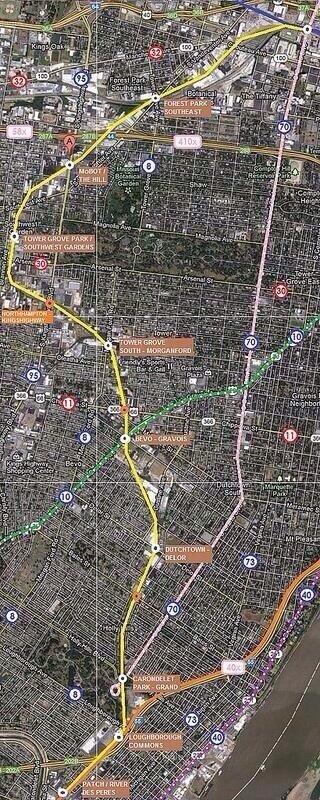
My "Cadillac plan" for the south side. Yellow line is Metrolink, dashed lines are streetcar/surface BRT, and circled numbers denote existing bus routes.

Unlike others though, I don't see it happening unless the City of St. Louis funds this thing exclusively (less federal grants/funds). And really, they should. If we want to be the center of the region, act like it, dammit! No more of this "regionalism" hooey -- because all that does is dilute the end project to the point you might as well not have it anyway. WHEN (not if) the City takes it upon themselves to fund a north-south line, the County is more than welcome to attach one of their own at the end points.

As far as how to get their, I'd support a combination of a City-only sales tax and a maxed-out special tax on tobacco products.

9,529
Life MemberLife Member
9,529

PostAug 08, 2014#47

Tax on $22m worth of fuel would be about $2.4million in fuel taxes. For that you can replace the Compton bridge over I-44 and repave a little bit of road.

190
Junior MemberJunior Member
190

PostAug 08, 2014#48

STLEnginerd wrote:
... also metro users fare cost only cover 19% of the cost of that trip, 81% is subsidized
I think its important to note that numbers like this would ideally get broken down by route. Some routes probably have a really high ROI while other are i sure dragging down the numbers. I'd wager 70 Grand turns a small profit, while the 57 Manchester is probably a money pit. Identifying and improving on those numbers is the key to a functional transit system.

I wonder what metro route has the worst ROI. Any guesses...?
Interesting question. I'm just curious to see the ridership #'s for each route and stop.

1,099
Expert MemberExpert Member
1,099

PostAug 08, 2014#49

Couldn't help myself and did my own estimate on 70 Grand farebox recovery.

MetroBus general
20.8% Farebox recovery
92,446 passenger trips average weekday
1,354,799 revenue hours
$151,590,583 operating expense
$31,530,841 operating revenue (20.8% of operating expense)
$111.89 operating expense per revenue hour

70 Grand
8,000 estimated ridership
8.65% of total MetroBus ridership
1157 trips per week (based on weekly schedule)
59,909 trips per year (52 weeks minus 5 holidays)
50 min per trip
49,924 revenue hours
3.68% of total MetroBus revenue hours

Summary
$2,728,585 estimated revenue for 70 Grand (8.65% of MetroBus operating revenues)
$5,586,015 estimated expense for 70 Grand (3.68% of MetroBus operating expenses)
48.8% estimated farebox recovery ratio for 70 Grand

13K
Life MemberLife Member
13K

PostAug 08, 2014#50

Which governments pay fuel taxes? I don't recall seeing school buses, fire trucks, police cars, or military vehicles filling up at gas stations.

Read more posts (1339 remaining)