^The stadium drawing wasn't a lark; that was an early conceptual design. I guess you could call it Post Modern Deco:
Huh! Well, I suppose they had to get it somewhere. Adds fuel to the "I wonder if that drawing is earlier than 1998" fire.
danke0 wrote:
Took the train to Kansas City over the weekend and didn't realize it was being pulled by one of the new Siemens Chargers until we arrived. OK, so this pic was taken in KC. This locomotive was in St. Louis earlier, I swear.
Nice! Saw that train or one very much like it pulling through the Grand interlocking this evening as I brought my wife home from school. It's good to see a little more passenger rail traffic and new locomotives are always a welcome change.
Adds fuel to the "I wonder if that drawing is earlier than 1998" fire.
I think you might be right SP. The reason I thought that map was from '98-'01 is because it includes the East Terminal (which didn't open until '98) but not the St. Clair County extension (which opened in '01). But.... maybe the East Terminal inclusion was a projection of some sort. I can't remember how early the East terminal and corresponding station were planned/anticipated. That could put the map toward the very beginning of Metrolink in '93-'94.
Unrelated, here's a great STL transit shot for so many reasons:
the south side of the 2100 block of Olive circa 1904-1906:
View of streetcar tracks under construction on the 2100 block of Olive Street. View is of south side of street. The first streetcar company began in 1859 on Olive and grew rapidly. In 1891 the city had 25 streetcar lines: 5 horse-drawn, 5 cable, and 15 electric. By 1894 it was estimated that nearly 100 million passengers used city streetcars every year. By the end of the 1940’s the streetcar era was drawing to a close as more and more lines were shut down in favor of buses.
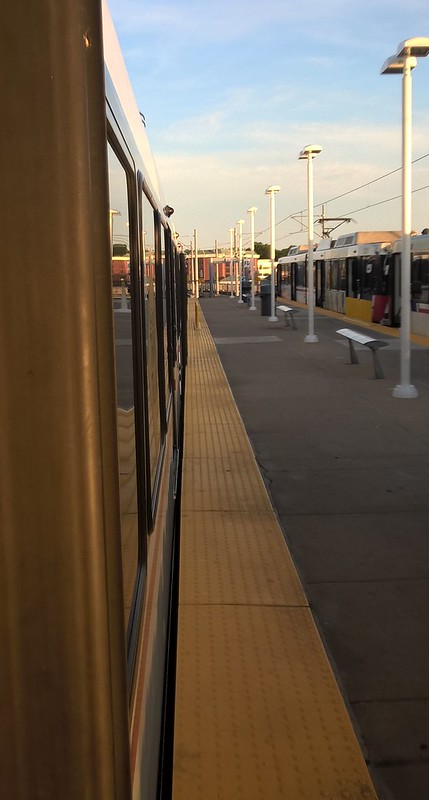
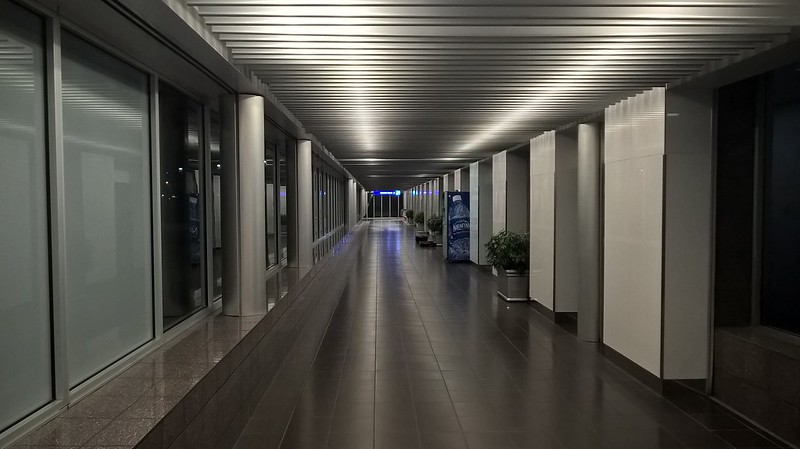
Since I might, possibly, have one or two newish transit photos I thought I'd post my transit photos here.
(That's the hallway leading to the Metrolink Station. You have to pass Metrolink ticket machines to get here. That counts, right? Nothing else down here, save for some windows and maybe a soda machine, I think.)
^That's a heck of a neat shot. I'm not absolutely positive, but my best guess is that the stack you see in the distance is probably the powerhouse at Union Station, which makes the bridge an early incarnation of perhaps the 14th Street viaduct. It could also be Tucker, which would have been 12th at the time. There were previously freight houses for all the major railroads downtown extending east from Tucker more or less to Broadway, which necessitated a thing called the UD Bridge between the Municipal "Free" Bridge (now MacArthur) and the Union Station leads on the north side of the spaghetti to facilitate passenger movements. (Which the TRRA fought tooth and nail to preserve their monopoly, I believe with a little help from Jay Gould, and thus J. P. Morgan, who pretty much owned him. It was a colorful mess. Rather like the present, really. New tech leads to horrifying monopolies and nasty abuses of power. Sound familiar?)
The caboose in the middle distance appears to be a type more or less unique to the Wabash. (Very distinctive cupola.) The switcher could be more or less any railroads, but Mr. Wabby certainly had examples matching the type. And 8443 might well say "WRR" on the side. Which would make this most probably the leads to the Wabash freight house, which makes that most likely Tucker or even another bridge further east of that. Let me do some consulting there. We should be able to get more specific. (I have fairly ready access to a wealth of Wabash history in my e-mail box. I might possibly have just edited up a newsletter for some organization related to same. Even though I am Mr. Junior Babychild member born nigh on a decade after Mr. Wabby was no more.)
The horses and buggies on the bridge are a very nice touch. I can't believe that's much later than maybe 1910. 1920 at the very latest. Got to be close to that, though. Not really any earlier than 1900. Automatic couplers, which are quite visible in the picture, weren't mandatory until 1893. And air brakes came in about the same time. (Both dramatically improving safety.) But the switcher still has an oil lamp. By 1930 those were pretty much replaced by electric. (And horses with internal combustion.) So I'll guess between 1900 and 1920. Does the history museum have a date on the thing? I love it! (Will ask further of better Wabash heads than I.)
Some new information: The boxcar in the foreground, 8443, belonged to the Vandalia Railroad, not the Wabash. Apparently that really is VRR and not just foreshortening. The VRR was active from 1905 to 1917 when it was absorbed by the Pennsy. Cars don't always get repainted fast, but . . . faster then than now. (They just didn't wear as well.) So that's probably between 1905 and 1917. I was wrong about the freight house. WRR did not have their freighthouse downtown at all. (But man, everybody else blooming did. Please forgive me.) That said, the line of Wabash cabooses still makes me think this is likely at least in part a Wabash yard. Which puts this closer to Vandeventer. in 1908 TRRA had a coal yard at Compton. The bridge has got to be the key to this, but I cannot place it. It's not Grand, 18th, or 21st. I can't believe it's Tucker/12th. I really don't think it's Jefferson. There were a few others, but . . . maybe it's an early version of Compton. And maybe that stack is Hydraulic Press Brick or something like that. (Approximately where the Amory is now. Hydraulic Press was the biggest thing in the area in 1908 per some Sanborn scrutiny.)
That picture is haunting me. I will dig further. There has to be some record of what bridge that was. And those crumbies have about got to be Wabash. (They are so unearthly distinctive. Part of my childhood, oddly. Not quite absolutely singular, but the Wabash clung to those things, and even non-Wabash people sometimes see that shape and immediately shout "Wabash!")
Thank you! Wasn't aware of the name change and so all I found was pictures of the later 18th Street bridge, which was obviously different. Seems the superstructure was replaced in 1908, so that it's the picture between 1905 and '08. And the stack is indeed Union Station and that really is a signal bridge just past it. Anyway . . . great picture!
Actually, looking at it again, I'm beginning to think it's not. Tayon/18th was supposed to have been wide enough to support two lanes of traffic between two streetcar lines. That doesn't look quite so wide. Further, the piers were reportedly reused in the early 20th Century 18th street bridge, which had both more numerous and more substantial looking piers. Lastly, the geography and surroundings don't make sense for 18th. If that's 18th looking west, even in St. Louis smog, you're literally next to Union Station. You should see something. The powerhouse is on 18th. You should see the station throat, which you clearly don't in that picture. You should see the 18th St. coach yard. It could be looking east, I suppose, in which case the station throat could be off to the left and maybe the viewer is towards the south of everything. Alternately, maybe it's just a similar bridge. 12th and 14th are extent in Compton and Dry, but surely they'd have been replaced sometime between their early wooden incarnations and their later deck versions. An early version of 21st also seems possible, as it would have been built and then rebuilt on a similar schedule. Likewise Jefferson. Alternately, there has to have been a bridge at Compton earlier than 1965. Just based on trackage I'm inclined to guess either 12th or Compton. The TRRA had a freight house just east of 12th and the tracks would have fanned out both before and behind the photographer, as they appear to. And they had coaling facilities nearby, which would explain all the gons. They also had a coal yard at Compton, and WRR had some yard tracks closer to there as well; probably a transfer yard off the TRRA feeding their facilities at Vandeventer and points beyond. So again, ladder tracks on both sides. Which you just don't get at 18th in any diagram I can recall or immediately find. It's all fanning out west at 18th.
I am way down the rabbit hole on this. Just for the record. I've just spent far too many hours digging through Sanborn, early St. Louis cheerleading literature, and even Compton and Dry. You're evil, Framer. I love it!
Personally, I'm intrigued by the three guys in the front of the pic. They seem to be carrying sticks, or maybe rolled-up signal flags? And several more of the "sticks" are on the ground to their right. The two guys behind seem to be ready to frisk the guy up against the gondola. Railroad detectives?
And did yard workers really wear bowlers back then?
The sticks on the ground appear to be a spike hammer and a prybar. The fellow in the rear waved his a little, so it's a little too blurred to make it out. The fellow in the front looks to me to be another member of the crew. The stick he's holding may be nothing more than a device to lift coupler pins. Always best to put as little of yourself between cars as humanly possible and "automatic" couplers were still pretty new when that picture was taken. I'd guess he's a brakeman. And I think pretty much everyone wore jackets and hats at the time. If not a bowler then a fedora or something similar. For what it's worth, I've looked up the original over at MoHS and caused a touch of a stir with it at the Wabash Railroad Historical Society. It might be appearing in a presentation near you soon. And wait . . . there are more! Wabash equipment features surprisingly prominently in a selection of photographs from the same collection that I very much suspect were taken by the same photographer at about the same time. Maybe the same day. And sure, the boxcar is the Vandalia Railroad. (Wood framed sucker with a wood ladder, no less!) But the one in the distance on the right I'm more confident is Wabash. The cabeese? Who knows. Maybe Wabby. But apparently St. Charles Car Company manufactured similar models for the MKT. (Which they didn't cling to like some kind of sacred relic in the way the WRR did. Never throw things away, I say.)




 I love it!