
I haven't heard much about this since the last main announcement. Anyone have any updates?

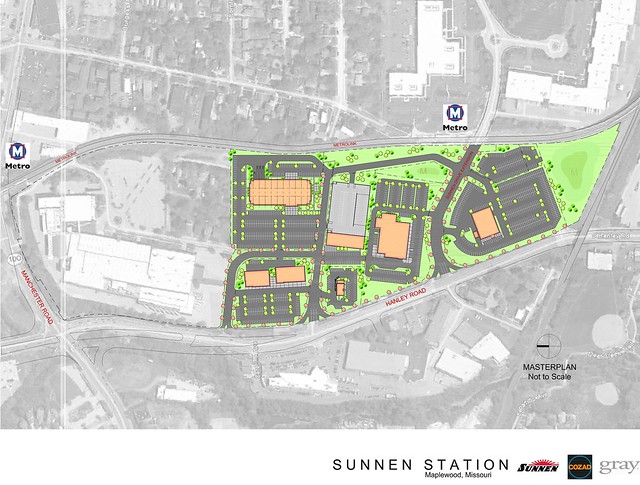

What a load of crap! Does anybody in this region get sustainable, urban development, TOD? St. Louis has to be one of the worst cities in the country for this kinda crap. It seems like cities that are not even urban in nature (Charlotte, Phoenix, Atlanta etc!) are all doing a much better job of promoting TOD.

I see a lot of parking and a lot of green space, but could someone inform me on the aspects of this project that don't conform to TOD?
This looks like a typical suburban build out to me and I don't know what a good TOD would look like...so I'm not sure how to compare.
Thanks!
This looks like a typical suburban build out to me and I don't know what a good TOD would look like...so I'm not sure how to compare.
Thanks!
- 11K
Hey, hey, it's cool. Citizens for Modern Transit just had a fabulous, national figure, an expert on TOD speak at a lunch the other day. Problem solved. </sarcasm>
Hummm. I was hoping for something a little more optimistic. Not surprised though.
I don't know what everyone is complaining about. How is this NOT transit-oriented development? This is VERY accessible so long as you own a car, don't carpool and are not handicapped.
Geez.
Geez.
Calling the Sunnen development a TOD is insulting to TODs everywhere!
The Brentwood Meridian development now has a Lazyboy so the only retail left vacant I believe is the spot next to Mai Lee. I know the development isn't ideal but I think this is the best TOD Metro has been able to facilitate, sadly. Mixed retail (best buy, sports authority, mens warehouse, lazyboy, mai lee), a 24 hour gym, plus the office building and i guess you can consider Missouri College as education. Much better than the Sunnen debacle.
Its so frustrating, especially as an ex-Brentwood resident of 14 years, how so few people in charge can ruin such an important area of the region. Seriously, the people who are in charge of Brentwood all act like they live in a 5k person town out in nowhere MO. With very little infrastructure changes the little shops along Brentwood and Manchester could be thriving. But for whatever reason the folks in charge chose to severe the Metrolink stops from the community and instead beef up the roads and police monitoring of those roads.
Its so frustrating, especially as an ex-Brentwood resident of 14 years, how so few people in charge can ruin such an important area of the region. Seriously, the people who are in charge of Brentwood all act like they live in a 5k person town out in nowhere MO. With very little infrastructure changes the little shops along Brentwood and Manchester could be thriving. But for whatever reason the folks in charge chose to severe the Metrolink stops from the community and instead beef up the roads and police monitoring of those roads.
^ The biggest disappointment concerning the Brentwood-Meridian development in my mind is not the excessive parking built but that the garage themselves were not planned or least the appearance of any thought put forth to re-development to the immediate south. I can understand a developers viewpoint, but Metro has to get beyond lot lines because the muni's are certainly not.
In the long term, I could see Home Depot/McDonalds/Lyons being demolished and mixed use residential being built that makes use of the metrolink garages. I believe it will be only a matter of time before Home Depot closes if Menards goes forward and still can't believe that Dierbergs gets that much traffic to keep afloat. However, It is going to take vision, leadership which is lacking across the board for every muni in that area. In the meantime, Families will continue to go to West County and beyond and young adults will continue to gravitate to the city which is exactly why St. Louis county is starting to lose population.
In the long term, I could see Home Depot/McDonalds/Lyons being demolished and mixed use residential being built that makes use of the metrolink garages. I believe it will be only a matter of time before Home Depot closes if Menards goes forward and still can't believe that Dierbergs gets that much traffic to keep afloat. However, It is going to take vision, leadership which is lacking across the board for every muni in that area. In the meantime, Families will continue to go to West County and beyond and young adults will continue to gravitate to the city which is exactly why St. Louis county is starting to lose population.

My online question to the experts on St. Louis On the Air earlier got a little truncated, so thought I'd try here. (I've been lurking for a long time, figured I'd finally register...)
When talking about TOD with various people (from friends to relatives to classmates, etc), I've heard, "well, St. Louis is just a car-centered metro area." The implication being that in many ways, its a waste of time to think about TOD. Are there any examples of other car-centric (possibly midwestern) cities that really stand out as embracing TOD?
Living in Philadelphia for the past several years, where commuting from the suburbs via light/regional rail is extremely common, its obvious that TOD faces different challenges here when light rail is effectively a foreign concept to a lot of the metro area.
When talking about TOD with various people (from friends to relatives to classmates, etc), I've heard, "well, St. Louis is just a car-centered metro area." The implication being that in many ways, its a waste of time to think about TOD. Are there any examples of other car-centric (possibly midwestern) cities that really stand out as embracing TOD?
Living in Philadelphia for the past several years, where commuting from the suburbs via light/regional rail is extremely common, its obvious that TOD faces different challenges here when light rail is effectively a foreign concept to a lot of the metro area.
^ Well the whole city of St. Louis and inner ring suburbs were basically built as the original TOD. So the argument that TOD is not possible or cant work in St. Louis is just asinine.
Other cities that are doing TOD in a major way in the Midwest. Minneapolis is doing a lot more TOD, but in my opinion that is a region that clearly understands what needs to be done to remain competitive, despite it having some of the most brutal winters in the country. Obviously Chicago is the only Midwestern city with a comprehensive, built out rail system, so TOD is pretty commonplace in the Chicagoland area. Denver is also doing a boat load of stuff involving TOD, probably some of the most impressive in the the country, but most people dont really consider them traditionally Midwestern.
St. Louis definitely has an opportunity with this TOD study to really make some great strides in becoming a more transit friendly, walkable, and urban region. I really think the St. Louis region is traumatized by the urban experience, because our urban decline has been so vast and violent. Cities like Denver, Dallas, Minneapolis etc. were never as urban as St. Louis during the industrial era, so there is no collective memory of tightly packed urban slums, hi rise public housing, white flight, deindustrialization etc. Most people in St. Louis are simply frightened by the idea of "urban living" they associate it with crime, crowding, and corruption. In newer cities it seen as being hip, cool, edgy etc. Cities like Denver, Dallas, Minneapolis are excited about getting more urban, St. Louis simply isn't and it is reflected in our collective investments, public and private.
All that said I do think St. Louis will see true TOD before 2020, but it would have taken us a little longer than other regions, but once we get it, we will have some of the best.
Other cities that are doing TOD in a major way in the Midwest. Minneapolis is doing a lot more TOD, but in my opinion that is a region that clearly understands what needs to be done to remain competitive, despite it having some of the most brutal winters in the country. Obviously Chicago is the only Midwestern city with a comprehensive, built out rail system, so TOD is pretty commonplace in the Chicagoland area. Denver is also doing a boat load of stuff involving TOD, probably some of the most impressive in the the country, but most people dont really consider them traditionally Midwestern.
St. Louis definitely has an opportunity with this TOD study to really make some great strides in becoming a more transit friendly, walkable, and urban region. I really think the St. Louis region is traumatized by the urban experience, because our urban decline has been so vast and violent. Cities like Denver, Dallas, Minneapolis etc. were never as urban as St. Louis during the industrial era, so there is no collective memory of tightly packed urban slums, hi rise public housing, white flight, deindustrialization etc. Most people in St. Louis are simply frightened by the idea of "urban living" they associate it with crime, crowding, and corruption. In newer cities it seen as being hip, cool, edgy etc. Cities like Denver, Dallas, Minneapolis are excited about getting more urban, St. Louis simply isn't and it is reflected in our collective investments, public and private.
All that said I do think St. Louis will see true TOD before 2020, but it would have taken us a little longer than other regions, but once we get it, we will have some of the best.
- 623
Went to the open house last night at Crossroads School. They had case studies from Dallas and LA. You can't get much more car centric than that. Another example was from Denver.
Response to your friends and family... if you build for the car how can you not be auto-centric. Another key thing is that this provides a lifestyle option that many people would prefer but there is very limited supply.
Response to your friends and family... if you build for the car how can you not be auto-centric. Another key thing is that this provides a lifestyle option that many people would prefer but there is very limited supply.
An interesting characteristic of St. Louis is that it's at the small end of cities that can even discuss TOD. Indy, Cincy, and KC don't have any transit to speak of. Detroit and Tampa don't have transit that would facilitate TOD. Baltimore hasn't seen TOD except as a destination for the DC job market. Comparably sized cities that seem to have successfully encourage/executed TOD are Seattle, Minneapolis, Denver, and Portland.
St. Louis falls somewhere in a category with Cleveland and Pittsburgh, where we have transit and have been redeveloping our CBDs, but not executing significant TOD. We're 500K bigger than Pittsburgh and 750K bigger than Cleveland, so one could argue that we are the furthest behind in this group.
A major factor is obviously population growth which has been relatively stagnant in these cities over the last decade. So, while there is a lot of interest and excitement about TOD among urbanists and transit enthusiasts, I don't think it has been the automatic by-product of transit investment that we hoped it would be.
In larger cities (Philly, Boston, Chicago, DC, San Francisco, New York) fuel prices tend to be higher, parking is more expensive, traffic is worse, and there is preexisting commuter rail infrastructure that stretches further out into the hinterlands than light rail is designed to. All of these factors, along with higher property costs (among others), make commuting a much more attractive option than in the smaller cities.
St. Louis falls somewhere in a category with Cleveland and Pittsburgh, where we have transit and have been redeveloping our CBDs, but not executing significant TOD. We're 500K bigger than Pittsburgh and 750K bigger than Cleveland, so one could argue that we are the furthest behind in this group.
A major factor is obviously population growth which has been relatively stagnant in these cities over the last decade. So, while there is a lot of interest and excitement about TOD among urbanists and transit enthusiasts, I don't think it has been the automatic by-product of transit investment that we hoped it would be.
In larger cities (Philly, Boston, Chicago, DC, San Francisco, New York) fuel prices tend to be higher, parking is more expensive, traffic is worse, and there is preexisting commuter rail infrastructure that stretches further out into the hinterlands than light rail is designed to. All of these factors, along with higher property costs (among others), make commuting a much more attractive option than in the smaller cities.
- 11K
Any mention of the hardware store Crossroads School bought for a parking lot on the Loop Trolley line?mattonarsenal wrote:Went to the open house last night at Crossroads School.
I agree with everything you said. St. Louis doesn't have the population growth to do the huge development projects you see in cities like Dallas or Denver etc., but St. Louis could use TOD as a catalyst for redevelopment in older, inner ring suburbs and St. Louis City. If planned right and implemented with serious intent we could make some real progress in changing our urban landscape. We give so much TIF money to commercial/retail developments in this region without a residential component, why not fund true mixed use development?wabash wrote:An interesting characteristic of St. Louis is that it's at the small end of cities that can even discuss TOD. Indy, Cincy, and KC don't have any transit to speak of. Detroit and Tampa don't have transit that would facilitate TOD. Baltimore hasn't seen TOD except as a destination for the DC job market. Comparably sized cities that seem to have successfully encourage/executed TOD are Seattle, Minneapolis, Denver, and Portland.
St. Louis falls somewhere in a category with Cleveland and Pittsburgh, where we have transit and have been redeveloping our CBDs, but not executing significant TOD. We're 500K bigger than Pittsburgh and 750K bigger than Cleveland, so one could argue that we are the furthest behind in this group.
A major factor is obviously population growth which has been relatively stagnant in these cities over the last decade. So, while there is a lot of interest and excitement about TOD among urbanists and transit enthusiasts, I don't think it has been the automatic by-product of transit investment that we hoped it would be.
In larger cities (Philly, Boston, Chicago, DC, San Francisco, New York) fuel prices tend to be higher, parking is more expensive, traffic is worse, and there is preexisting commuter rail infrastructure that stretches further out into the hinterlands than light rail is designed to. All of these factors, along with higher property costs (among others), make commuting a much more attractive option than in the smaller cities.
- 623
Alex, no mention of that. I only noticed as I was leaving. Somebody mentioned on here that the strip mall on DeBaliviere was being torn down so I was paying attention to that. And NO it is not being torn down.
The meeting format was an open house with boards summarizing each Metrolink Station (ridership, population, employment, pros/cons of TOD at the station) and case studies. A short presentation mostly summarizing what TOD is, benefits, and outlining the study. Nothing new here. The study will identify 5 stations that will get full TOD plans, market studies, renderings, etc. They said this doesn't mean other stations cannot get TOD, but the effort and funds will be focused on the five stations as a model for the other stations in the system.
At the end they asked survey questions with interactive polling, mostly it was about how and where you use MetroLink, then I had to leave. I'm not sure if they started asking opinions about what stations made most sense for TOD.
The meeting format was an open house with boards summarizing each Metrolink Station (ridership, population, employment, pros/cons of TOD at the station) and case studies. A short presentation mostly summarizing what TOD is, benefits, and outlining the study. Nothing new here. The study will identify 5 stations that will get full TOD plans, market studies, renderings, etc. They said this doesn't mean other stations cannot get TOD, but the effort and funds will be focused on the five stations as a model for the other stations in the system.
At the end they asked survey questions with interactive polling, mostly it was about how and where you use MetroLink, then I had to leave. I'm not sure if they started asking opinions about what stations made most sense for TOD.
- 11K
Preliminary Plans - North Hanley
What you guys think? Mostly comprised of 2 and 3 story buildings. Very doable in my opinion. Will be interested to see what further plans bring for Hanley and other stations.
http://stlouistod.com/documents/north-h ... 130220.pdf
What you guys think? Mostly comprised of 2 and 3 story buildings. Very doable in my opinion. Will be interested to see what further plans bring for Hanley and other stations.
http://stlouistod.com/documents/north-h ... 130220.pdf
Union Station TOD?
![]()

- 1,792

^^So tear downt the Drury Building and associatied Parking Garage... why? Currently its a dead area but by reorking the interchange the building becomes useful again. Same for Upprelimits Gym.
Also Parking (collective sigh) for blues games and Union Station is going to be an issue. Any plan for the area needs to recognize that reality.
There is no scale indicated but these blocks sort of remind me of the developments in Darst and Columbus Sqare... I feel like to justify reworking the interchange the development here has to be significant.
The interchange needs reworked but i prefer some other plans that have been suggested.
^^^Really love the Haneley stop plan. I think it has to be marketed toward UMSL students and Express Scripts though. Even Boeing Employees. If you aren't capturing these segments of the market I don't know if retail is going to take the risk moving in there. Maybe throw an Airport hotel in there as well as an anchor.
Also Parking (collective sigh) for blues games and Union Station is going to be an issue. Any plan for the area needs to recognize that reality.
There is no scale indicated but these blocks sort of remind me of the developments in Darst and Columbus Sqare... I feel like to justify reworking the interchange the development here has to be significant.
The interchange needs reworked but i prefer some other plans that have been suggested.
^^^Really love the Haneley stop plan. I think it has to be marketed toward UMSL students and Express Scripts though. Even Boeing Employees. If you aren't capturing these segments of the market I don't know if retail is going to take the risk moving in there. Maybe throw an Airport hotel in there as well as an anchor.
- 1,320

More on the Union Station / Civic Center TOD Study here:
http://nextstl.com/forum/viewtopic.php?f=25&t=9605
http://nextstl.com/forum/viewtopic.php?f=25&t=9605