chaifetz10 wrote:
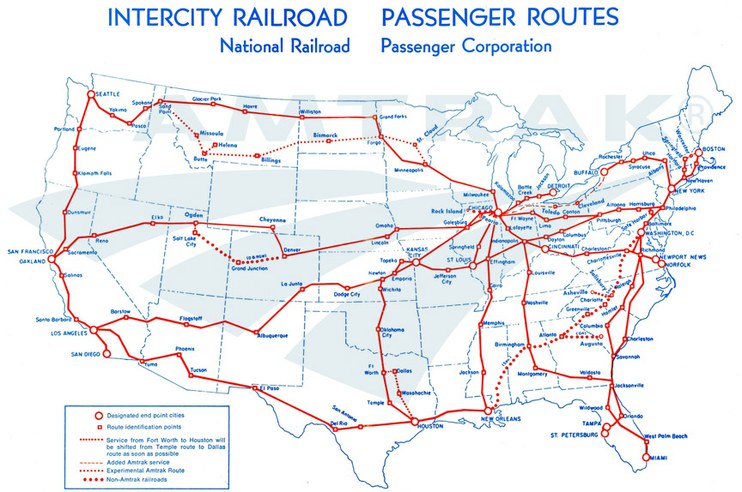
The biggest hurdle with that alignment is the interlocking / exchange / whatever the rail term is at Toledo, IL right? If I'm remembering correctly (and I'm most likely not) wasn't this a major reason that Amtrak dropped Decatur back in 1971?
I suspect you mean Tolono, where the Wabash line from Decatur to Fort Wayne and points east crossed the IC from Chicago to Paducah and points south. The old Wabash is easily the best route from St. Louis to Decatur, but the Wabash route from Decatur to Chicago was pulled from Forest north. And it never went through Champaign in any case, though it got you close. The IC had lines to all of the above places, but it would have been a circuitous route at best, since the St. Louis line ran through Springfield and Clinton, not Decatur. There is an interlocking at Tolono between the Wabash and IC that at one time appears to have included a couple of interchange tracks that would have allowed a train to transition from eastbound on the W. A. Bash to northbound on the IC, but I don't think it was ever a major junction for either road. Alternately you could have gotten from St. Louis to Decatur and Champaign on the IT, but I doubt their tracks would have pleased Amtrak in the best of days, and most of that was pulled in the sixties in any case, if I recall correctly. So . . . failing that, you go via the old Alton route, which is what they do now. There's no reason you couldn't go St. Louis, Decator, Tolono, Champaign, Chicago. But you would have to rebuild the junction.
Also: a short bit of explanation. An interlocking is a type of junction where a mechanical device, called an interlocking machine, controlled the switches and signals. The "interlocks" between the handles and levers prevented an operator from selecting conflicting routes. So every interlocking is a junction of sorts, but not all junctions had interlockings. And interlockings do not necessarily facilitate interchange between different railroads or lines, though it is pretty common that they include that. (Not a lot of reason to have an interlocking for a simple crossing or "diamond." Those can be controlled entirely automatically, or even just with operating rules if traffic is light enough.) Short version: the terms are different, but they overlap quite a lot. Junction is pretty much always safe. (And you'll hear particular junctions referred to as tower, cabin, crossing, junction, station, and probably a host of other historic names I can't immediately think of. Just based on what the thing was called at one time a hundred fifty years ago.)