547
Senior MemberSenior Member
547

PostFeb 07, 2011#51

john w. wrote:
zun1026 wrote:Brentwood is more of a park n' ride. I don't understand how anyone could consider it a TOD, because its missing too many elements. Continue to throw out ideas for a Deconess/FP TOD. I might be able to draw up something this week.
While you and I both know that the Brentwood metrolink stop is nothing more than a glorified park'n'ride with the garage, the new "Hanley Station" mixed-use development adjacent to the stop (as well as the retail buildings where Best Buy and Dierberg's are located) are billed as a TOD, and were during their construction. The laughable "Boulevard St. Louis" across from the Galleria was billed as TOD related to the Richmond Heights metro stop. Chew on that one for awhile.
Handley Station is not walkable, a major component of TODs.

I haden't heard that Boulevard St. Louis was a TOD. It seems more of an attempt at new urbanism.

216
Junior MemberJunior Member
216

PostFeb 07, 2011#52

DaronDierkes wrote:John, BRT terminal as TOD? We've got to overcome that model. We've already spent too much on it. Bus stop transfers are more flexible, cheaper, keep the action and investment on the street, and allow room for real businesses instead of expensive fields of concrete and fumes. I want to get off the bus in a place that has placeness, not an ugly concrete bunker.

Daron, can you cite some examples of TOD as you perceive them in our city (here... not abroad)? What model that exists in St. Louis do we need "to overcome"? Consider the intersection of Hampton and I-64 as thoroughfares (and not the continuance of the Hampton path north of I-64 and into FP proper. This intersection is a 'T' shape, of sorts, and is therefore a prime nexus or node for the confluence of multi-modal transit. This discussion thread, after all, is about what could be done with the FP hospital, and a properly formed TOD is one such solution for a nexus like this intersection. I can fully see this location as strategic, with the zoo, the 90 Hampton bus and of course the highway. The institutional use of the hospital itself only adds to the validity of such a site because of the further programmatic overlay that activates this corner with people. I'd submit that your idealized BRT stops are perfect for along-the-line stops rather than critical nodes like this intersection, and that's why I believe it is a great location for a TOD.

8,908
Life MemberLife Member
8,908

PostFeb 07, 2011#53

@ John W. - I'm not sure what this has to do with the Forest Park Hospital but I'll chime in...

Putting the questionable faux asthetics aside, why is the Boulevard not considered TOD?

The boulevard is mixed use with residential, office, and retail. There also origianally were plans for a hotel. The Boulevard is walkable, close to transit and is a huge improvement over the typical strip mall. Would I live there, No. But that doesn't make it any more or less TOD.

These development (Hanley Station, The Meridian, The Boulevard) may not be EXACTLY what I'd chose to build there, but the density and mixed use of the development are a huge step in the right direction as far as I'm concerned. We need shops, restaurants, office, and residential next to our ML stops, and these mit that criteria.

I'm curious if you'd feel the same way if the surrounding plots weren't so auto centric...(Home Depot, Dierbergs, old blockbuster).

216
Junior MemberJunior Member
216

PostFeb 07, 2011#54

moorlander wrote:The Boulevard is walkable...

No. It is not. To say that the Boulevard is walkable, is to say the Galleria across the street is 'walkable'. Once inside, after parking a car in the Indian Ocean of paving, one can walk from Macy's to Dillard's and back. Then depart the confines of the interior streets and return to the car in the Indian Ocean, and drive somewhere else that is 'walkable'. I can step out the front door of my parents' house is Chesterfield, walk 6 houses up the cul-de-sac street to visit some friends of my parents, but I cannot walk anywhere to purchase some milk. Or see a cinema movie. Or go to school. It's this type of connectivity that is imperative to walkability. While some examples of very walkable areas may still require the assistance of transit (like the school or cinema example above), the typical everyday occurances should be easily within walking distance. I do not see how the Boulevard is walkable.

PostFeb 08, 2011#55

moorlander wrote: The boulevard is... close to transit
Yes. It is. So is Best Buy and Dierberg's just south of I-64 from the Boulevard. The closeness is referred to as adjacency in transit orientation parlance. The Boulevard is a Transit Adjacent Development (TAD). TODs are directly shaped by the transit line or stop. DIRECTLY. Upon arrival at a transit stop, and departing the [train, bus] one is already in the TOD. The stop is integral to the development. It is not just NEXT to the development. If the historic Union Station on Market Street still hosted trains as a terminal, and along with the shops and restaurants and hotel, it would be an outstanding example of TOD. The trains aren't there anymore. There's a metrolink station in a ditch nearby. Is this the fault of Metro? Is this the fault of the redeveloper's of Union Station? No. Of course not. It's just not a TOD, that's all.

547
Senior MemberSenior Member
547

PostFeb 08, 2011#56

moorlander wrote:@ John W. - I'm not sure what this has to do with the Forest Park Hospital but I'll chime in...

Putting the questionable faux asthetics aside, why is the Boulevard not considered TOD?

The boulevard is mixed use with residential, office, and retail. There also origianally were plans for a hotel. The Boulevard is walkable, close to transit and is a huge improvement over the typical strip mall. Would I live there, No. But that doesn't make it any more or less TOD.

These development (Hanley Station, The Meridian, The Boulevard) may not be EXACTLY what I'd chose to build there, but the density and mixed use of the development are a huge step in the right direction as far as I'm concerned. We need shops, restaurants, office, and residential next to our ML stops, and these mit that criteria.

I'm curious if you'd feel the same way if the surrounding plots weren't so auto centric...(Home Depot, Dierbergs, old blockbuster).
I agree that they are an improvement over what we had, but I also think they show how far off we are at the same time. Maybe its because I have spent some time in Denver and Portland, but I think we have a long way to go when it comes to Transit and TODs. However, I am optimistic that we can get there.

As for The Boulevard, it might be close to transit, but transit is not a major structural element to the urban fabric that is found there. Thus it is not a TOD. The Hanley Station is not a TOD because it turns its back to the transit stop and does not have the supportve mix of uses.

I think the reason that this discussion is valuable to this specific thread is due to the possibility that the FP Hospital site could and would be a good site for a TOD IMO. Feel free to disagree. But with this site becoming nextSTL and there being a mission to push to make STL better, it probably is fair to say these are the types of discussions we should have. (Hopefully this reads as a positive remark, I am not intending to come off as snide.)

216
Junior MemberJunior Member
216

PostFeb 08, 2011#57


712
Senior MemberSenior Member
712

PostFeb 09, 2011#58

john w. wrote:Consider the intersection of Hampton and I-64 as thoroughfares (and not the continuance of the Hampton path north of I-64 and into FP proper. This intersection is a 'T' shape, of sorts, and is therefore a prime nexus or node for the confluence of multi-modal transit. This discussion thread, after all, is about what could be done with the FP hospital, and a properly formed TOD is one such solution for a nexus like this intersection. I can fully see this location as strategic, with the zoo, the 90 Hampton bus and of course the highway. The institutional use of the hospital itself only adds to the validity of such a site because of the further programmatic overlay that activates this corner with people. I'd submit that your idealized BRT stops are perfect for along-the-line stops rather than critical nodes like this intersection, and that's why I believe it is a great location for a TOD.
I don't see it as a T at all. Not at all. Hampton is the bus to the zoo and the SLAM, not to the unwalkable concourse. I take buses to destinations, not empty crossroads, at least if I can. I currently take two buses to get to Dogtown, the 14 and the 59. The 59 used to come to my house, but Metro broke it in two and decided I should wait in a parking garage for a half hour every time I want to get to Tamm. It's a bus system of dead ends, not destinations, and that's a problem.

If that intersection is developed, it should be developed as a major gateway to Forest Park, and that means it must be an X, not a T.

Yes, it can be a fantastic location for transit! Especially with on street buses passing through in many different directions.

547
Senior MemberSenior Member
547

PostFeb 09, 2011#59

DaronDierkes wrote:
john w. wrote:Consider the intersection of Hampton and I-64 as thoroughfares (and not the continuance of the Hampton path north of I-64 and into FP proper. This intersection is a 'T' shape, of sorts, and is therefore a prime nexus or node for the confluence of multi-modal transit. This discussion thread, after all, is about what could be done with the FP hospital, and a properly formed TOD is one such solution for a nexus like this intersection. I can fully see this location as strategic, with the zoo, the 90 Hampton bus and of course the highway. The institutional use of the hospital itself only adds to the validity of such a site because of the further programmatic overlay that activates this corner with people. I'd submit that your idealized BRT stops are perfect for along-the-line stops rather than critical nodes like this intersection, and that's why I believe it is a great location for a TOD.
I don't see it as a T at all. Not at all. Hampton is the bus to the zoo and the SLAM, not to the unwalkable concourse. I take buses to destinations, not empty crossroads, at least if I can. I currently take two buses to get to Dogtown, the 14 and the 59. The 59 used to come to my house, but Metro broke it in two and decided I should wait in a parking garage for a half hour every time I want to get to Tamm. It's a bus system of dead ends, not destinations, and that's a problem.

If that intersection is developed, it should be developed as a major gateway to Forest Park, and that means it must be an X, not a T.

Yes, it can be a fantastic location for transit! Especially with on street buses passing through in many different directions.
I am not sure I follow the T and X intersection discussion. What streets specifically make up the T? How could they become a X type? Why does it matter all that much in your opinion? (Not disagreeing, just interested)

Also, could the stops move off the street and rather move through the new development? I think the I-64 BRT could more easily return to the highway if it moved through the site...thus making a loop.

Could this work?


216
Junior MemberJunior Member
216

PostFeb 10, 2011#60

I don't see the 'X' at all, so I'm not quite sure what Daron is referring to, but the 'T' is simply, and I mean SIMPLY, referring to the function of Hampton Avenue as a thoroughfare effectively ending at its intersection with I-64. I mentioned the exclusion of the portion of the Hampton Avenue path the continues into Forest Park proper, so if you sever this portion of the path north of the intersection of Hampton and I-64 what you are left with is a very simple 'T' shape. Why is this a natural nexus as a 'T' shape? Well, because as a termination of the flow of traffic from the Hampton Avenue thoroughfare at I-64, there is obvious value in the FP hospital site as a park-n-ride for motorists arriving from south city. This is so because the convenience of fluid travel at 35 to 40 mph through all of those coordinated green lights on thoroughfares (like Hampton, McCausland, Big Bend, Hanley and so forth) is interrupted at the intersection of Hampton and I-64. If auto drivers could simply continue northward at the fluid rate of speed they'd been traveling up to the point of the intersection, they would do just that. The intersection becomes a natural break in the fluidity of northbound traffic flow, and therefore opportunity for shift in mode. This may change if the connector from Big Bend or Hanley is somehow built to funnel southbound traffic from mid-county to south county via River de Peres Parkway (because a lot of auto traffic may be diverted to a more convenient auto route if available), but for this current time it is still true. The proximity to the zoo and science center make this location logical for a transit stop.

PostFeb 10, 2011#61

john w. wrote:The proximity to the zoo and science center make this location logical for a transit stop.
This will rely on whatever shuttle service is currently available to reach the zoo, I would add. I aint walkin' across that overpass!

712
Senior MemberSenior Member
712

PostFeb 10, 2011#62

X because there's no cross button...

I want the Hampton bus going straight across the bridge, not ducking into some underground facility, just like I'd like to take the Kingshighway bus from south city to the Chase without it driving in circles for twenty minutes.

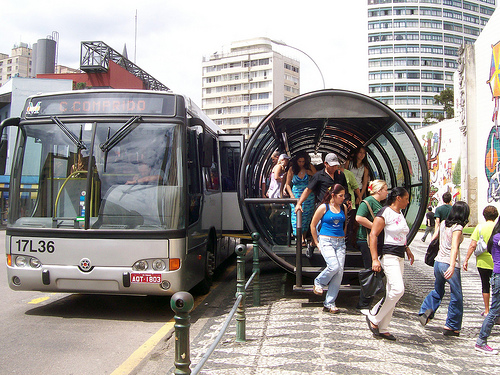
Zun1026 we are talking about a long articulated bus that doesn't make easy turns. It wouldn't be so rapid if it made your loop, especially if there's a loop at every stop. Better to go up the exit ramp, drop people off, go straight across Hampton, pick people up, and then go back onto the highway. Being dropped off there wouldn't be a problem at all if there were nice bus stops (think Curitiba tubes) with sidewalks behind them and the zoo made an effort to turn the Animals Always sculpture into an entrance for pedestrians with nice sidewalks approaching it.


I have said on this forum many times that I think highways are lousy bus routes and not at all walkable. The Hampton Concourse is a nightmare, especially for women with small children trying to walk to the zoo (haha, my friend thinks she can walk to the zoo... :( )

The current design of the concourse would probably make your loop necessary, but I'd still prefer something more like this,


It would make the concourse a true gateway to the park, not just a place for cars to dump onto the highway. Wide sidewalks with noise reducing extensions like what was suggested by MVVA for the arch grounds would make sense on a bridge like this, and so would fancy crosswalks.

On the northern end more fancy animal sculptures could be added. On the southern end, walkable businesses. (across Oakland... perhaps classified as adjacent)

PostFeb 10, 2011#63

^ha! disregard those directional arrows. :)

216
Junior MemberJunior Member
216

PostFeb 10, 2011#64

DaronDierkes wrote:^ha! disregard those directional arrows. :)
disregard the black arrows. This makes perfect sense, but I was actually suggesting the BRT bus departs the highway at the Hampton exit (either direction), and after stationing at the FP hospital, it then continues down Oakland in order to re-enter the flow of traffic on I-64. I'm not sure I understand the graphic used by Zun1026 at the FP Hospital because it clearly implies that the building would be replaced by a newly constructed loop. This is not what I would ever propose, because there is no reason to trade the existing building for a loop when Oakland Avenue will serve this purpose very effectively.

547
Senior MemberSenior Member
547

PostFeb 10, 2011#65

DaronDierkes wrote:X because there's no cross button...

I want the Hampton bus going straight across the bridge, not ducking into some underground facility, just like I'd like to take the Kingshighway bus from south city to the Chase without it driving in circles for twenty minutes.

Zun1026 we are talking about a long articulated bus that doesn't make easy turns. It wouldn't be so rapid if it made your loop, especially if there's a loop at every stop. Better to go up the exit ramp, drop people off, go straight across Hampton, pick people up, and then go back onto the highway. Being dropped off there wouldn't be a problem at all if there were nice bus stops (think Curitiba tubes) with sidewalks behind them and the zoo made an effort to turn the Animals Always sculpture into an entrance for pedestrians with nice sidewalks approaching it.


I have said on this forum many times that I think highways are lousy bus routes and not at all walkable. The Hampton Concourse is a nightmare, especially for women with small children trying to walk to the zoo (haha, my friend thinks she can walk to the zoo... :( )

The current design of the concourse would probably make your loop necessary, but I'd still prefer something more like this,


It would make the concourse a true gateway to the park, not just a place for cars to dump onto the highway. Wide sidewalks with noise reducing extensions like what was suggested by MVVA for the arch grounds would make sense on a bridge like this, and so would fancy crosswalks.

On the northern end more fancy animal sculptures could be added. On the southern end, walkable businesses. (across Oakland... perhaps classified as adjacent)

Thats why I proposed what I did. I don't disagree with your intentions to make the line more streamlined and I think elsewhere we should try such methods. However, I think this area could be a good place for something else.

Putting the stops where you have them (mainly the north side) is not putting them in a destination. Its in the middle of traffic hell for a pedestrian (IMO)...too many cars coming from too many directions. Its too far (either visually or in physical distance) from the destinations of the Zoo, a TOD at FPH, and the Highlands. Also, I see you have the bus stops converging on or right next to the overpass. This leaves little area for public restrooms or cafes. If people disagree, please fee free to state your thoughts.

From an economic standpoint it seems more feasible to not rework the overpass and ramps, but to rather to make a TOD where all the converging lines can pick up and drop off passengers. There they can use the restroom, shop, read a paper or magazine, have a cup of coffee...etc, all withing the comforts of a shop, a sidewalk cafe,a small park/plaza or even in a bus shelter. This activity works well to support the surrounding businesses and residential units. Plus, such redevelopment could add some tax revenue and hopefully a positive image toward TODs.

Here is a revised proposal. Let me know what everyone thinks.


216
Junior MemberJunior Member
216

PostFeb 10, 2011#66

zun, why can't the BRT simply stop at the corner of Hampton and Oakland (in an existing parking garage modified to feature active street frontage), and then continue up or down Oakland and re-enter the flow of traffic at either Kingshighway or McCausland? Your graphic still seems to imply that the hospital would be removed to accommodate a new loop. Am I missing something?

PostFeb 10, 2011#67

If it has to be a loop, perhaps the (now vacant, or little used?) Fox 2 News studio lot could serve as the loop. I was thinking Imo's could somehow play a role in some food service.

547
Senior MemberSenior Member
547

PostFeb 10, 2011#68

john w. wrote:
DaronDierkes wrote:^ha! disregard those directional arrows. :)
disregard the black arrows. This makes perfect sense, but I was actually suggesting the BRT bus departs the highway at the Hampton exit (either direction), and after stationing at the FP hospital, it then continues down Oakland in order to re-enter the flow of traffic on I-64. I'm not sure I understand the graphic used by Zun1026 at the FP Hospital because it clearly implies that the building would be replaced by a newly constructed loop. This is not what I would ever propose, because there is no reason to trade the existing building for a loop when Oakland Avenue will serve this purpose very effectively.
I would suggest tearing down FPH, creating some sort of system that would allow the buses to drop off / pick up and develop the area with a mix of uses. Unless the hospital becomes something medical or educational, I can't think of many other uses for the building. Also, I thought it would be ideal to have the 4/5 bus lines converge at one station.

The loop I drew on the image is just a rough idea, not one that is set in stone by any means.

PostFeb 10, 2011#69

john w. wrote:zun, why can't the BRT simply stop at the corner of Hampton and Oakland (in an existing parking garage modified to feature active street frontage), and then continue up or down Oakland and re-enter the flow of traffic at either Kingshighway or McCausland? Your graphic still seems to imply that the hospital would be removed to accommodate a new loop. Am I missing something?
I was thinking about that, but the BRT would have to loop around to get on the highway, so why not make it part of a new development? However, the Oakland maneuver could work as well. I just hadn't really considered it. I wonder though if it is any more time effective than the loop.

Regardless, I will come up with a schematic of that as one of a couple of alternatives. I will try to devise on that has the stops proposed by Daron as well. If everyone continues to add their thoughts I will try to incorporate them if they like.

PostFeb 10, 2011#70

john w. wrote:If it has to be a loop, perhaps the (now vacant, or little used?) Fox 2 News studio lot could serve as the loop. I was thinking Imo's could somehow play a role in some food service.
That could most certainly be an option as well. Though that site might be a bit tight, but I am sure that I or someone else could come up with an idea for that sight as well.

712
Senior MemberSenior Member
712

PostFeb 10, 2011#71

I wouldn't advocate tearing down the hospital, but reworking the overpass to make it safe for pedestrians is essential. Avoiding it completely doesn't address the problem. The bus stops I suggested would have to have six foot sidewalks behind them built out into the highway ROW berm, good crosswalks, and similarly wide sidewalks protected from cars and noise crossing the bridge.

People should be able to enter Forest Park on foot and by bike. Adding nice bus stops to the bridge forces that retrofit. It'd be up to the zoo and Forest Park Forever to bring the destination experience closer to the bus stop. A large archway/gateway (think SLU arches on Grand) saying Forest Park would be a start. A small Forest Park visitors center wouldn't be out of place there either. Development doesn't always have to be a cafe. The proper development for a park entrance could be very different. The point is that it has to be walkable and screem, "you have arrived." Welcome to Forest Park, and then a hundred feet down the path Welcome to the Zoo.

216
Junior MemberJunior Member
216

PostFeb 10, 2011#72

zun1026 wrote:I wonder though if it is any more time effective than the loop.
I'm thinking of both ease of navigation through an intersection for an articulated bus, and a more natural flow for such a bus along a straight line. The frontage along Oakland Avenue is the longest (north edge of the corner parking lot) and is visible to I-64. I believe this is a more attractive option, and arguably more effective than a loop. I'd also submit that the preservation of the existing building for reuse is 10x more valuable to our built environment than its absence.

PostFeb 10, 2011#73

DaronDierkes wrote:I wouldn't advocate tearing down the hospital, but reworking the overpass to make it safe for pedestrians is essential. Avoiding it completely doesn't address the problem. The bus stops I suggested would have to have six foot sidewalks behind them built out into the highway ROW berm, good crosswalks, and similarly wide sidewalks protected from cars and noise crossing the bridge.

People should be able to enter Forest Park on foot and by bike. Adding nice bus stops to the bridge forces that retrofit. It'd be up to the zoo and Forest Park Forever to bring the destination experience closer to the bus stop. A large archway/gateway (think SLU arches on Grand) saying Forest Park would be a start. A small Forest Park visitors center wouldn't be out of place there either. Development doesn't always have to be a cafe. The proper development for a park entrance could be very different. The point is that it has to be walkable and screem, "you have arrived." Welcome to Forest Park, and then a hundred feet down the path Welcome to the Zoo.
It's hard to argue with the point of arrival for FP and the zoo, so if the FP Hospital site were to be the point of arrival, then a strong pedestrian connection (read: not the road overpass) would need to be provided. I could argue that this necessity would force a positive outcome, because there currently isn't a strong and safe connection to the park from the south side of I-64 at this intersection. I'll admit I've never crossed the Tamm Avenue bridge on foot, so I do not know of its degree of pedestrian safety, but the highway overpass at Hampton and I-64 is currently inhospitable to any pedestrian or cyclist.

712
Senior MemberSenior Member
712

PostFeb 10, 2011#74

Tamm isn't bad.

547
Senior MemberSenior Member
547

PostFeb 10, 2011#75

DaronDierkes wrote:Tamm isn't bad.
I agree. Tamm is not bad at all. Its rather nice considering the highway. I used to walk it everyday before the improvements, so I assume its only gotten better.

Read more posts (168 remaining)