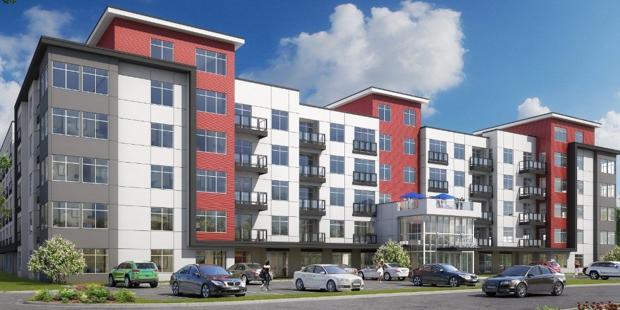
Encore at Forest Park, a $51 million apartment project announced Wednesday, will complete the Highlands at Forest Park development in St. Louis.
Balke Brown Transwestern, the Highlands developer, said Encore will be a six-story building of 246 apartments. The structure will go up on a 3-acre site between the $42 million Cortona apartments, opened last year, and a medical office building at the southern end of the 26-acre property.
The developer hopes to break ground in April and have the building ready for tenants in 2017.
I love the road with no sidewalk and convenient surface parking directly out front. Kind of like a Hampton Inn just off a rural stretch of highway.
In all seriousness though, I continue to be surprised and impressed by the amount of development @ The Highlands. It wouldn't be my first (or tenth) choice of place to live or develop, but I commend the continued interest and investment in it.
I know The Highlands isn't the urban form that a lot of people here prefer, but it's good-looking quality development that is really a strong first impression of the city when entering from the west. Plus, I'd say that the office park design works well for this site, and like framer I'm impressed with how well they've incorporated residential.
framer wrote:I'm surprised how well residential has done there; I really thought office would dominate. Do we have a final site-plan for The Highlands?
Sounds like this will be the last building...
When Encore opens, the Highlands will have 725 apartments, 126 hotel rooms, 300,000 square feet of office space and 20,000 square feet of stores, including Comet Coffee and Yoga Six studio.
I agree with the sentiment that while it isn't the greatest development ever, it does have pretty good aesthetics and decent density for a rather disconnected site. Now on to my plan to relocate Forest Park CC to Greater Downtown and open up more prime land for development!
I'd love to know the demographics of the residential tenants in the Highlands. While I totally agree, it isn't the most classically urban development, I think it likely serves a need for a clientele that loves the concept of living in the city for the convenience of entertainment, diversity, recreation, and (hopefully) proximity to work, but isn't in love with the idea of going all out, waste deep gritty STL.
I picture a lot of young professionals perhaps from surrounding areas or suburbs that want to live closer in/in the city, what have you, but have the developmental influential stigma from self, family, or friends about crime rates and safety "in the city." This area, while certainly not free from challenge, would seem to serve as a mix of familiar and new for a suburban kid. Maybe I'm grasping at straws here.
No matter, the positive momentum of these developments are important to spur growth and get people in who can slowly start to change the complexion of how "we" regionally see the city. Perhaps some of those young people, as they mature, will look east (or north or south) instead of west when deciding their next move.
This question belongs on the urban theory thread, but this calls to mind, similar to the stadium land debate... can being in the city be enough for development to have urban value? Or do developments need to abide by classic urban principles to truly realize their full potential?
I find it interesting that Cortona was a $42 million development with 278 units and Encore will be $51 million with 246 units. I wonder what the reason for the increased cost is - hopefully higher end materials and finishes.
blzhrpmd2 wrote:I'd love to know the demographics of the residential tenants in the Highlands. While I totally agree, it isn't the most classically urban development, I think it likely serves a need for a clientele that loves the concept of living in the city for the convenience of entertainment, diversity, recreation, and (hopefully) proximity to work, but isn't in love with the idea of going all out, waste deep gritty STL.
I think that is pretty spot on... here is how they market the Cortona:
"bedroom apartment community that’s close to everything you love about St. Louis."
"This is where you unplug. Kick back. Swim. Relax. Grill. All with a clear view of the sky. This is the middle of it all. Welcome to Cortona at Forest Park."
It's a central location but it's own community away from the hubbub.
roger wyoming II wrote:Now on to my plan to relocate Forest Park CC to Greater Downtown and open up more prime land for development!
Now hold on, there; I hope you're not suggesting clearing the FPCC site? Those are landmark buildings, representing a style (Brutalism?) of architecture of which we have precious few examples in St. Louis. The long, low, main building perfectly responds to its site next to the highway. I understand Brutalism is out of favor at the moment, but mark my words, if we tear down these buildings, our kids will be screaming at us in a couple of decades. Remember, it was once popular to destroy all the "old fashioned" Victorian, Gothic, and Romanesque architecture, and we all regret it now. Let's not be short-sited.
^^No sarcasm at all, Wabash. I love those buildings; classic examples of their era.
It's important for a city to preserve the history of it's built environment. Like I say, tastes come and go, but once a building is gone, it's gone forever.
framer wrote:^^No sarcasm at all, Wabash. I love those buildings; classic examples of their era.
It's important for a city to preserve the history of it's built environment. Like I say, tastes come and go, but once a building is gone, it's gone forever.
Here's my thing. It's okay to tear down buildings. Not everything has to be preserved for the sake of history.
The problem in St. Louis is that we liked to tear down buildings for parking. We didn't replace them with anything as good or better than what was there before.
Now, you may be right the this is a rare example of a certain style and therefore we shouldn't raze this building no matter what. Fair enough. But in general it's not that we need to preserve everything the way it was, it's that when we tear something down we need to do it because we're building something better.
The problem I see with Forest Park Community College is the massive amount of surface parking lots and the disjointed, unconnected Wise Ave on the back side when you literally got a very successful project/development that utilized space next door to build offices and multiunit residential in the city. Why, because it is area with great access to/from I64/Central corridor next to established institutions/jobs and a great urban park. The city needs to push for a change to the FP Community College footprint somehow, someway
I would love to see St. Louis City commit to reconnecting Wise Ave as a continuous street again, St. Louis Community College sell off the some of its surface lots to the Highland Developers and use those funds/maybe a TIF for the area to add structured parking to its campus. Build the parking structures with the intention of adding roof top green space, recreationally facilities and or solar
HighLand with its success tells me that the city needs to find a way to build upon it. Especially when you consider its private development, housing and provides a TAX Base!!! Maybe City can give up some property somewhere else to the SLCC to make it happen or heck, look at long term plan to repurpose/relocate/consolidate light industrial away from Highlands development but somewhere close enough where you still have multiple options to getting the work.
FPCC was designed by Harry Weese, and is a really good example of brick brutalism, it is in a good accessible location for students from all over the city. The grounds and buildings still look good at 50 years. I am not crazy about the large surface lot to the south, but demolishing for redevelopment would be a mistake, we have lots of much better candidates for redevelopment. The old St. Louis Marketplace, the old Forest Park lumber site, the vacant industrial on the south west edge of the grove, should be the top priorities in this neighborhood.
I'd love to know the demographics of the residential tenants in the Highlands. While I totally agree, it isn't the most classically urban development, I think it likely serves a need for a clientele that loves the concept of living in the city for the convenience of entertainment, diversity, recreation, and (hopefully) proximity to work, but isn't in love with the idea of going all out, waste deep gritty STL.
For what it's worth, one of my relatives was placed there as part of an executive training program by ABInBev. She said lots of younger low-level executives, engineers, and marketing folks were there.
beer city wrote:FPCC was designed by Harry Weese, and is a really good example of brick brutalism, it is in a good accessible location for students from all over the city. The grounds and buildings still look good at 50 years. I am not crazy about the large surface lot to the south, but demolishing for redevelopment would be a mistake, we have lots of much better candidates for redevelopment. The old St. Louis Marketplace, the old Forest Park lumber site, the vacant industrial on the south west edge of the grove, should be the top priorities in this neighborhood.
I'm not unsympathetic to the architecture, but I just don't think that desirable location's best use is as a rather low-density, not particularly urban-designed, property tax-exempt commuter campus. And I disagree on the point that other areas are better candidates for redevelopment.... The Highlands is a proven market that again has given us "725 apartments, 126 hotel rooms, 300,000 square feet of office space and 20,000 square feet of stores, including Comet Coffee and Yoga Six studio." That's pretty impressive for the space and I'd love to add even more density than that to the east. Also, I just don't see that kind of development opportunity arising at places like the St. Louis Marketplace for a very long time.
Anyway, my ideal would be to have a downtown Community College that would be accessible to Metrolink and anchor an historic building like Webster U did for Arcade-Wright or help anchor something like a 22nd St. redevelopment and have the Forest Park site master planned for a higher quality Highlands 2.0. Land values surely would have to rise significantly to get to the point where it would make economic sense, but maybe one day.
beer city wrote:FPCC was designed by Harry Weese, and is a really good example of brick brutalism, it is in a good accessible location for students from all over the city. The grounds and buildings still look good at 50 years. I am not crazy about the large surface lot to the south, but demolishing for redevelopment would be a mistake, we have lots of much better candidates for redevelopment. The old St. Louis Marketplace, the old Forest Park lumber site, the vacant industrial on the south west edge of the grove, should be the top priorities in this neighborhood.
I'm not unsympathetic to the architecture, but I just don't think that desirable location's best use is as a rather low-density, not particularly urban-designed, property tax-exempt commuter campus. And I disagree on the point that other areas are better candidates for redevelopment.... The Highlands is a proven market that again has given us "725 apartments, 126 hotel rooms, 300,000 square feet of office space and 20,000 square feet of stores, including Comet Coffee and Yoga Six studio." That's pretty impressive for the space and I'd love to add even more density than that to the east. Also, I just don't see that kind of development opportunity arising at places like the St. Louis Marketplace for a very long time.
Anyway, my ideal would be to have a downtown Community College that would be accessible to Metrolink and anchor an historic building like Webster U did for Arcade-Wright or help anchor something like a 22nd St. redevelopment and have the Forest Park site master planned for a higher quality Highlands 2.0. Land values surely would have to rise significantly to get to the point where it would make economic sense, but maybe one day.
I appreciate you passion and intent - but that is not the parcel for it - Just to the east there are several low density properties in addition to the better candidates that I mentioned earlier. Also Highlands has taken a long 16 years to get to where it is today, development is not moving fast enough to absorb StLCC site even if it was an option.
Perhaps FPCC could sell air-rights above their parking lots, giving The Highlands a bit of expansion room. For that matter, perhaps The Highlands could build on their own parking lots.
framer wrote:Perhaps FPCC could sell air-rights above their parking lots, giving The Highlands a bit of expansion room. For that matter, perhaps The Highlands could build on their own parking lots.
Is the selling of air rights necessary? Are there zoning restrictions at the Highlands?
^ Highlands is zoned H- Area Commercial which reverts back to E- Multi Family when it comes to residential. and the height limit in E is 8 stories or 100 feet.
the FPCC southwest of highlands is J- Industrial (no idea why) so it would have to be re-zoned as residential is not allowed in Industrial .
Could build in redboxes...tho 2 of those garages may not be designed to hold up a 5-6 story building or any type of building
There is some room to expand on the western side too
None of those lots are really possible inside the Highlands boarders. Two of them are newer garages and the one in the lower east corner is for the doctors building. Now, if Neis/Artcraft decide to sell they could redevelop the lot west of the Cortona. It may already be for sale.
^ That northeast corner of Hampton and Wise seems to be ideally suited now for a tear down in order to get a mixed use structure anchoring the corner and taking up the entire back lot, west lost. Talk about a nice lead in to the Highlands with great access to I64/Forest Park via Hampton. Now if only the loop trolley would extend south past History museum to dogtown. Going all in on the wishful thinking.
I believe it would be a huge opportunity and big step forward if the city could find a way to buy very southern end of FPCC lot and rebuild Wise Ave as through street, reintroduce some grid. The city could turn around and offer for development. FPCC could use the funds in part to build some structured parking with a recreational/green field/practice field on top for its student body or even a solar facility for long term savings/financing package. The scale not as big as replacing 22nd parkway/interchange downtown west nor the opens us the sheer amount of space but lot more doable in constrained budgets and as noted on previous posts. Highland development has been steady and slow. You don't need a lot of space, just some well purposed placed space for some more infill.