Here is an interesting recent piece on the cost of transit per mile and per user. And compares to lower costs on Europe.
https://www.citylab.com/transportation/ ... us/551408/
https://www.citylab.com/transportation/ ... us/551408/
I'm confused on what you are saying.KC's is starting to look a whole lot like an outlier. KC's streetcar started out purely as a novelty and KC residents ate it up and they've done a good job capitalizing on it in the form of development throughout the Crossroads area that connects Crown Center to downtown. Kind of the opposite of St. Louis with Metrolink.
Poor leadership is why we lack true TOD around stations. St. Louis is too fractioned and needs comprehensive planning. We've made many TOD plans but NIMBYism and are multitude of fiefdoms are holding back wholesale redevelopment. Hell even downtown St. Louis doesn't have form based code and it's probably the last major city downtown in America without it.aprice wrote: ↑Mar 06, 2018Yeah, I would say Jazz At Walter Circle and the new Senior Housing at the Memorial Hospital station are the only real TOD we've had. MetroLink has been abysmal when it comes to spurring development. Though I would only blame our region's poor leadership and our State's continual funding of highway expansion.
But until the Country Club Plaza / UMKC expansion, I wouldn't call any streetcar development TOD per se. Speaking of which, Someone really needs to propose a serious Loop Trolly expansion proposal. I'd prefer a route through Forest Park and down Lindell but down Delmar would work too.
Source?
Are you serious? Most major cities have some sort of form based code, at the very least in their urban cores. Some cities even have form based code over the entirety of the city. It's not just market dynamics that determine if your city will have successful TOD or urbanism, you have to have the correct policy to get the outcomes you want. You honestly think you can build whatever you want in San Francisco, Chicago, or New York? Let's be real. It may not be explicitly described as form based code, but most cities have government sanctioned zoning guidelines of what can be built where and how it must relate to it's surrounding environment. St. Louis Planning Department and SLDC has even admitted that it has totally dropped the ball on this. Then again most cities have updated their city plans since 1947.
I know that increased investment in Central West End and Grove has been guided by form based code and guidelines. Obvious, development would have happened anyway but may not have been as urban in nature.quincunx wrote: ↑Mar 07, 2018The bus doesn't go down this part of Euclid anymore. Did any of those projects build less parking than gov't mandated because of their proximity to transit?
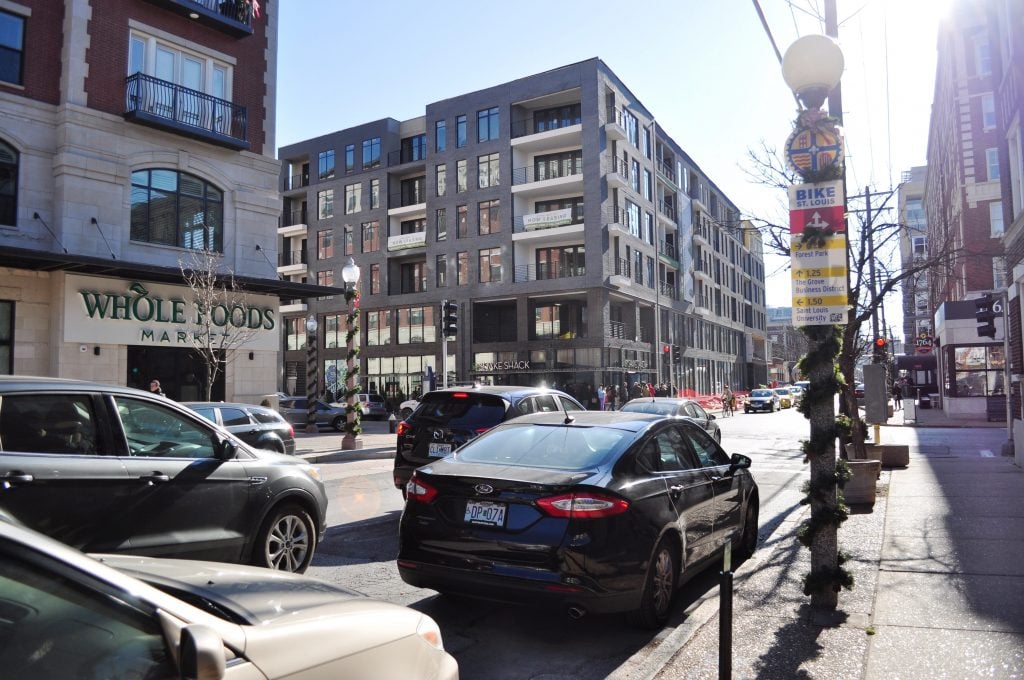
TOD Corner: Central West End Euclid Corridor Adds More Homes, Restaurants
http://www.metrostlouis.org/nextstop/to ... staurants/
Safety on Metro trains is not an isolated concern for Metro as it is for every mass transit system in the country. I think it is important that we improve safety on Metro don't get me wrong - but I personally have never felt unsafe riding the trains in STL during day and early evening commutes. Right now, mass transit systems across the country are having plagues of safety concerns and assaults In STL there has been around three big news incidents involving assaults on trains recently and the media reports it as if the entire system is plagued with crime. With rideship at 55,000 to 80,000 daily (depending on day) a person is safer on the train than walking on a street. Every station has cameras and a guard. Can it improve, of course. But, this is NOT unique just to STL mass transit.Not comparing the KC streetcar to Metrolink in terms of mass transit devices, only the surrounding development that it spurred. I think you'll run into a lot of opinions that respectively disagree that Metrolink is a runaway success or hailed as one of the best in the US. A lot of its problems aren't applicable to this discussion (i.e. safety)
I was honestly just asking for your source.