

Daron, you not being too harsh. Had the privilege of visiting in Park Guell in Barcelona.
Have any funds been raised to cover this? Please let me know because it's my understanding there are not any funds wet aside?
I believe you're right. There are no funds currently set aside to build anything. Private foundations have paid for the competition and I believe there is enough funding for the winning team to translate their vision into an actual plan. Beyond that, the Arch Competition released an endorsement letter from area politicians endorsing the competition and pledging to help find funding. My guess is that we'll see $50-100M in private funding (most likely for a new museum/other attraction) and state/federal money for the rest.
Were the designers given any dollar parameters? The Behnisch proposal, for example, is clearly more ambitious that the PWP, so I would think it would have the least chance of being realized? I guess it depends on how much money can be raised. Perhaps the PWP folks were thinking more practically? I don't know. I need to actually read the voluminous narratives that each team submitted to see if these type of things are addressed.
The teams were not given a design budget. Clearly Behnisch is trying to win with a more audacious plan while PWP is trying to show that their plan can be fully completed by 2015 more easily. Gambles both ways.
It seems none of the teams voted to go with removing the highway? Is that correct? Quick glance...

Agree, Doug. I gleened more talk of "lids" than actual removal of the highway.
I overheard a guy from one of the teams telling someone that they only went with what they could get done by 2015 and removing the highway was left out of the equation.ttricamo wrote:Agree, Doug. I gleened more talk of "lids" than actual removal of the highway.
^I agree with that statement, and highway removal isn't up to the planners themselves, but some of the plans are quite ambitious. I would guess we could get rid of the highway before we ever got large amounts development in East St. Louis. Unless of course something like the Rams moved over there to spur development.
Stupid Question 1: how could these teams compete without some sort of budget restraint? Everyone loves the Behnisch proposal but it would cost the most money, which seems as though it is less likely to happen (at least in its proposed iteration). Did I miss something? I really don't know much about "Architecture Competitions" but I would assume you hold each team to a certain budget number to better frame the competition. Is the 2015 completion the only "hard" requirement?
Stupid Question 2: What happens to the probability of the Boulevard when no team actually incorporates it into their plan?
Stupid Question 2: What happens to the probability of the Boulevard when no team actually incorporates it into their plan?
So far from my reading, Weiss-Manfredi, Behnisch and SOM-Hargreaves-BIG all call for I-70 removal after 2015.Doug wrote:It seems none of the teams voted to go with removing the highway? Is that correct? Quick glance...
For example, here's the SOM portion regarding removing I-70 and City to River:
North of the Gateway Arch, plans are underway for the Ronald
Reagan Memorial Bridge, a new interstate connection over the
Mississippi River that will become a portion of the rerouted
I-70. When completed, the bridge will absorb much of the
traffic currently routed through St. Louis, making the remaining
stretch of road from Cass Avenue to the Poplar Street Bridge
open for possible reinterpretation.
Bearing this in mind, the design team supports the efforts
put forth by City to River in advocating for the removal of I-70
between Cass Avenue and the Poplar Street Bridge, and its
subsequent replacement with an at-grade signature boulevard
to better connect the city to the river.
City to River articulates an
enormous number of benefits arising from such a scheme:
• Connectivity: A boulevard will connect the city, the river, and
key downtown destinations, thus improving access for both
pedestrians and cars.
• Cost: In the long-run, the demolition (above-grade) and fill
(below-grade) of the existing road will be far less costly than
eventual upgrade or reconstruction.
• Traffic: While the new boulevard will be able to
accommodate the majority of projected traffic through the
area, drivers will also seek alternate routes through the
downtown grid which is currently underutilized.
• Economic Benefits: Turning I-70 into a boulevard will free
up acres of new, desirable development sites; increase the
value of existing adjacent properties; and spur new retail
and restaurant growth in the surrounding area.
• Place Making: A boulevard will provide a more suitable
means of approach to the Arch and the downtown area.
The “Magic Carpet” cap over the freeway to be built during the
first phase can also remain as a signature piece of architecture
at the boulevard’s center, providing additional program for the
park and museums beneath the upturned edges of its sweeping
landscaped roof.
Unfortunately, the scope and complexity of the boulevard
conversion will likely preclude it from being realized before the
October 2015 celebration. This does not, however, mean the
boulevard concept should not be implemented. We strongly
believe that the momentum created by the Memorial upgrades
will help refocus the efforts of City to River and similar advocacy
groups, realign political will towards the proposal, and lay the
groundwork for the organizational cooperation needed to make
the new boulevard become reality.
^That actually has nothing to do with their proposal. Or did I miss something?
^I believe MoDOT was one of the entities involved in establishing the competition parameters.
So my take is the teams were handcuffed. I'm sure every one of them wanted to remove it but I assume that option was probably off the table.
So my take is the teams were handcuffed. I'm sure every one of them wanted to remove it but I assume that option was probably off the table.
Doug wrote:So they support it but do not include it actually in their plan. Got it!
Weiss-Mafredi, Behnisch and SOM all call for I-70 removal after the 2015 deadline. City to River is specifically mentioned in several of the full narratives. Beyond the storyboards for public presentation each team has a 100-300pg narrative plan.
The October 2015 deadline was the biggest obstacle and yet the majority of teams are calling for I-70 to be removed (as is the National Park Service of course).shadrach wrote:^I believe MoDOT was one of the entities involved in establishing the competition parameters.
So my take is the teams were handcuffed. I'm sure every one of them wanted to remove it but I assume that option was probably off the table.
The day long presentation next Thursday should be interesting. Unless I misunderstood, it is open to the public.

Before voting for which complete vision you like, I'd like to hear some opinions about specifics.
All of them have a new museum entrance off the Gateway Mall. Which entrance do you prefer?
A few plans call for removal of Wash Ave between the park and the bridge. Most of the renderings look great, but which team has the best plan for that space?
Some of the teams propose a walking circle through the two parks and across the two bridges. This is an extremely obvious thing to plan, and I'm amazed that not everybody did it. The PWP team seems to have ignored the Poplar Street Bridge and the southern half of the park. Anyway, which team best planned pedestrian access on the two (or three) bridges?
Which team did the best job of integrating transit? Planning access from the Metrolink on the Illinois side seems vitally important to me.
Regarding the gondola. I think it'd be expensive and kind of unattractive, but it could pay for itself. My experience with the Singapore Flyer and the London Eye and a few other gondolas is that they have a lot of potential users. Special night? Want to propose to your girlfriend? Rent a gondola for three hours.
![]()
For an example read about Sky Dining on Mt. Faber.
I don't think the gondola is a great idea, but it could work. I'd like it much better if it kept going all the way to the MetroLink station.
All of them have a new museum entrance off the Gateway Mall. Which entrance do you prefer?
A few plans call for removal of Wash Ave between the park and the bridge. Most of the renderings look great, but which team has the best plan for that space?
Some of the teams propose a walking circle through the two parks and across the two bridges. This is an extremely obvious thing to plan, and I'm amazed that not everybody did it. The PWP team seems to have ignored the Poplar Street Bridge and the southern half of the park. Anyway, which team best planned pedestrian access on the two (or three) bridges?
Which team did the best job of integrating transit? Planning access from the Metrolink on the Illinois side seems vitally important to me.
Regarding the gondola. I think it'd be expensive and kind of unattractive, but it could pay for itself. My experience with the Singapore Flyer and the London Eye and a few other gondolas is that they have a lot of potential users. Special night? Want to propose to your girlfriend? Rent a gondola for three hours.

For an example read about Sky Dining on Mt. Faber.
I don't think the gondola is a great idea, but it could work. I'd like it much better if it kept going all the way to the MetroLink station.
Who has the best Kienar Plaza redo? Not everybody decided to use the Gateway Mall's Hallway concept.

can anyone tell me why I it tells me I dont have permission to view the city arch river forum?
I see nothing in any of the renderings that screams St Louis. Why not integrate a few aspects from our rich history into the designs. After all the monument we are trying to frame is a symbol for our contribution to westward expansion.
I am not a fan of eliminating Lenor K Sullivan. I do like the cocept of making the Eads and McKinley bike and pedestrian friendly.
I also don't see as big of an emphasis on activities that go right up to the banks of the river.
I am not a fan of eliminating Lenor K Sullivan. I do like the cocept of making the Eads and McKinley bike and pedestrian friendly.
I also don't see as big of an emphasis on activities that go right up to the banks of the river.

I would love to see Leonor K Sullivan converted into exclusively pedestrian/biking access. Get rid of the cars and get rid of the parking on the levee. The stretch along the river has such potential as a promenade. But the fact that so much of the space adjacent to the river is dedicated to cars gives people the impression that it is not a place to stroll, explore, connect to the river.
Provide a couple floating businesses along the river--a nice restaurant, an ice cream shop, etc. Have places for people to sit near the water. Attractions at the north and south ends of the promenade will give people a reason to walk. This prevents the dreaded "dead mall."
Provide a couple floating businesses along the river--a nice restaurant, an ice cream shop, etc. Have places for people to sit near the water. Attractions at the north and south ends of the promenade will give people a reason to walk. This prevents the dreaded "dead mall."
Interesting thought. Here is a link to a site that promotes Gondolas as a normal transit mode -- The Gondola Project -- a cable propelled transit primer.DaronDierkes wrote:I don't think the gondola is a great idea, but it could work. I'd like it much better if it kept going all the way to the MetroLink station.
http://gondolaproject.com/
Here is a picture from that site:
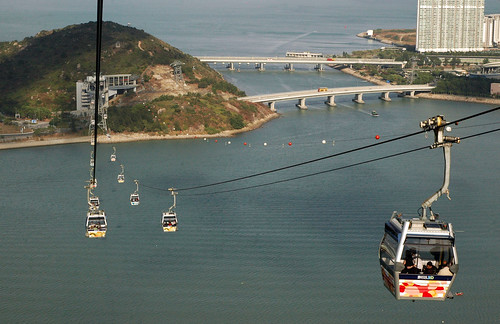
It should not be that expensive just across the river. They could get by constructing just two easily accessible towers, one on each side of the river. Unlike Portland where they went with a single large gondola over rough terrain uphill. Even Six Flags had a gondola style ride across the park for several years, (before the accident.) The site above describes the various types of gondolas and their cost -- the one in Portland was on the expensive end and is now out of favor, according to the author.
This .pdf file has some nice pictures of existing sytems:
http://www.tramway.net/PDF/Role%20of%20 ... nsport.pdf

I took a closer look at all of the presentations tonight. I still prefer the Behnisch plan because it is the most ambitious and potentially transformative concept. That said, the more I looked at each plan, the more I realized each has its merits, even those like the PWP and MVVA plans that aren't nearly as exciting as the others but pay a lot of homage to Saarinen's vision and may be much easier to complete within the specified timeframe.
I do have some quick thoughts about specific design elements. I like the plans that included the extension of the allees into Kiener Plaza, along with the idea of including underground parking beneath the plaza. I also think it's a great idea to reposition the museum entrance as multiple plans suggest, and to use skylights to showcase views of the arch from within the museum and to eliminate the dungeon effect. Getting rid of the north parking garage should be a must- the Behnisch plan including the St. Louis Music Project is especially interesting. I am not quite as enthusiastic, however, about the plans that would eliminate Washington Avenue parallel to Eads Bridge and/or Leanor K. Sullivan Boulevard. There are ways to restrict vehicular movement and parking without eliminating cars from the riverfront altogether.
Perhaps the most encouraging thing about this design competition is the opportunity to reconsider the East St. Louis riverfront and its relation to the Gateway Arch. On this side of the river, I am most impressed with the Weiss-Manfredi plan, which emphasizes pedestrian and cyclist connections to the Missouri side along with passive open space on the Illinois side of the river. A more passive Illinois side is more realistic given the lack of adjacent amenities, and it is a fitting tribute to the idea of westward expansion to have a portion of the parkland that closely emulates its original state as much as possible. I remember reading in one of the narratives about connectivity with the proposed Illinois Highway 3 extension and relocation, and I think completion of that route would not only improve access to the Illinois side amenities, it could also be one more reason to eliminate Interstate 70 through downtown as it will provide a multi-lane connection to Interstate 70 from the Poplar Street Bridge if and when it is completed.
Speaking of the City to River plan to replace the depressed lanes of Interstate 70 with an at-grade Memorial Boulevard, I am encouraged to see that multiple plans acknowledge the proposal and recommend its completion. I'm not surprised to see that it wasn't given more consideration within the plans simply because of the timeline constraints. Still I have to believe that ideally most of the planners involved in these proposals would be adamantly in favor of eliminating what is perhaps the greatest barrier and challenge to linking downtown to the arch grounds and river.
I do have some quick thoughts about specific design elements. I like the plans that included the extension of the allees into Kiener Plaza, along with the idea of including underground parking beneath the plaza. I also think it's a great idea to reposition the museum entrance as multiple plans suggest, and to use skylights to showcase views of the arch from within the museum and to eliminate the dungeon effect. Getting rid of the north parking garage should be a must- the Behnisch plan including the St. Louis Music Project is especially interesting. I am not quite as enthusiastic, however, about the plans that would eliminate Washington Avenue parallel to Eads Bridge and/or Leanor K. Sullivan Boulevard. There are ways to restrict vehicular movement and parking without eliminating cars from the riverfront altogether.
Perhaps the most encouraging thing about this design competition is the opportunity to reconsider the East St. Louis riverfront and its relation to the Gateway Arch. On this side of the river, I am most impressed with the Weiss-Manfredi plan, which emphasizes pedestrian and cyclist connections to the Missouri side along with passive open space on the Illinois side of the river. A more passive Illinois side is more realistic given the lack of adjacent amenities, and it is a fitting tribute to the idea of westward expansion to have a portion of the parkland that closely emulates its original state as much as possible. I remember reading in one of the narratives about connectivity with the proposed Illinois Highway 3 extension and relocation, and I think completion of that route would not only improve access to the Illinois side amenities, it could also be one more reason to eliminate Interstate 70 through downtown as it will provide a multi-lane connection to Interstate 70 from the Poplar Street Bridge if and when it is completed.
Speaking of the City to River plan to replace the depressed lanes of Interstate 70 with an at-grade Memorial Boulevard, I am encouraged to see that multiple plans acknowledge the proposal and recommend its completion. I'm not surprised to see that it wasn't given more consideration within the plans simply because of the timeline constraints. Still I have to believe that ideally most of the planners involved in these proposals would be adamantly in favor of eliminating what is perhaps the greatest barrier and challenge to linking downtown to the arch grounds and river.