385
Full MemberFull Member
385

PostAug 23, 2007#51

jlblues wrote:Well, if this is true they don't seem to have done a very good job on the tracks. It is still a pretty rough ride. The mid speed trains in Europe are smooth as glass in comparison. You could balance champagne glasses in their cars. Amtrak, on the other hand, was like riding on an airplane with severe air turbulence the entire trip. They don't seem to have gotten rid of many of the crossings either, which I thought was part of the plan. No complaints about Amtrak, though. The train was on time with only a few brief unscheduled stops.


This has more to do with the age and lack of maintenance of the rail cars than the condition of the track (though it does play some part). European trains are much more frequently replaced and the newer trains have made leaps and bounds in the areas of suspension technology and rider comfort over older designs (just as automobiles have). That said, most of the European rail system has track that is rated higher than the new 100 mhp track in Illinois. This can also make a big difference as to the smoothness of the ride.


I don't believe that removing crossings was ever part of the plan, but only that these signal crossings would be upgraded with new safety devises. I believe that some of the old crossings didn't even have barriers and relied soley on the lights and bells.

2,821
Life MemberLife Member
2,821

PostAug 23, 2007#52

Thanks for the info! Well then, I hope Amtrak plans on buying new cars, because I'd hate to imagine what it would be like riding on that train going 120 mph. :shock:

3,428
Life MemberLife Member
3,428

PostAug 23, 2007#53

Little Egyptian wrote:
Right, there is a reason Chicago is booming. It has a lot of advantages, but one of the biggest is that it is in Illinois and not in a state like Missouri.


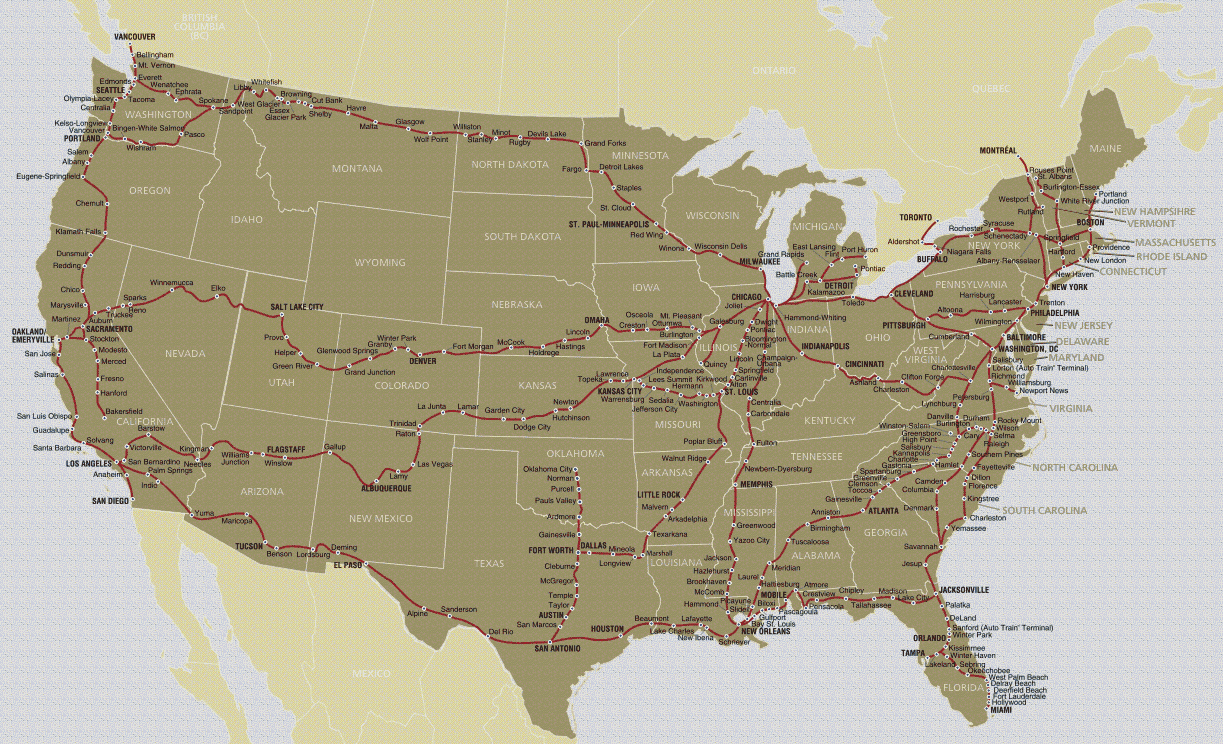
Here is another reason. From the looks of this map, it looks like Illinois requires all AMTRAK trains to go through its biggest city - Chicago. I'm guessing they won't support a train going across the state so people from the central East Coast could bypass Chicago and go through St. Louis to get further West -- a more direct route.


Missouri, on the other hand, allows a train to go from KC directly to Chicago, bypassing the state's biggest city to our detriment.


49
New MemberNew Member
49

PostAug 24, 2007#54

Gary Kreie wrote:
Little Egyptian wrote:
Right, there is a reason Chicago is booming. It has a lot of advantages, but one of the biggest is that it is in Illinois and not in a state like Missouri.


Here is another reason. From the looks of this map, it looks like Illinois requires all AMTRAK trains to go through its biggest city - Chicago. I'm guessing they won't support a train going across the state so people from the central East Coast could bypass Chicago and go through St. Louis to get further West -- a more direct route.


Missouri, on the other hand, allows a train to go from KC directly to Chicago, bypassing the state's biggest city to our detriment.


Out of curiosity, do you have any nonspeculative (i.e., concrete) reason to believe that Illinois requires that trains go through Chicago?

3,428
Life MemberLife Member
3,428

PostAug 25, 2007#55

sda wrote:
Out of curiosity, do you have any nonspeculative (i.e., concrete) reason to believe that Illinois requires that trains go through Chicago?


No, that's why I said "It looks like".


Illlinois is in a position to block any cross-state lines that could allow people from St. Louis and points West to go straight East. I could picture Ohio supporting a line from Cleveland or Pittsburg to Columbus to Cincinnati. But extending it logically to St. Louis might be a hard sell since Illinois may see it as bypassing Chicago even if it benefits mid-state Illinois.

2,327
Life MemberLife Member
2,327

PostAug 27, 2007#56

It's the other way around. There is no requirement. All rail lines lead to Chicago. That's the way the rail system was built in the late 1800s and that's why Chicago IS Chicago.

362
Full MemberFull Member
362

PostAug 27, 2007#57

One of the reasons there are no rail lines in "downstate" Illinois that do not lead to Chicago is the lack of Southern/Ohio cities with Amtrak. If you notice on the map above, Nashville, Columbus, Louisville, and Evansville have no connection. Indy and Cincy only have 1 connection leading to Chicago. If those cities were to have more than 1 connection, there would be an east-west line running through Southern Illinois (besides the City of New Orleans line, the north-south). Those east-west lines would end up in Saint Louis, which is a much more natural rail hub than Chicago is.


If there was a Pittsburgh/Cleveland, Columbus, Cincy, Louisville, Evansville, Carbondale, Saint Louis line, I think Illinois would support it, but I do not think there is a natural track between all those cities.

49
New MemberNew Member
49

PostAug 27, 2007#58

shadrach wrote: All rail lines lead to Chicago. That's the way the rail system was built in the late 1800s and that's why Chicago IS Chicago.

Little Egyptian wrote:


If there was a Pittsburgh/Cleveland, Columbus, Cincy, Louisville, Evansville, Carbondale, Saint Louis line, I think Illinois would support it, but I do not think there is a natural track between all those cities.


not sure i'd agree:


http://upload.wikimedia.org/wikipedia/e ... n_Rail.gif


http://en.wikipedia.org/wiki/Image:Rail ... _16960.png


keep in mind that union station was once the busiest rail termainal in the country. do you really think all of those passengers were connecting through chicago?

11K
Life MemberLife Member
11K

PostAug 27, 2007#59

The rail lines exist to nearly every small town, former grain depot in the nation. What doesn't exist is Amtrak service along those lines. With the great increase in goods being transported via rail, there is less space for passenger rail. A massive investment will be needed to provide capacity for both. Maybe, just maybe if it put forth in terms of "helping American business" (and maybe even security) that investment will be made.

362
Full MemberFull Member
362

PostAug 27, 2007#60

^^^I agree there are rail lines to every small town, but I am not sure all of those could accommodate Amtrak, even if they wanted to put in a line. Amtrak always seems to follow fairly major rail lines that are regularly maintained. All those lines in the country would need a serious upgrade before they could handle passenger rail, especially anything at high speed. Plus, many rail lines in small towns are being abandoned as the grain industry consolidates and ships more cargo by truck to ports, like Saint Louis. Also, individual farmers are beginning to ship their own grain, so there is less reliance on local granaries. But, you are right, many rail lines are still there they just need improvement.


But, I think I would oppose any more major investment in Amtrak, such as new lines. I am fine maintaining what we have at present, but it is an outdated system and will never be profitable. What we need is a viable alternative mass transit system for city to city trips. If I am going from Saint Louis to Denver, I am flying (Frontier by the way). The only time I would consider taking the train is from StL to KC, Indy, Chicago, Memphis or shorter trips like that where waiting in line and getting my shoes checked at the airport is just not worth it. That is the only place Amtrak even has a chance at working in the air travel era.


So, you have to think about designing a system to function in that era, not a system that functioned well in the past. Also, you have to think about a system for a population that is addicted to individual mobility. I don't care what they do in Europe, I am never, never giving up the freedom that my individual car provides me (plus, I am not really fond of walking where I need to go in Memphis). Within those kinds of constraints, we have to think about redesigning the transportation system.


So, here is a possibility or example of what might work in today's world given the constraints we are faced with. Think about this: integrated rail/car capability. We need personal transport vehicles that can function like a train and like a car. You have seen those trucks of the rail companies that run both on rails and on tires, well, like that only high speed when on rail and the rail would be elevated and designed both with clean energy and for extremely high speeds. When in town, you use the gas/electric/hydrogen (right, eh) engine like a normal car. But, if you wanted to go to KC, you go to the station, buy a $5 pass, and then transition to the passenger dedicated rail, which is high speed (100 mph or so to start and up from there). Since everyone would be going the same speed to the same destination in the same direction (two accompanying lines), there would be: (1) limited traffic issues, (2) more safety on the highways because it would be mostly trucks using them in the rural areas, (3) vastly reduced carbon-fuel dependence, (4) increased productivity (like a train you can work while you travel, not to mention the time saved, (5) massive new investment in cities around the transportation centers (if you want McDonalds you would have to get it before you go in the city), (6) etc. etc. etc. When approaching the destination, the lines would split off, the transports would slow down and exit the rail line and function like cars again.


Given what we could potentially save on highway construction and fuel costs, you could probably almost pay for it. Plus, at $5 or more dollars per toll, you could generate a lot of money very quickly. But, of course, like the Interstates, it would be an investment in our future as a nation, so the long term returns would massively outweigh the initial costs.


Anyway, that is just a possibility I have thought of (yeah when bored at work and based on observations of various Discovery channel programs). But, that is what we need. A major change like that to the transportation system instead of putting more investment in Amtrak, which will never be high speed and will never be profitable. Sorry, dreaming big on a Monday.

2,687
Super ModeratorSuper Moderator
2,687

PostAug 27, 2007#61

Little Egyptian wrote:One of the reasons there are no rail lines in "downstate" Illinois that do not lead to Chicago is the lack of Southern/Ohio cities with Amtrak. If you notice on the map above, Nashville, Columbus, Louisville, and Evansville have no connection. Indy and Cincy only have 1 connection leading to Chicago. If those cities were to have more than 1 connection, there would be an east-west line running through Southern Illinois (besides the City of New Orleans line, the north-south). Those east-west lines would end up in Saint Louis, which is a much more natural rail hub than Chicago is.


If there was a Pittsburgh/Cleveland, Columbus, Cincy, Louisville, Evansville, Carbondale, Saint Louis line, I think Illinois would support it, but I do not think there is a natural track between all those cities.


Does Kentucky support Amtrak rail? That would be my biggest question. Considering the small number of train stations in Kentucky currently, and absolutely nothing in Louisville, I would say a line east, from St. Louis, would have the issue of encouraging a state with little Amtrak presence, to expand from virtually nothing.


The other question would be, do people in St. Louis go to that part of the country, enough to provide service to it?

49
New MemberNew Member
49

PostAug 27, 2007#62

Little Egyptian wrote:
But, I think I would oppose any more major investment in Amtrak, such as new lines. I am fine maintaining what we have at present, but it is an outdated system and will never be profitable. What we need is a viable alternative mass transit system for city to city trips. If I am going from Saint Louis to Denver, I am flying (Frontier by the way). The only time I would consider taking the train is from StL to KC, Indy, Chicago, Memphis or shorter trips like that where waiting in line and getting my shoes checked at the airport is just not worth it. That is the only place Amtrak even has a chance at working in the air travel era.


Generally, that's right. High-speed trains most often make sense for trips of 400 or so miles or less. See, e.g.:


From: http://en.wikipedia.org/wiki/High-speed_rail


"Aircraft: Optimal Distance


While commercial high-speed trains have maximum operating speeds much slower than jet aircraft, they have advantages over air travel mostly for relatively short distances, and can be an integral part of any good transportation system. Both systems complement each other if they are well designed and maintained. . . .


When traveling less than about 650 km (400 mi), the process of checking in and going through security screening at airports, as well as the journey to the airport itself makes the total journey time comparable to HSR."


The important thing to think about in this respect is how this mode of transit can help St. Louis improve its position as a regional economic hub. We are fortunate to have a significant percentage of the country's population within 450 or so miles, including those who live in the Chicago, Milwaukee, Des Moines, Omaha, Springfield, Little Rock, Tulsa, Witchita, Memphis, Louisville, Indianapolis, Cincinnati, Columbus, Cleveland, Detroit, Dallas, Minneapolis, and Atlanta regions.

1,099
Expert MemberExpert Member
1,099

PostAug 27, 2007#63

^^ From 1999 until 2003, there used to be Amtrak from Indianapolis to Louisville, the Kentucky Cardinal, but it ran at a pathetic 30 mph.

710
Senior MemberSenior Member
710

PostAug 27, 2007#64

Xing wrote:
Little Egyptian wrote:One of the reasons there are no rail lines in "downstate" Illinois that do not lead to Chicago is the lack of Southern/Ohio cities with Amtrak. If you notice on the map above, Nashville, Columbus, Louisville, and Evansville have no connection. Indy and Cincy only have 1 connection leading to Chicago. If those cities were to have more than 1 connection, there would be an east-west line running through Southern Illinois (besides the City of New Orleans line, the north-south). Those east-west lines would end up in Saint Louis, which is a much more natural rail hub than Chicago is.


If there was a Pittsburgh/Cleveland, Columbus, Cincy, Louisville, Evansville, Carbondale, Saint Louis line, I think Illinois would support it, but I do not think there is a natural track between all those cities.


Does Kentucky support Amtrak rail? That would be my biggest question. Considering the small number of train stations in Kentucky currently, and absolutely nothing in Louisville, I would say a line east, from St. Louis, would have the issue of encouraging a state with little Amtrak presence, to expand from virtually nothing.


The other question would be, do people in St. Louis go to that part of the country, enough to provide service to it?


i don't know. i only saw one other missouri plate driving between cinci/louisville on I-64 and st. louis city today. quite a difference from I-55 north or I-70 east. saw none on I-64 between lexington, ky and the shenandoah valley. mo cars in maryland on the more northerly "federal highway" however.

11K
Life MemberLife Member
11K

PostAug 27, 2007#65

^ Driving to Cincinnati I see many more MO plates when I go through Indy than when taking the Louisville route.

3,428
Life MemberLife Member
3,428

PostAug 30, 2007#66

There are plenty of existing tracks east of St. Louis to Indianapolis, Cincinnatti, and Columbus.


11K
Life MemberLife Member
11K

PostAug 30, 2007#67

Of course I'd like to see StL as the high-speed hub of the midwest, but Chicago is the most popular destination and Indy is most centrally located. Unfortunately there doesn't seem to be the ridership needed to build high speed connecting Nashville, Cincinnati, Columbus, Indy, St. Louis, Chicago, Memphis, Detroit, Cleveland, etc. At least if it were to come down to Indy v. St. Louis I'd give our statehouse an even shot!

46
New MemberNew Member
46

PostSep 06, 2007#68

That map can be deceiving. Yes, there are plenty of lines, but what shape are they in and what traffic do they carry?


Let's consider St. Louis-Cincinnati: The direct route is the old B&O, now CSX line, which carried the likes of the National Limited, Diplomat and the Metropolitan Special in the old days. The line is still in use, but would have to be upgraded for apssenger speeds and has little on line population.


The other route might be the former Pennsylvania (now CSX) to Indianapolis and from there to Cincinnati via another old B&O line via Hamilton, OH, a slow affair used by Amtrak's Cardinal. The other Indy-Ciny possibility is the near-defunct ex-New York Central Big Four route, which is wedgrown and downgraded. The bright spot here is that it's rumored to be upgraded to access an auto plant.


The third line is via the ex-Southern RR St. Louis to Louisville, which is an unsignalled line, which by law is restricted to no more than 59 mph for safety reasons. From Louisville to Cincinnati we'd have to use the ex L&N (CSX), a really congested and hilly ride.


Problems everywhere and no easy solutions. I think the best thing to do would be to throw everything into getting Chicago-Springfield-St. Louis up to a top speed of 110 mph, with at least 10 daily trains and ramping up St. Louis-Kansas City to six daily trains operating at an average speed of 60 mph (79 mph top speed.


The success of these two corridors will lead to a call for more and THEN we will have the oomph to start taking a serious look at now routes and services.


We were stupid enough to throw away the best rail passenger service in the world and it will take years to replace it.

2,327
Life MemberLife Member
2,327

PostSep 06, 2007#69

^WOW! And I thought I was a train geek!! Good job, Eastside Willie.


And I wish the National Limited still ran across the country (starting in Omaha like the original Wabash (?) route.)

49
New MemberNew Member
49

PostSep 06, 2007#70

Eastsidewillie wrote:I think the best thing to do would be to throw everything into getting Chicago-Springfield-St. Louis up to a top speed of 110 mph, with at least 10 daily trains and ramping up St. Louis-Kansas City to six daily trains operating at an average speed of 60 mph (79 mph top speed.


The success of these two corridors will lead to a call for more and THEN we will have the oomph to start taking a serious look at now routes and services.


We were stupid enough to throw away the best rail passenger service in the world and it will take years to replace it.


From a practical perspective, I think this makes a great deal of sense.

46
New MemberNew Member
46

PostSep 06, 2007#71

The one glaring omission in the national "system" (I use that word very loosely) is the lack of direct service from St. Louis to the east. That died in 1979 when the National Limited (the Amtrak incarnation) came off.


If we are to resore this, I think the two best things might be:


1) An Indianpolis-St. Louis-Kansas City section of the New York-Washington-Cincinnati-Indianapolis-Chicago "Cardinal." This could be done by assuming one existing STL-KCY round trip between those cities, which means we only have to pay operating costs between Indy and St. Lou.


Here we have good track all the way. The problem is equipment. Amtrak has barely enough to meet current needs, let alone something like this, which would probably require 20 cars or more, plus locomotives. That's a major stumbling block.


2) Service to the east St. Louis-Indianapolis-Cleveland-Buffalo-New York, by dovetailing with existing New York-Buffalo trains. Again, good track, but not enough equipment.


Both of these should be done if St. Louis is to be the gateway it should be. Just goes to show that once you lose something, you may find it very difficult to get it back!

49
New MemberNew Member
49

PostSep 06, 2007#72

Eastsidewillie wrote:The one glaring omission in the national "system" (I use that word very loosely) is the lack of direct service from St. Louis to the east. That died in 1979 when the National Limited (the Amtrak incarnation) came off.


When you look at the national map posted by Gary, this absence is indeed glaring.


Any speculation on what a passenger traveling, say, from Washington to Kansas City (assuming your NYC/DC/...KC line is established) might save by traveling directly from Indianapolis to St. Louis instead of going through Chicago?

46
New MemberNew Member
46

PostSep 06, 2007#73

An Indy-KC passenger would save many hours over going via Chicago. A passenger would have to take the Hoosier State, leaving Indy at 630 am, layover at Chicago and arrive Kansas City at 1011 pm, a trip of close to 16 hours. Pretty grueling.


If we had a direct route IND-STL-KCY, we'd probably have about a ten hour running time.


Interestingly, Amtrak had a thru coast-to-coast sleeper and coach that ran from New York on the National Limited and was handed off to the Southwest Chief at Kansas City for the trip west. This ran for a number of years.


If we had a schedule from the east that got us into St. Louis in the afternoon, the train could continue west, assuming the schedule of the afternoon KC Mule and connect at KC with the SW Chief again. Thru cars could be a possibility as well.

PostSep 08, 2007#74

I don't wanna hog the conversation here, but I do want to add one more thing and that is the historical pattern of train service to St. Louis. If we look at service before the mid-1960's, long distance traind from the east arrived in St. Louis in the early afternoon, in time to connect with Trains to the west.


This pattern played to St. Louis's role as a gateway city of national importance and it's something local leaders should be thinking about. St. Louis is not playing that role now and is really just a stop on the way to Texas from Chicago.


Trains from the east included the Pennsylvania Railroad's New York-St. Louis Spirit of St. Louis and Penn-Texas, which carried thru cars to Texas and even Mexico City, B&O's national Limted and the Diplomat, which also carried thru cars, as well as New York Central's Southwestern Limited and the Knickerbocker.


Trains to the west included Missouri Pacific's Texas Eagle, which was the dominant route west and ran in two sections, one to Dalls-Ft. Worth-El Paso and another to Houston/San Antonio-Laredo, with thru cars to Mexico City. The Frisco offered the Meteor to Tulsa and Oklahoma City and the Texas Special to Dallas, Ft. Worth and San Antonio.


A lot of service and I'm just scratching the surface here. If you are interested in more, see the book "Twilight of the Great Trains" by Fred Frailey. It has a fascinating look at what MoPac offered in 1956 and an account of the activity at Little Rock in 1960. An amazing amount of service and fascinating reading!


Anyhow, getting back to my reason for writing all this: St. Louis needs to do wahtever it can to reposition itself as not only an important gateway for air travel, but for rail as well. If trains came back, a lot of new jobs could be created.

49
New MemberNew Member
49

PostSep 08, 2007#75

Eastsidewillie wrote:
Anyhow, getting back to my reason for writing all this: St. Louis needs to do wahtever it can to reposition itself as not only an important gateway for air travel, but for rail as well. If trains came back, a lot of new jobs could be created.


Very interesting post.


The key, it seems to me, is upgrading both regional and national rail infrastructure to make high-speed rail travel a practical alternative, in terms of travel time, to air travel. Once this occurs, St. Louis could leverage both its central location and existing track placement and emerge as the gateway you describe, beyond what the Midwest High Speed Rail Initiative currently proposes.


Anyone have any insight on how best to go about making this happen? Best approached at the federal or state level? Or both?

Read more posts (167 remaining)