

That was in the infrastructure bill. Dunno if it been undone.
One of the vehicles I drive for work displays the speed limit of whatever street I'm driving on (not always accurately). It would be simple to send that info to the engine, but I suspect all kinds of other real-life issues would complicate things.
A friend of mine had a court-ordered breathalyzer ignition lock on his car for a while.JaneJacobsGhost wrote: ↑Nov 02, 2025You could also make cars verify the operator is not intoxicated before operating
New cars have radar and distance control/adaptive cruise. My car also had semi autonomous driving. Not sure how a QR code would help. The other suggestions are awfully Orwellian. Drivers with DWI offenses already get interlock/breathalyzer devices in their cars.
I wrote a piece in 2012 for the Post journal on car-to-car and car-to-infrastructure coms. Can’t believe it hasn’t happened yet. But a QR code viewed with video could be better for now. No delay. No dependence on cell or WiFi signals.
And QRs could pass info learned learn the car ahead or behind to the next car ahead or behind. Current adaptive cruise can't do that. The only comms between cars now is your 1-bit horn or your 1-bit brake/turn lights. We currently use our horn to communicate with other cars. 1) tiny beep means wake up politely, 2)long beep means GO or, you cut me off, 3)two short beeps usually means, hello to someone you know, 4) Mexican Hat Dance played by some horns means -- don't know what that means.
Sent from my iPhone using Tapatalk
And QRs could pass info learned learn the car ahead or behind to the next car ahead or behind. Current adaptive cruise can't do that. The only comms between cars now is your 1-bit horn or your 1-bit brake/turn lights. We currently use our horn to communicate with other cars. 1) tiny beep means wake up politely, 2)long beep means GO or, you cut me off, 3)two short beeps usually means, hello to someone you know, 4) Mexican Hat Dance played by some horns means -- don't know what that means.
Sent from my iPhone using Tapatalk


The current approach of giving motorists the free will to violate vehicle safety laws enforced by tank operating, gun wielding cops that have the constitutional right to shoot you to death with qualified immunity is FAR MORE Orwellian than programming cars not to speed.moorlander wrote: ↑Nov 03, 2025New cars have radar and distance control/adaptive cruise. My car also had semi autonomous driving. Not sure how a QR code would help. The other suggestions are awfully Orwellian. Drivers with DWI offenses already get interlock/breathalyzer devices in their cars.

Focus: Uber and Nvidia teamed up last week to create a fleet of 'Level 4-ready' cars, 100,000 strong, beginning in 2027... What we currently drive is 'Level 0', fully human controlled; 'Level 5' is Full Self-Driving. 'Level 4' equates to a Waymo robotaxi. FYI GM's "Super Cruise" and Tesla's "Autopilot" operate at 'Level 2'.
Trump killed all work on this in his first term as over-regulation. But I think we'll see it in China before the end of this decade.quincunx wrote: ↑Nov 02, 2025That was in the infrastructure bill. Dunno if it been undone.
I'd settle for crashless cars over self-driving cars. I can't crash the little cars that drive around a track at six flags, even though I'm "driving". We have the tech to do the equivalent with comms and cameras now for real cars. So sad when tech doesn't stop someone from going the wrong way down an interstate ramp and kills people.gone corporate wrote: ↑Nov 03, 2025
Focus: Uber and Nvidia teamed up last week to create a fleet of 'Level 4-ready' cars, 100,000 strong, beginning in 2027... What we currently drive is 'Level 0', fully human controlled; 'Level 5' is Full Self-Driving. 'Level 4' equates to a Waymo robotaxi. FYI GM's "Super Cruise" and Tesla's "Autopilot" operate at 'Level 2'.
So if Speed Limit signs also had a QR code, it could be accurate every time. QR codes embed a digital checksum that guarantees the message was either received correctly and completely, or not received at all.framer wrote: ↑Nov 02, 2025quincunx wrote: ↑Nov 02, 2025I'd like cars to know the speed limit and not exceed it.
One of the vehicles I drive for work displays the speed limit of whatever street I'm driving on (not always accurately). It would be simple to send that info to the engine, but I suspect all kinds of other real-life issues would complicate things.
I suppose as a redundant means for resiliency. The scooters know their speed limit without such a thing.
QR codes are super easy to alter/hack, and malicious alteration is difficult to spot at a glance. I like the idea but solving for the misuse cases would be a difficult challenge.
I favor something like GM's V2V network communication protocol as an industry standard, and extending that by integrating a DoT transponder digitally communicating real-time broadcasts of speed limits, red lights, blocked lanes, crashes & closures, etc. could have real value. That said, it would require a significant investment in a complex infrastructure, as well as cooperation between both private and government infrastructure developers, which also seems a difficult challenge to overcome.
While we're thinking wishfully I'd love to see an effort to build a standard for a 'panic braking' brake light - something to supplement standard brake lights that differentiates a gradual slowing down from someone slamming on the brakes. All new cars have all the sensor data to detect a panic braking event - use that to grab the attention of nearby drivers by using additional brake lights, flashing brake lights, another color light, or maybe even an audible signal. Autonomous driving vehicle sensors could be trained to detect and identify those panic signals and respond accordingly.
-RBB
I favor something like GM's V2V network communication protocol as an industry standard, and extending that by integrating a DoT transponder digitally communicating real-time broadcasts of speed limits, red lights, blocked lanes, crashes & closures, etc. could have real value. That said, it would require a significant investment in a complex infrastructure, as well as cooperation between both private and government infrastructure developers, which also seems a difficult challenge to overcome.
While we're thinking wishfully I'd love to see an effort to build a standard for a 'panic braking' brake light - something to supplement standard brake lights that differentiates a gradual slowing down from someone slamming on the brakes. All new cars have all the sensor data to detect a panic braking event - use that to grab the attention of nearby drivers by using additional brake lights, flashing brake lights, another color light, or maybe even an audible signal. Autonomous driving vehicle sensors could be trained to detect and identify those panic signals and respond accordingly.
-RBB


That would be good. And video in following cars could decipher that too. I’d still like to go to something digital rather than analog for instant error checking with checksums. On V2V, all messages were defined in IEEE standards 12 years ago. But I wonder if 802.11p or cell phones have too much lag or reliability issues. That’s why I was thinking of direct car to video digital.rbb wrote:QR codes are super easy to alter/hack, and malicious alteration is difficult to spot at a glance. I like the idea but solving for the misuse cases would be a difficult challenge.
I favor something like GM's V2V network communication protocol as an industry standard, and extending that by integrating a DoT transponder digitally communicating real-time broadcasts of speed limits, red lights, blocked lanes, crashes & closures, etc. could have real value. That said, it would require a significant investment in a complex infrastructure, as well as cooperation between both private and government infrastructure developers, which also seems a difficult challenge to overcome.
While we're thinking wishfully I'd love to see an effort to build a standard for a 'panic braking' brake light - something to supplement standard brake lights that differentiates a gradual slowing down from someone slamming on the brakes. All new cars have all the sensor data to detect a panic braking event - use that to grab the attention of nearby drivers by using additional brake lights, flashing brake lights, another color light, or maybe even an audible signal. Autonomous driving vehicle sensors could be trained to detect and identify those panic signals and respond accordingly.
-RBB
Sent from my iPhone using Tapatalk

Saw in biz journal that Nvidia chief was in St Louis this week for the computer conference at Americas Center.
By the way, a St Louis conference played a role in the invention of the blue LED which led to the white LED. In 1992, Shuji Nakamura presented his prototype blue LED at the first international conference on nitrides held in St. Louis, Missouri, and received a standing ovation. At the time, his invention was groundbreaking because it was the first efficient blue LED to be shown, marking a major step toward the development of white LEDs and other applications like blue laser diodes, for which he later won the Nobel Prize in Physics in 2014.
Sent from my iPhone using Tapatalk
By the way, a St Louis conference played a role in the invention of the blue LED which led to the white LED. In 1992, Shuji Nakamura presented his prototype blue LED at the first international conference on nitrides held in St. Louis, Missouri, and received a standing ovation. At the time, his invention was groundbreaking because it was the first efficient blue LED to be shown, marking a major step toward the development of white LEDs and other applications like blue laser diodes, for which he later won the Nobel Prize in Physics in 2014.
Sent from my iPhone using Tapatalk
Talton sent these out in a press release.
Let's hope that white box shown to the south becomes something.

Let's hope that white box shown to the south becomes something.

Iris Apartments - Conditional Use Hearing - filed by Arcturis
Scheduled January 15th
"AB-587176-25 & AB-587667-25 – Arcturis, c/o, John Prather, has applied to construct multi-family mixed-use building and parking lot per plan at: 4108-12 Clayton Ave. & 4148 Clayton Ave. WARD 9 ZONE: “H” – Area Commercial District "
Scheduled January 15th
"AB-587176-25 & AB-587667-25 – Arcturis, c/o, John Prather, has applied to construct multi-family mixed-use building and parking lot per plan at: 4108-12 Clayton Ave. & 4148 Clayton Ave. WARD 9 ZONE: “H” – Area Commercial District "
Tarlton has set up a field-office at the Iris apartments site. Hopefully a Spring groundbreaking
The most ridiculously delayed project in all of STL. I mean that in the sense that the success/ROI is obvious and the land is clear. Should be on phase 3 right now.
Iris, a.k.a., Cortex K, is confirmed under construction!
STL Biz Journal: Keeley Properties breaks ground on $37M mixed-use Cortex development
![]()
STL Biz Journal: Keeley Properties breaks ground on $37M mixed-use Cortex development
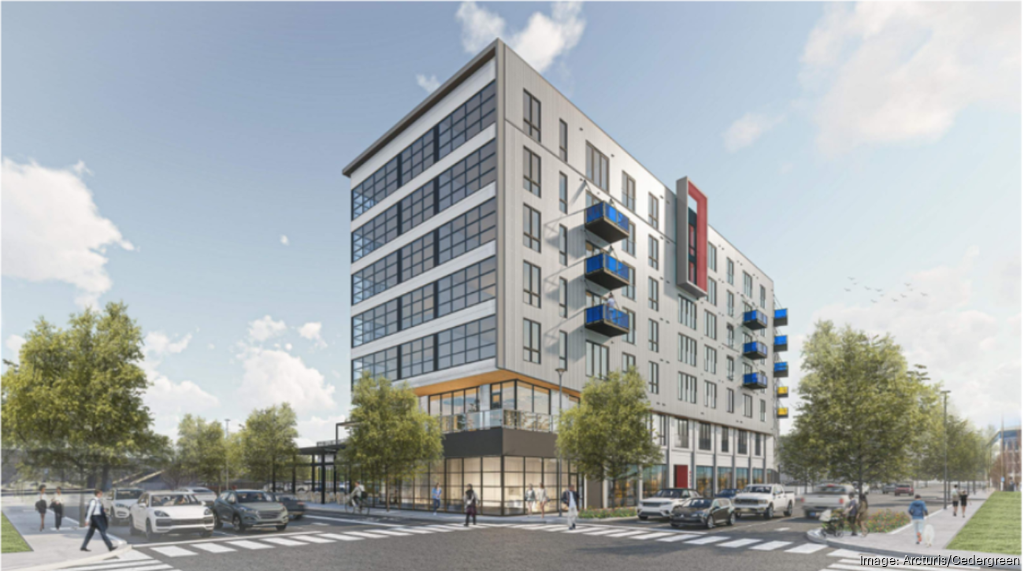
Keeley Properties has broken ground on the Cortex Innovation District's first new‑construction residential project, which has been in the works for years.
Located at 4108 Clayton Ave. near the Cortex MetroLink station, the mixed-use development, named Iris, will have ground-floor retail space and 174 apartments, 17 of which will be classified as affordable housing.
The project is a $37.4 million development, a Cortex spokesperson said Tuesday.