

The people who’s job is to solve it would be on top of the list.leeharveyawesome wrote: ↑Jan 04, 2020Who would you say is responsible for the very poor solve rate, if anyone? Maybe it's just dumb luck and a statistical anomaly.
To be fair, "solving" a crime and having someone successfully prosecuted for a crime are two different things. Either can be inept leading to seeming failures for the other. The one thing that seems to be indisputable here is that there has been a dramatic drop in successful murder convictions.
That aside, this has been a particularly violent start to the year comparatively speaking for StL, but unfortunately I am in the camp that sees this as much more of a legislative/societal/national issue. Do I want to see people getting killed? Certainly not. But until people start voting for things that actively discourage this, it's not going to get any better.
FWIW I feel as safe as I ever have and I've lived in the city in 5 different decades now (hooray for apparently dodging bullets so well!
 )
)The wash Ave shooting apparently was an argument inside a car between 2 person that knew each other and as we’ve seen too often, people settle those with guns in this town. Shooter dumped the body out of the car and drove off
I never conflated the too, I know the difference. Lack of convictions also hinges on the quality of investigation by the detectives. Low convocation rate is a shared blame between CAO and PD. The clearance rate is solely on the PDnewstl2020 wrote: ↑Jan 05, 2020To be fair, "solving" a crime and having someone successfully prosecuted for a crime are two different things. Either can be inept leading to seeming failures for the other. The one thing that seems to be indisputable here is that there has been a dramatic drop in successful murder convictions.
)

If you look at the statistics, Gardner's office has something to do with the lack of prosecutions.
In 2016 (Joyce's last year), 0 cases were refused by the Prosecuting Attorney's office.
In 2017 (Gardner's first year), 0 cases were refused by the Prosecuting Attorney's office.
In 2018, 7 cases were refused by the Prosecuting Attorney's office.
In 2019, 12 cases were refused by the Prosecuting Attorney's office.
In 2016 (Joyce's last year), 0 cases were refused by the Prosecuting Attorney's office.
In 2017 (Gardner's first year), 0 cases were refused by the Prosecuting Attorney's office.
In 2018, 7 cases were refused by the Prosecuting Attorney's office.
In 2019, 12 cases were refused by the Prosecuting Attorney's office.
^Maybe, but it's hard to make out much from that without knowing why the cases were refused and what else might have changed in the same period of time. We also got a new mayor and police chief in 2017. There was a lot of churn in the department, if I understand correctly, and there have been plenty of allegations bandied about and lots of finger pointing. Were the cases good? Was the evidence solid and untainted? Were there any commonalities between all the cases? (Same officers reporting, or some such.) There's a lot that could be at play here. Maybe Gardner bears some part of the responsibility, but it's hard for me to say from some very naked (and quite small) numbers. It's such a complicated problem that I would be really surprised if the blame all lies in one place. And really . . . the root cause of the problem is almost certainly longstanding systematic injustice. No amount of policing will solve an economic and social problem.
This directly correlates with the current beef between her office and Pd, she started to refuse cases from officers with credibility issues- I mean how many officers got charged, plead guilty or found guilty in 2019 alone? 20?gregl wrote: ↑Jan 05, 2020If you look at the statistics, Gardner's office has something to do with the lack of prosecutions.
In 2016 (Joyce's last year), 0 cases were refused by the Prosecuting Attorney's office.
In 2017 (Gardner's first year), 0 cases were refused by the Prosecuting Attorney's office.
In 2018, 7 cases were refused by the Prosecuting Attorney's office.
In 2019, 12 cases were refused by the Prosecuting Attorney's office.
St. Louis Considers Bringing Back Red-Light Cameras, But Experts Say It Might Not Help
https://news.stlpublicradio.org/post/st-louis-considers-bringing-back-red-light-cameras-experts-say-it-might-not-help
https://news.stlpublicradio.org/post/st-louis-considers-bringing-back-red-light-cameras-experts-say-it-might-not-help
Waelterman said he’s particularly concerned about people speeding in school zones, as well as accidents along thoroughfares such as Grand and Kingshighway boulevards. He said drivers have been clocked exceeding 100 mph on city streets.
St. Louis has higher rates of car accidents than many cities with similar characteristics, according to a study by the East-West Gateway Council of Governments.
“You watch these people that just have no care in the world, blowing these lights blatantly,” he said.
I love how the professor from Montana thinks that lowering speed limits will influence the human garbage that drives 100 mph on a 25 mph street. Not that the cameras will help either since laws aren't enforced anymore.[Gallagher] said that changing speed limits, lane widths and median locations might be better ways to make streets safer.
I fancy myself as something of an expert in this field and the good professor is correct, and to be fair he didn’t say just the speed limit- it’s speed limit together with a few other things. Red light cameras will not improve safety, I looked at the data for accidents at interactions before and after cameras and there is nothing there to point that they’re helping improve safety. Now with that said, sure let’s bring them back BUT 100% of the revenue has to be into systematic improvements that will actually lower accidents and improve safety.urban_dilettante wrote: ↑Jan 05, 2020St. Louis Considers Bringing Back Red-Light Cameras, But Experts Say It Might Not Help
https://news.stlpublicradio.org/post/st-louis-considers-bringing-back-red-light-cameras-experts-say-it-might-not-help
Waelterman said he’s particularly concerned about people speeding in school zones, as well as accidents along thoroughfares such as Grand and Kingshighway boulevards. He said drivers have been clocked exceeding 100 mph on city streets.
St. Louis has higher rates of car accidents than many cities with similar characteristics, according to a study by the East-West Gateway Council of Governments.“You watch these people that just have no care in the world, blowing these lights blatantly,” he said.I love how the professor from Montana thinks that lowering speed limits will influence the human garbage that drives 100 mph on a 25 mph street. Not that the cameras will help either since laws aren't enforced anymore.[Gallagher] said that changing speed limits, lane widths and median locations might be better ways to make streets safer.
StlToday - Crime data doesn’t support celebrated St. Louis police strategy
https://www.stltoday.com/news/local/cri ... 8c56d.html
https://www.stltoday.com/news/local/cri ... 8c56d.html
Shooting at Gringo on wash Ave tonight but this one was of accidental variety, in the men’s room. Employees gun discharged, killing him
sounds good to me.dbInSouthCity wrote: ↑Jan 05, 2020Now with that said, sure let’s bring them back BUT 100% of the revenue has to be into systematic improvements that will actually lower accidents and improve safety.
and, yeah, physical barriers can be more effective than cameras. but muni's are scared to emplace barriers that would actually do any good because people who plow their cars into sh*t then turn around and sue for property damage. even so, there's only so much that can be done with physical barriers. and the guy in the stolen car probably doesn't give a sh*t about what/who he mows down, so consistent enforcement is still necessary.
Making the road 10 feet wide vs 12, speed humps, bike lanes, road diets. All proven to work with no physical “barrier” and for the person with a stolen car, the red light camera isn’t exactly going to do much.urban_dilettante wrote: ↑Jan 06, 2020sounds good to me.dbInSouthCity wrote: ↑Jan 05, 2020Now with that said, sure let’s bring them back BUT 100% of the revenue has to be into systematic improvements that will actually lower accidents and improve safety.
and, yeah, physical barriers can be more effective than cameras. but muni's are scared to emplace barriers that would actually do any good because people who plow their cars into sh*t then turn around and sue for property damage. even so, there's only so much that can be done with physical barriers. and the guy in the stolen car probably doesn't give a sh*t about what/who he mows down, so consistent enforcement is still necessary.

Curious what people think about why the crime problem is so persistent here. Is it really a combination of our state gun laws and the residency requirement, as our electeds seem to think? Or is there something else going on? I recently read that Chicago has had steady reductions in homicides over the past few years.

Fentanyl and its industry is large in St. Louis second only to Chicago
Fentanyl Inc by Ben Westhoff St. Louis is quoted in his book
https://www.amazon.com/Fentanyl-Inc-Che ... 0802127436
Fentanyl Inc by Ben Westhoff St. Louis is quoted in his book
https://www.amazon.com/Fentanyl-Inc-Che ... 0802127436
Homicides are down 40% in Chicago over the last 3 years.JacksonPolyp wrote: ↑Jan 06, 2020Curious what people think about why the crime problem is so persistent here. Is it really a combination of our state gun laws and the residency requirement, as our electeds seem to think? Or is there something else going on? I recently read that Chicago has had steady reductions in homicides over the past few years.
to clarify, by physical barriers i mean objects that nominally deter speeding by increasing the likelihood of collisions at high speeds, not impassable obstacles. curbs, bollards, speed humps, parked cars, etc. all fall into this category. but, again, these things only work on drivers who care about not plowing into stuff. and speed humps are commonly softened to the point that they don't do much good anyway (as is the case with the one directly in front of my house). there are, apparently, quite a few in STL that are more than happy to plow into whatever, and in those cases the cameras, while not a deterrent, could at least provide information. not saying it's the final solution but it's another tool. i really don't like the idea of using bike lanes to slow traffic because it puts people's lives at risk based on the assumption that drivers give a damn, which they don't.dbInSouthCity wrote: ↑Jan 06, 2020Making the road 10 feet wide vs 12, speed humps, bike lanes, road diets. All proven to work with no physical “barrier” and for the person with a stolen car, the red light camera isn’t exactly going to do much.
this sort of thing, for example,
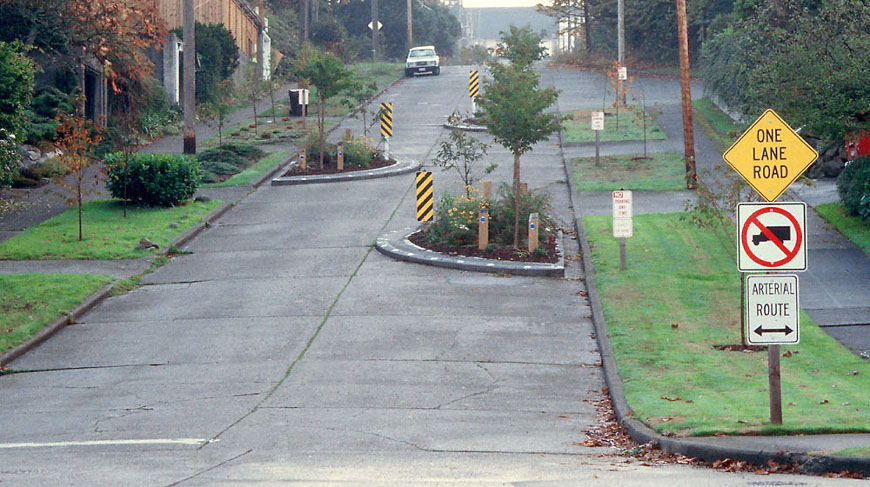
could be implemented widely with simple, cheap concrete bollards
to narrow roads and introduce curvature so that it's not physically possible to navigate at high speeds.
Sometimes, this stuff hits close to home.
A coworker's daughter was murdered Saturday night in ESL. Not sure of the circumstances and I know that she had problems but still hard to hear the news.
A coworker's daughter was murdered Saturday night in ESL. Not sure of the circumstances and I know that she had problems but still hard to hear the news.

Poverty has a lot to do with the gun violence.
How do you "slow" down the rate of poverty. Well one place to start is the 800 pound gorilla in the room that no one seems to want to address and that is the number of
teenage pregnancies, pregnancies in which the couple have no real relationship other than a role in the hay, the lack of use of birth control and the ability to obtain birth
control at reduced cost or free. The lack of the male role model in the home. etc. etc. etc.
My significant other has worked in public housing all over the city and county so I have a had a unique prospective as to what he sees everyday.
A 15 year old getting pregnant is like a 15 year old getting a cold. Everyday normal occurrence. There are behind the 8 ball before they even graduate high school.
How do you "slow" down the rate of poverty. Well one place to start is the 800 pound gorilla in the room that no one seems to want to address and that is the number of
teenage pregnancies, pregnancies in which the couple have no real relationship other than a role in the hay, the lack of use of birth control and the ability to obtain birth
control at reduced cost or free. The lack of the male role model in the home. etc. etc. etc.
My significant other has worked in public housing all over the city and county so I have a had a unique prospective as to what he sees everyday.
A 15 year old getting pregnant is like a 15 year old getting a cold. Everyday normal occurrence. There are behind the 8 ball before they even graduate high school.
this would be relevant if it was the 1980-1990s....teen pregnancies are at 17 per 1000 female teens vs 61 per 1000 in the 1990sRooster wrote: ↑Jan 06, 2020Poverty has a lot to do with the gun violence.
How do you "slow" down the rate of poverty. Well one place to start is the 800 pound gorilla in the room that no one seems to want to address and that is the number of
teenage pregnancies, pregnancies in which the couple have no real relationship other than a role in the hay, the lack of use of birth control and the ability to obtain birth
control at reduced cost or free. The lack of the male role model in the home. etc. etc. etc.
My significant other has worked in public housing all over the city and county so I have a had a unique prospective as to what he sees everyday.
A 15 year old getting pregnant is like a 15 year old getting a cold. Everyday normal occurrence. There are behind the 8 ball before they even graduate high school.

Still happens and it is not just teens in public housing that have children they cannot support financially, emotionally, spiritually etc.dbInSouthCity wrote: ↑Jan 06, 2020this would be relevant if it was the 1980-1990s....teen pregnancies are at 17 per 1000 female teens vs 61 per 1000 in the 1990sRooster wrote: ↑Jan 06, 2020Poverty has a lot to do with the gun violence.
How do you "slow" down the rate of poverty. Well one place to start is the 800 pound gorilla in the room that no one seems to want to address and that is the number of
teenage pregnancies, pregnancies in which the couple have no real relationship other than a role in the hay, the lack of use of birth control and the ability to obtain birth
control at reduced cost or free. The lack of the male role model in the home. etc. etc. etc.
My significant other has worked in public housing all over the city and county so I have a had a unique prospective as to what he sees everyday.
A 15 year old getting pregnant is like a 15 year old getting a cold. Everyday normal occurrence. There are behind the 8 ball before they even graduate high school.
Yes as the 17 per 1,000 number indicates, it does in fact still happen. Point is it does not happen at a rate of catching a cold. Or even as much as a 1/3 as the 90sRooster wrote: ↑Jan 06, 2020Still happens and it is not just teens in public housing that have children they cannot support financially, emotionally, spiritually etc.dbInSouthCity wrote: ↑Jan 06, 2020this would be relevant if it was the 1980-1990s....teen pregnancies are at 17 per 1000 female teens vs 61 per 1000 in the 1990sRooster wrote: ↑Jan 06, 2020Poverty has a lot to do with the gun violence.
How do you "slow" down the rate of poverty. Well one place to start is the 800 pound gorilla in the room that no one seems to want to address and that is the number of
teenage pregnancies, pregnancies in which the couple have no real relationship other than a role in the hay, the lack of use of birth control and the ability to obtain birth
control at reduced cost or free. The lack of the male role model in the home. etc. etc. etc.
My significant other has worked in public housing all over the city and county so I have a had a unique prospective as to what he sees everyday.
A 15 year old getting pregnant is like a 15 year old getting a cold. Everyday normal occurrence. There are behind the 8 ball before they even graduate high school.
Yeah noone is saying its not a problem at 17/1,000. But lets be aware that we have reduced teen pregnancy by like 70% in the last 20 years. So any increase in violence over that time would likely not be because of teen pregnancy problems.Rooster wrote: ↑Jan 06, 2020Still happens and it is not just teens in public housing that have children they cannot support financially, emotionally, spiritually etc.dbInSouthCity wrote: ↑Jan 06, 2020this would be relevant if it was the 1980-1990s....teen pregnancies are at 17 per 1000 female teens vs 61 per 1000 in the 1990sRooster wrote: ↑Jan 06, 2020Poverty has a lot to do with the gun violence.
How do you "slow" down the rate of poverty. Well one place to start is the 800 pound gorilla in the room that no one seems to want to address and that is the number of
teenage pregnancies, pregnancies in which the couple have no real relationship other than a role in the hay, the lack of use of birth control and the ability to obtain birth
control at reduced cost or free. The lack of the male role model in the home. etc. etc. etc.
My significant other has worked in public housing all over the city and county so I have a had a unique prospective as to what he sees everyday.
A 15 year old getting pregnant is like a 15 year old getting a cold. Everyday normal occurrence. There are behind the 8 ball before they even graduate high school.
Now that we are passed that faux elephant in the room, we can talk about the actual elephants in the room that have lead to generational poverty- redlining, job discrimination, failed war on drugs, lead paint. There are many more but these 4 should fix a lot of the poverty issues