

This.ImprovSTL wrote:Nashville also has a growing population. Ours is still shrinking.

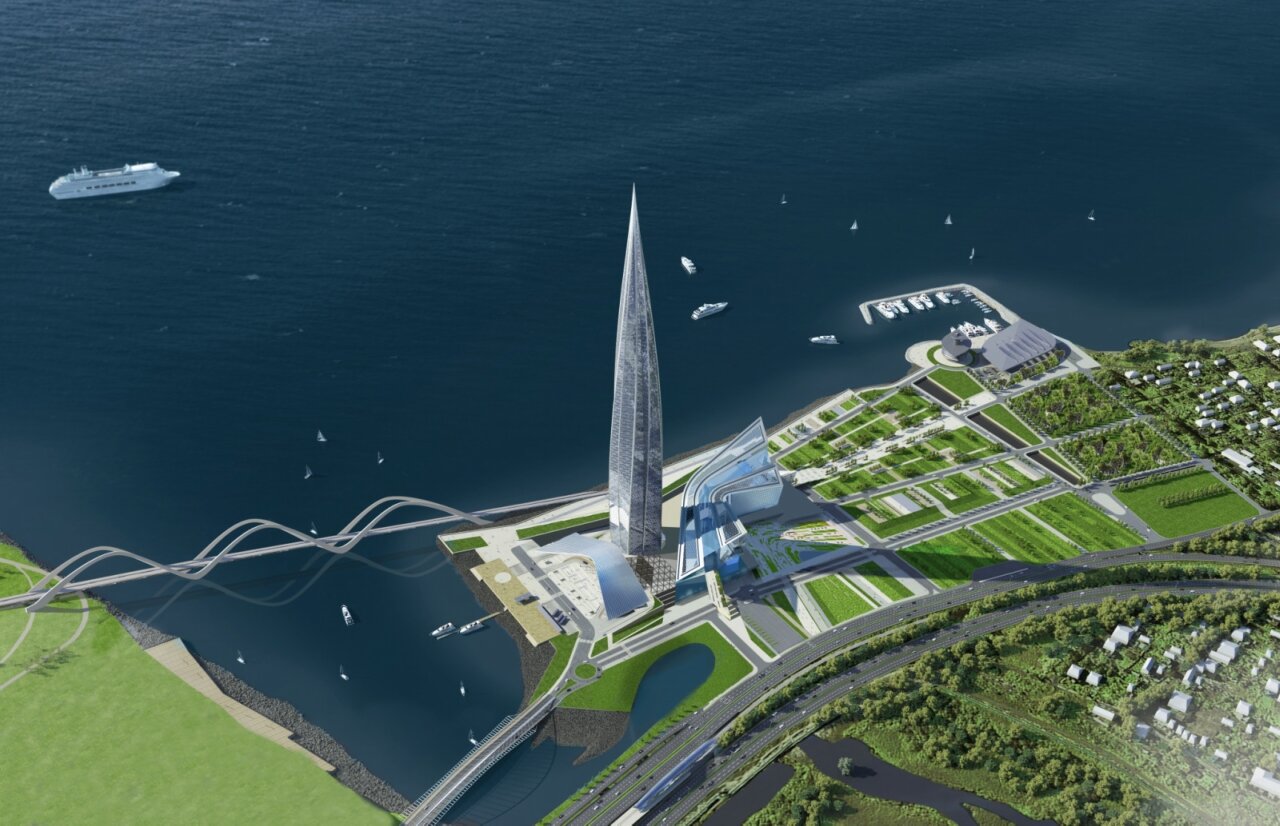
Reminds me of St. Petersburg's Lakhta Center. Oligarchs weren't able to force the supertall on the old Soviet constituency who have some notion of class and the centuries old height restriction. Now the tower is going up on the far edge of town, across the bay. I don't even know if you'll be able to see it from downtown. All this in a country where the word for downtown is literally "center". Can't imagine it will be very successful.arch city wrote:Timely article from London.
While St. Louis certainly isn't London with the amount of proposed high-rises - some 400 - St. Louis could use some height density in downtown and throughout the Central Corridor - particularly with modern high-rises.
Londoners back limit on skyscrapers as fears for capital’s skyline grow
I'm not arguing the city's density. My father lives in Nashville so I am there a lot. It's a hot market that is seeing a population boom right now so mid-rises are going up all over the place. If we were adding 100K residents every ten years right now you would see the same here. That's all I am saying. I lived in Austin. Same thing there.dbInSouthCity wrote:Nashville has 1300 people per square mile....we have 5100 per sq mile....extend our sq mile to match Nashville and we have doubled their population and growing at a faster rate.ImprovSTL wrote:Nashville also has a growing population. Ours is still shrinking.
The City should abolish the Building Height code but only implement it to where buildings can't rise over 630 feet within 3 blocks of the arch
Sent from my iPhone using Tapatalk
Sent from my iPhone using Tapatalk
Once downtown is done rehabbing the empty buildings we will have no choice but to see new construction. The question is will new construction be in the form of 300+ ft hi rises or mid-rise mixed use buildings? I think we will see a mix of both. I also think our skyline will look noticeably different in a decade. If you think about it, all of those massive loft conversions would be tall modern hi- rises in other cities that don't share our historic built environment of warehouses the size of a city block. We are actually in a unique place to have a very large and interesting historic downtown with modern buildings mixed in. Downtown really hasn't tapped into the modern hi-rise crowd yet, yes we have the Roberts Tower, but BPV2 will really test the luxury hi-rise market and we will see if there is really demand for it downtown. My thoughts are that a metropolitan area of 3 million people, slow growth or not, can probably support more modern hi-rise residential construction than we currently have downtown. I remember when people said that nobody would want to live downtown, now its one of the fastest growing neighborhoods in the region, there is definitely pent up demand for upscale urban living in the St. Louis area, I think we are just scratching the surface.
goat314 wrote:Once downtown is done rehabbing the empty buildings we will have no choice but to see new construction. The question is will new construction be in the form of 300+ ft hi rises or mid-rise mixed use buildings? I think we will see a mix of both. I also think our skyline will look noticeably different in a decade.
I would hope for this to happen. I believe that when the Railway Exchange Building or the closed Millennium Hotel are brought back from
Being abandoned, new construction will begin. That construction will be on vacant lots and the monstrous lots South of Interstate 64. Also, new construction could be built where parking garages that aren't used that much stand
Sent from my iPhone using Tapatalk
^ As long as the economy continues to do okay I think we have a lot of opportunity to grow all of the Central Corridor for an extended period of time and if some basic deficiencies such as safety (real/perceived) and streetscapes are addressed successfully I can see downtown once again overtaking Clayton and CWE as the hot spot in the Corridor (which I think it had enjoyed in the pre-recession era) by 2020.
How far this can all go largely will depend upon the number of jobs downtown can attract, downtown's leadership (which I am concerned about) and whether we can expand rapid transit. Also, with demographic changes we may be looking at having to attract more empty nesters and a bit of families along with more condos/for sale housing as the young adult population wave begins to crest,
How far this can all go largely will depend upon the number of jobs downtown can attract, downtown's leadership (which I am concerned about) and whether we can expand rapid transit. Also, with demographic changes we may be looking at having to attract more empty nesters and a bit of families along with more condos/for sale housing as the young adult population wave begins to crest,
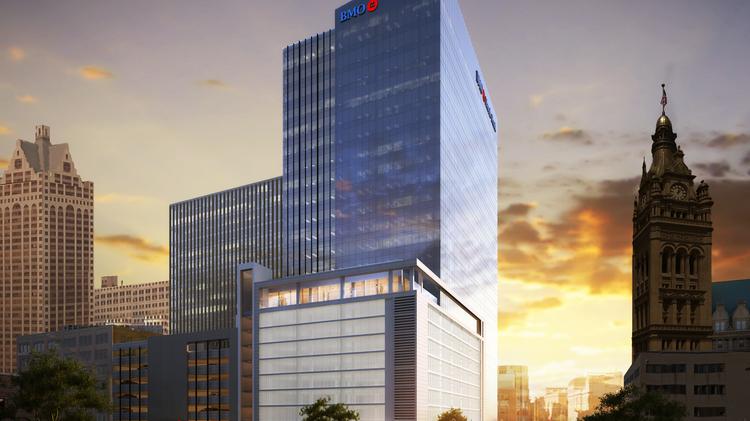
Looks like downtown Milwaukee will get yet another new office tower, this time owned by BMO Harris with new HQ on site of current parking garage.
![]()
http://www.bizjournals.com/milwaukee/ne ... aukee.html
http://www.bizjournals.com/milwaukee/ne ... aukee.html

CWE meeting next monday, image shows a large ? tower "Major Development".
https://twitter.com/PresbyterianStl/sta ... 9785149442
https://twitter.com/PresbyterianStl/sta ... 9785149442


Either you are not aware that Nashville includes (almost?) all of Davidson County including very rural areas like Joelton et al or you are being obtuse.ImprovSTL wrote:I'm not arguing the city's density. My father lives in Nashville so I am there a lot. It's a hot market that is seeing a population boom right now so mid-rises are going up all over the place. If we were adding 100K residents every ten years right now you would see the same here. That's all I am saying. I lived in Austin. Same thing there.dbInSouthCity wrote:Nashville has 1300 people per square mile....we have 5100 per sq mile....extend our sq mile to match Nashville and we have doubled their population and growing at a faster rate.ImprovSTL wrote:Nashville also has a growing population. Ours is still shrinking.
The Architects Newspaper - This 90-story tower could become the tallest building in Denver
https://archpaper.com/2017/10/90-story- ... ng-denver/
https://archpaper.com/2017/10/90-story- ... ng-denver/
I remember thinking back after 9/11 happened, that it was the end of the skyscraper era. Boy was I wrong! The world-wide binge of super-tall buildings shows no sign of slowing down.
That tower is..well..shocking?quincunx wrote:The Architects Newspaper - This 90-story tower could become the tallest building in Denver
https://archpaper.com/2017/10/90-story- ... ng-denver/
Sent from my iPhone using Tapatalk
Nice design for the Denver building. One day, we will have something taller than the arch.
Denver has something St.Louis doesn't have going on for itself. A continued moderate growing population until St.Louis as a whole turns things around a tallest is likely not in its future or our future.
Probably not.chriss752 wrote:Nice design for the Denver building. One day, we will have something taller than the arch.
Is there any truth to the height limit?
I rather see a sea of 400 ft tall buildings downtown. I think St. Louis' skyline and general density would be helped by buildings in the 250-450 foot range. The tallest building in Vancouver is only about 650 ft, no too much taller than the Arch. The rest of the buildings are in the 300-500 foot range, but nobody can tell me that Vancouver doesn't have a beautiful big city skyline. Could you imagine what a Vancouverized North Riverfront would do for our skyline?
The North Riverfront I genuinely believe is raring to explode.goat314 wrote:I rather see a sea of 400 ft tall buildings downtown. I think St. Louis' skyline and general density would be helped by buildings in the 250-450 foot range. The tallest building in Vancouver is only about 650 ft, no too much taller than the Arch. The rest of the buildings are in the 300-500 foot range, but nobody can tell me that Vancouver doesn't have a beautiful big city skyline. Could you imagine what a Vancouverized North Riverfront would do for our skyline?
Sent from my iPhone using Tapatalk

I want to believe it. But why are we having such difficulty in filling potential class A office space Downtown?Chalupas54 wrote: ↑Oct 07, 2017The North Riverfront I genuinely believe is raring to explode.goat314 wrote:I rather see a sea of 400 ft tall buildings downtown. I think St. Louis' skyline and general density would be helped by buildings in the 250-450 foot range. The tallest building in Vancouver is only about 650 ft, no too much taller than the Arch. The rest of the buildings are in the 300-500 foot range, but nobody can tell me that Vancouver doesn't have a beautiful big city skyline. Could you imagine what a Vancouverized North Riverfront would do for our skyline?
Sent from my iPhone using Tapatalk
Clayton, Chesterfield, Maryland Heights to name a few that take from downtown and not elsewhere in the country
It's hard to make apple-to-apple comparisons between cities - each is somewhat unique in their own way - but I think most all would agree that the downtown areas of other comparable cities seem to be improving ahead of downtown STL. Certainly these other cities have suburban options for corps and large businesses but at least some still seem to be choosing to be downtown more frequently than STL corps/businesses do. This leads me to think there is something larger at play.St.Louis1764 wrote: ↑Oct 07, 2017Clayton, Chesterfield, Maryland Heights to name a few that take from downtown and not elsewhere in the country
I suppose slower growth could be an obvious factor. Crime/safety might be another factor. Whether justified or not, I would suspect non-city STL area residents would poll pretty high relative to other cities for being apprehensive to spend time downtown due to crime concerns. Would some employees (especially good ones with options of alternative employment elsewhere) jump ship if their employer relocated them from the suburbs to downtown?
If so, I could definitely see that making business apprehensive to make the move. In business, your employees are often among your most valuable assets. Having the right/wrong ones can make/break you.

People tend to overthink why high rises are built in certain cities while not in others. Topography and population growth/decline are really the only reasons you need to focus on. History of cities in this country shows that if there's enough available land the city will always grow outward at some point. The 2 densest places in this country are San Francisco and Manhattan. Well, SF is a peninsula surrounded by water on 3 sides. Manhattan is an island. They simply can't sprawl outward even if they wanted to. And believe me after WW2 they wanted to just like every other city.
There's a residential high rise building boom in L.A. right now. Now, why is it happening now where it wasn't before? Because building outward is no longer an option. There's no more available land. And yet the city is still growing, so developers are building upward.
There's a residential high rise building boom in L.A. right now. Now, why is it happening now where it wasn't before? Because building outward is no longer an option. There's no more available land. And yet the city is still growing, so developers are building upward.
True, but that doesn't explain why Atlanta, Houston, Dallas, etc. are booming like crazy with hi-rises. I think it's a matter of development decisions. Obviously, geographically constrained cities will build denser but planning, incentives, and markets play a big role as well.FoghornLeghorn wrote: ↑Oct 08, 2017People tend to overthink why high rises are built in certain cities while not in others. Topography and population growth/decline are really the only reasons you need to focus on. History of cities in this country shows that if there's enough available land the city will always grow outward at some point. The 2 densest places in this country are San Francisco and Manhattan. Well, SF is a peninsula surrounded by water on 3 sides. Manhattan is an island. They simply can't sprawl outward even if they wanted to. And believe me after WW2 they wanted to just like every other city.
There's a residential high rise building boom in L.A. right now. Now, why is it happening now where it wasn't before? Because building outward is no longer an option. There's no more available land. And yet the city is still growing, so developers are building upward.
That's a good point. It would make sense that the expense of going vertical only makes sense once the land value of going elsewhere makes it make sense... However, if this premise is absolutely true, I'm not sure you can explain why any building of any serious height exists in Midwest cities.FoghornLeghorn wrote: ↑Oct 08, 2017Topography and population growth/decline are really the only reasons you need to focus on. History of cities in this country shows that if there's enough available land the city will always grow outward at some point.