Tapatalk

The view of STL from I-70

The view of STL from I-70

1,064
Expert MemberExpert Member
1,064

PostJun 11, 2012#1

I don't know exactly where this goes.

But. When I was a kid, I remember taking field trips into STL via I-70 (back in the 80s) and thinking how run down the city looked - all the boardups, closed factories, etc. Since returning to the area, most of my access to city activity has involved the use of 40-64, much of which looks great, and it got me to thinking about how welcoming or foreboding STL must look to out of town visitors who approach the city from the west via I-70. Since I know the highways well enough to not really need signs, I can't speak to how they direct visitors through the area, but where 170 directs to Clayton, should it also direct to St. Louis so visitors don't have their first impression spoiled by all the blighted zones?

710
Senior MemberSenior Member
710

PostJun 26, 2012#2

Yeah, I've thought about it too over the years. I wonder how deep the psychological impact goes, for instance. I feel like the rift between NW suburban areas/St. Charles along I-70 and the City go much deeper than say Kirkwood or Chesterfield and the City. A sloughing off of an entire quarter of the region.

All that aside, it would be nice if we could spruce up the corridor our NW expressway runs through just a tad.

2,687
Super ModeratorSuper Moderator
2,687

PostAug 11, 2012#3

It doesn't look nearly as bad as I remember.

2,437
Life MemberLife Member
2,437

PostAug 11, 2012#4

Same goes for the MetroLink ride from the airport to the city. Not exactly an attractive entrance. Junkyards, burned buildings, barbed-wire fencing and tons of graffiti. Seems like something could be done to beautify the view along the red line. It certainly paints a very foreboding first impression for visitors.

118
Junior MemberJunior Member
118

PostFeb 28, 2013#5

I wonder if there could be a program created that provides improvement tax credits or other incentive to properties that face or are in close proximity to and are negatively impacted by the presence of federal interstate highways. Particularly in urban areas, man of these properties existed before the interstate and their re-development is challenged by the presence of the highway (among other reasons depending on their neighborhood location) and therefore should be in consideration for some offset from that highway impact that the general public benefits from use of.

The tax credit possibly could be limited to say, facade, structural and sound abatement work, and maybe limited to buildings built before the highway to limit sprawl encouragement, but this development tool would help provide an incentive for the market to re-develop properties that are impacted by the highway AND help improve properties that provide a negative appearance for drivers on the highway - the way many people first experience a city. Just a thumbnail idea but I think most would like to see the most visible properties in ANY city look presentable.

How to pay for it is a different question, especially in these divisive times, but probably falls into a transportation bill, possibly fuel tax, OTR shipping fees/surcharges, license fees, etc, and/or some combination, but should be funded from sources from general users of the highway system in my opinion.

Thoughts?

788
Super MemberSuper Member
788

PostFeb 28, 2013#6

I think the problem is that the city has no codes/laws (at least none they enforce) that apply to condition of unoccupied buildings. Only once someone applies for an occupancy permit do they do inspections, although I think those are a bit strict.

118
Junior MemberJunior Member
118

PostMar 01, 2013#7

I think code enforcement only goes so far. Its not much of a development catalyst, more just a stick that's best used to bring the worst house on the block in line with the others. Riding down any of our highways there are far too many eyesore buildings in states of vacancy & disrepair for simple code enforcement to be effective in my opinion. If the owners have no economic use or incentive to improve the property eventually they quit spending money on it at all and it falls for back taxes or demo (see Powell Square). An incentive that recognizes that these buildings were harmed economically by the adjacent highway, that serves the driving public, is a justifiable application of a public subsidy for development I think.

8,155
Life MemberLife Member
8,155

PostMar 01, 2013#8

I agree the visual character of I-70 is disastrous and presents a terrible first impression of the region. Aside from the issues outside the right-of-way (and excessive billboard blight is a huge problem), the elements within the right-of-way don't help either. The aesthetic treatments are poor, there is little quality landscaping and its just simply dreary and depressing.

Indianapolis does a great job with a number of parks created along I-70 -- some small some large -- with public art, etc. created in cooperation with Keep Indianapolis Beautiful. In the Dayton area, substantial new I-70 infrastructure has been built in recent years and incorporate a number of aesthetic elements conveying the National Aviation Heritage Area identity. A cool Wright Flyer sculpture around several interchanges is a neat touch that is an example of small things making a big difference. I'd love to see some Spirit of Saint Louis branding along I-70 especially near the airport.

788
Super MemberSuper Member
788

PostMar 01, 2013#9

americancitizen wrote:I think code enforcement only goes so far. Its not much of a development catalyst, more just a stick that's best used to bring the worst house on the block in line with the others. Riding down any of our highways there are far too many eyesore buildings in states of vacancy & disrepair for simple code enforcement to be effective in my opinion. If the owners have no economic use or incentive to improve the property eventually they quit spending money on it at all and it falls for back taxes or demo (see Powell Square). An incentive that recognizes that these buildings were harmed economically by the adjacent highway, that serves the driving public, is a justifiable application of a public subsidy for development I think.
Why would code enforcement not work? Say they establish some policy for owners having to maintain buildings at usable levels; levels which would qualify for occupancy permits. That way people wouldn't buy up a bunch of properties in hopes of something coming along and making some money on a sale. Right now abandoned buildings are crumbling all over the city and it's getting more and more expensive to fix them. This discourages building re-use because of massive upfront cost of repair.

I'm much more concerned with buildings looking and being abandoned than aesthetically pleasing. There is a lot of industry along 70 and often those buildings are not going to be the nicest looking and I don't think it makes sense to spend a bunch of money to make them look pretty.

If there was ever any extra money (Ha), they could line the sides of the highway with densely placed, tall trees like on a boulevard. Highway 44 between Vanderventer and Grand would look really nice I think. Maybe they could do that along 70 too between Taylor and Salisbury. That would hide a lot of the northern industry.

118
Junior MemberJunior Member
118

PostMar 04, 2013#10

While not discounting the effectiveness of code enforcement in the right setting, if code enforcement alone was a large scale solution to blight the problem would have been solved by now.

Maybe I didn't convey the idea well enough but I was thinking large scale, federal program, funded by motorists nationally as the problem exists in every city that had its street grid and urban fabric ripped apart with interstate highways. St. Louis being the most proximate example, of course.

Just trying to figure out how to help present the best face of a city to the general public using the highways because I think we all agree that visitors traveling I70 don't see the best of St. Louis. The buildings most adjacent to the highway and therefore most impacted probably need some additional economic help.

8,155
Life MemberLife Member
8,155

PostNov 09, 2014#11

stlgasm wrote:Same goes for the MetroLink ride from the airport to the city. Not exactly an attractive entrance. Junkyards, burned buildings, barbed-wire fencing and tons of graffiti. Seems like something could be done to beautify the view along the red line. It certainly paints a very foreboding first impression for visitors.
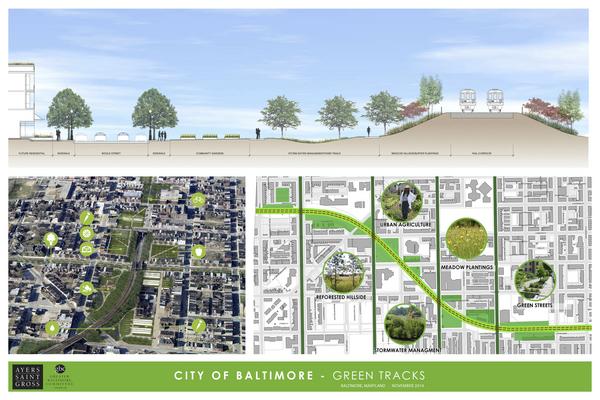
Baltimore is undertaking an interesting Green Tracks initiative to improve the appearance of, and quality of life in, the area around the Amtrak corridor leading into downtown:


About a mile before passengers reach Penn Station, all manner of urban decay — crumbling row homes, graffiti, litter — is on view as the southbound trains rumble through the city's east side. Both city officials and people in the business community have bristled at the state of the tracks for years, saying it's no way to welcome visitors to a place that calls itself Charm City.

That's finally about to change. Mayor Stephanie Rawlings-Blake is set Wednesday to mark the start of the $3 million "Green Tracks" program, a major cleanup effort along the Amtrak corridor, where workers have already begun dismantling rowhomes far too decrepit to renovate. Along the tracks, the city is also planning to spend $200,000 to beautify the corridor with community gardens, urban farms and stormwater management installations to provide green space....

"It's frustrating when the business community talks about that last mile coming in, when residents live there every day and it's for them that we're doing that deconstruction and beautification," Rawlings-Blake said. "This is more than just putting a fresh coat of paint on the front door. This is about innovative ways to partner with the community to develop the community, to grow our cities sustainably and deal with long-languishing issues with the vacants."


That last paragraph is key. And of course blighted properties should undergo a extensive analysis on redevelopment potential over demo.

989
Super MemberSuper Member
989

PostNov 09, 2014#12

Wasn't there some celebrity that gave a bad impression of St. Louis based on this? Which was likely a function of the fact said person likely traveled between the Airport and Downtown which would be the corridor in question for this.

One big issue i see in this is that you run right into the tiny munincipalities of North County in the segment between the Airport and the City Limits. Not sure how much can be done in fixing that (along with the speed trap issues)

8,155
Life MemberLife Member
8,155

PostNov 09, 2014#13

^ You might be thinking of Howard Stern... I'm sure there have been others.

edit... also, I think something like this could work with Metrolink. MSD, GRG and private groups like the Gateway Foundation are just a few examples of capable organizations that could work with community partners to make an impact. Of course, developing and implementing TOD plans is needed as well.

738
Senior MemberSenior Member
738

PostNov 09, 2014#14


3,447
Life MemberLife Member
3,447

PostNov 09, 2014#15

I have always been surprised someone didn't go in and develop the water towers area along I-70. Its been run down for 50 years. I would have thought the two old water towers would be attractive icons to build a community of rehabbed and new middle and upscale homes around. Couldn't they contract for private security to make it safe?

1,067
Expert MemberExpert Member
1,067

PostMar 03, 2015#16

Just a random thought. My job takes me to the 367 and 270 interchange at least once a week, and the view to downtown is a pretty good one showing the decent east-west density of the skyline with the Arch and Four seasons kind of perched to the east. It's an interesting vantage point being that far away. The new stadium would be a nice addition to that swath of visual space looking south.

3,447
Life MemberLife Member
3,447

PostMar 30, 2015#17

I was driving East on I-64 downtown where the lanes go to two decks just East of IKEA at Grand. The buildings along the North side of the lower lanes are always covered with graffiti and are pretty unsightly. They've been that way for 40 years. I was hoping SLU might buy that property and clean it up to give a better view to visitors -- the current view just screams "nobody cares".

So instead, what would it take to plant a row of Thuja "Green Giant" evergreens along there, and other places along some stretches of I-70 and I-44, to just screen off those areas to visitors traveling through the city.

There is a place called The Botany Shop in Joplin Missouri that sells these trees over the internet and mails them to you as small -- ready to plant trees. You can buy them in various maturity / sizes -- I bought about 6 of the smallest size 12 years ago and planted them next to my house to form a screen between my house and the one then under construction next door. We call them the internet trees. But now 12 years later they form a gorgeous very tall screen. They are vertical shape, grow very fast, no maintenance, and almost indestructible. I read about them in a newspaper article about the Botany Shop back then, and the shop owner could not have been more excited about this tree, so I had to buy some. It is the main tree they sell. Here is what mine look like now.

Thuja Green Giant Screen by ZGare, on Flickr

Thuja Green Giant by ZGare, on Flickr

If we could buy a few of these and plant them between the interstate and the graffiti derelict truck property, in a few years we'd never have to look at that 40 year eyesore again. Here is a link to the Botany Shop Garden Center web site:

http://www.botanyshop.com

8,155
Life MemberLife Member
8,155

PostMar 30, 2015#18

^ gary, I think the site you are referring to is the old Federal Mogul plant that should be demolished before too long for the planned Midtown Station development. The site plan I've seen at nextstl shows surface parking there, but I'd love to at least have a parking structure to support more intensive, mixed-use development like at the same company's Boulevard development .

3,447
Life MemberLife Member
3,447

PostMar 25, 2016#19

roger wyoming II wrote:^ gary, I think the site you are referring to is the old Federal Mogul plant that should be demolished before too long for the planned Midtown Station development. The site plan I've seen at nextstl shows surface parking there, but I'd love to at least have a parking structure to support more intensive, mixed-use development like at the same company's Boulevard development .
So when does demolition of Federal Mogul begin? Or should we have the Mayor call up the Botany Shop in Joplin and order the $2.50 each Giant Thuja plants now so that in 10 years that entire site will be totally hidden behind a row of these gorgeous fast growing evergreens when visitors drive by on the lower lanes of I-64?

Untitled by Gary Kreie, on Flickr

http://www.botanyshop.com/index.htm

7,848
Life MemberLife Member
7,848

PostMar 25, 2016#20

gary kreie wrote:I was driving East on I-64 downtown where the lanes go to two decks just East of IKEA at Grand. The buildings along the North side of the lower lanes are always covered with graffiti and are pretty unsightly. They've been that way for 40 years. I was hoping SLU might buy that property and clean it up to give a better view to visitors -- the current view just screams "nobody cares".
It does look horrible. As I understand it the graffiti a**holes used to have a lot of their "battles" under the old Kingshighway overpass where a lot of it was hidden from view. But since that's not an option some of them have moved to the Federal Mogul site.

Personally I'd like to go all "English Patient" and cut their thumbs off: but that's a bit extreme.

3,563
Life MemberLife Member
3,563

PostMar 25, 2016#21

I-70 needs this treatment asap from city limits to downtown. Yes, our highways scream, we dont give a damn about our city.

537
Senior MemberSenior Member
537

PostMar 28, 2016#22

As a kid that double deck and graffiti was one of the few things that made St. Louis feel urban at all to me. Better than trees that won't get enough sun.