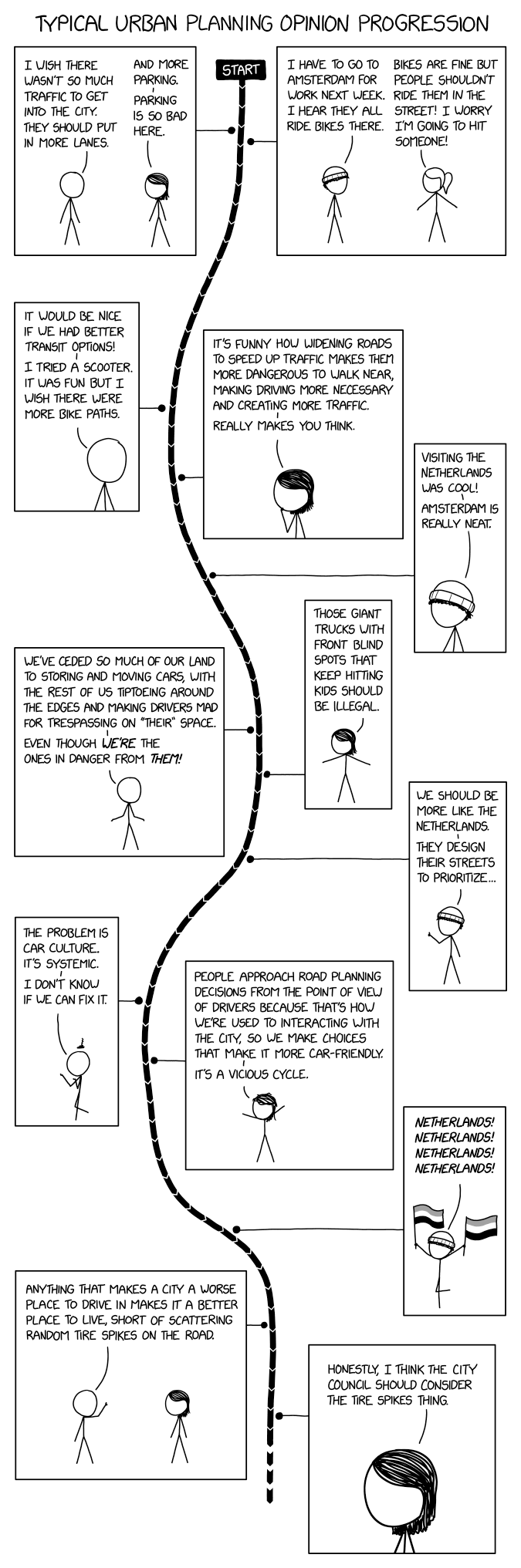
Salon - Is a post-car future actually possible? Experts say yes — here's how we could get there
https://www.salon.com/2023/04/09/is-a-p ... get-there/
https://www.salon.com/2023/04/09/is-a-p ... get-there/
I was a little disappointed that it just discussed metro-scale policy like light rail. I was hoping for more suburban-applicable stories like these:quincunx wrote: ↑Jun 19, 2023StreetsBlog - Less Driving Is Possible — And These US Communities Are Already Doing It
https://usa.streetsblog.org/2023/06/15/ ... y-doing-it
https://humantransit.org/2023/06/the-ol ... -cars.htmlDense cities don’t have room for everyone’s car. If too many people use cars, they take up all the available space and still get in each other’s way, which is what congestion is.
“The typical American devotes more than 1500 hours a year (which is 30 hours a week, or 4 hours a day, including Sundays) to his [or her] car. This includes the time spent behind the wheel, both in motion and stopped, the hours of work to pay for it and to pay for gas, tires, tolls, insurance, tickets, and taxes .Thus it takes this American 1500 hours to go 6000 miles (in the course of a year). Three and a half miles take him (or her) one hour. In countries that do not have a transportation industry, people travel at exactly this speed on foot, with the added advantage that they can go wherever they want and aren’t restricted to asphalt roads.”
2028 muhahahahahaquincunx wrote: ↑Jun 21, 2023Flying cars are just around the corner and will fix this.
Human Transit - The Old, Old Idea of High-Tech Cars
https://humantransit.org/2023/06/the-ol ... -cars.htmlDense cities don’t have room for everyone’s car. If too many people use cars, they take up all the available space and still get in each other’s way, which is what congestion is.
https://slate.com/business/2023/06/subu ... tions.htmlAs Tomer said: “Turns out, when you put more stuff near people, they don’t have to travel as far, and that has huge impacts on what we’re able to achieve economically and environmentally.”
https://www.krqe.com/news/albuquerque-m ... ty-values/Under the law, Lara said they can only raise the value of a residential property by 3%. However, if a property is non-residential, vacant, or isn’t producing income, there is no limit to how much the value can be raised.
Ditto re LVT. If there is a single "silver bullet" idea to really help the City (there's not, but) it's surely the LVT. Gradually lower the improvements portion while raising the land portion of current real estate taxes in a budget neutral manner. We could add circuit breakers or longer phase-ins for owner-occupied properties, the elderly/impoverished, etc., if necessary to get political buy-in. Over time you could probably even ditch the earnings tax and fully replace it with LVT.dtgwvc wrote: ↑Aug 20, 2023Raising property taxes on vacant lots is good, no more than 3 percent rise on residential is a bad idea. Basically rent control for property, meaning shortages due to nobody wanting to sell. Reminds me of California’s controls on property values that didn’t work out and there are a lot of areas of the city where property values really need to go up. Seems very anti market and we would be better off taxing land
Sent from my iPhone using Tapatalk