

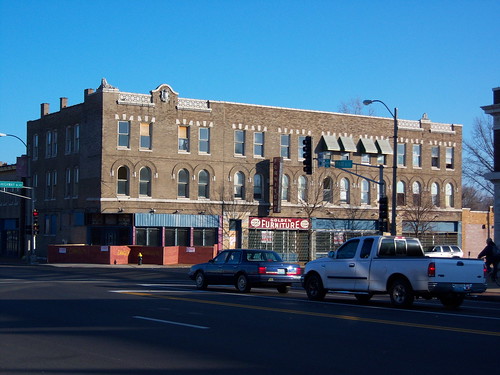
Over at Curious Feet St. Louis, there is news of the impending demolition of a Roberts Brothers owned commercial building at the corner of Page and Kingshighway.
Picture is courtesy of Curious Feet:
![]()
With the this news and the threat of demolition of the commercial building at Page and Union, there is a very disturbing continuance of the very trend that continues to rob north St. Louis of its ability to improve and shed its negative reputation. Vacant lots and destroyed history cannot be the path of development in north St. Louis--or anywhere in the city. Certainly, it is economically feasible for the Roberts Brothers to stabilize this handsome building and in doing so keep a modicum of urbanity on a dreary stretch of Kingshighway. We have let too much go in too many parts of the city to where now it is uncertain whether some neighborhoods will ever recover.
It's hard for me to believe our city and its entrepreneurs allow demolition by neglect of our astounding architectural heritage. The news that two Ittner buildings in the BJC complex will likely be demolished for the "campus" expansion seems to just further the point that St. Louis is a city too weak to even declare an identity.
It cannot decide if it will steadfastly protect its history and heritage, its only true assets when it comes down to it, and promote preservation as economic development. Note that St. Louis's shining examples of success, the Loft District and the nascent movement to restore and redevelop Old North St. Louis as a whole derive from two positive, yet highly site specific preservation successes.
In the Loft District, positioned near to the CBD and the commercial core of the city, a determined and concerned group of business and civic leaders noticed an attractive, urban streetscape that had been simply too grand in scale to demolish wholesale. And so Wash Ave. remains and shines. There was nothing too fancy involved in this redevelopment plan. Yes, streetscape improvements and a one-way to two-way street conversion. But in reality, the historicity of the buildings and their worth in an urban context spoke for themselves.
In ONSL, the opposite is true. Much of the urban fabric has in fact been lost. And yet, enough has remained to instill passion in some of St. Louis's most ardent and valued preservation and neighborhood activists. Working with much less than the Loft District, the people and allies of ONSL are nevertheless lobbying to reinstate everything that made the neighborhood so livable and attractive--walkability, accessibility to jobs, safety, etc.
Is either redevelopment perfect? No. The Loft District isn't quite attracting a retail boom downtown and ONSL, in the name of history, has allowed some passable but kind of blase infill. Regardless, these two scenarios involve a common element that is essential to the future of our city. They both celebrate that St. Louis is actually a city, an urban environment and both attend to the needs of that urbanity. As a result, both are becoming increasingly livable neighborhoods with snowballing activity.
But much of the depressed parts of St. Louis, of which there are too many, there is little drive to recognize that St. Louis is a city worth saving, or that it is a city at all. Parking lots and strip centers do not a city make.
But back to the identity crisis in St. Louis: With its stagnant economy also comes a toxic inability to demand anything other than mediocrity, which comes at a lower cost. And so neither a strengthened past nor a brightened future seems set for St. Louis. This is an important point. Many cities across the country have failed to preserve their history, but their economies and job opportunities kept them afloat long enough to reestablish themselves. And, of course, many cities have accomplished both forging a new identity and salvaging that which once made them great (Pittsburgh comes to mind as a poster child).
My whole point is that a large, powerful company like Roberts and its two business/civic leaders should not so nonchalantly allow the demolition of this corner structure. It is but one building, true. But St. Louis's piecemeal destruction, except in the days of renewal, has always been that way. And it continues unabated for areas not within local historic district designation.
What road will St. Louis take? Salvage our past? Forge a new future? Or both?
Oh, and, by the way, anyone have an email or phone number for the Roberts Brothers?
Picture is courtesy of Curious Feet:
With the this news and the threat of demolition of the commercial building at Page and Union, there is a very disturbing continuance of the very trend that continues to rob north St. Louis of its ability to improve and shed its negative reputation. Vacant lots and destroyed history cannot be the path of development in north St. Louis--or anywhere in the city. Certainly, it is economically feasible for the Roberts Brothers to stabilize this handsome building and in doing so keep a modicum of urbanity on a dreary stretch of Kingshighway. We have let too much go in too many parts of the city to where now it is uncertain whether some neighborhoods will ever recover.
It's hard for me to believe our city and its entrepreneurs allow demolition by neglect of our astounding architectural heritage. The news that two Ittner buildings in the BJC complex will likely be demolished for the "campus" expansion seems to just further the point that St. Louis is a city too weak to even declare an identity.
It cannot decide if it will steadfastly protect its history and heritage, its only true assets when it comes down to it, and promote preservation as economic development. Note that St. Louis's shining examples of success, the Loft District and the nascent movement to restore and redevelop Old North St. Louis as a whole derive from two positive, yet highly site specific preservation successes.
In the Loft District, positioned near to the CBD and the commercial core of the city, a determined and concerned group of business and civic leaders noticed an attractive, urban streetscape that had been simply too grand in scale to demolish wholesale. And so Wash Ave. remains and shines. There was nothing too fancy involved in this redevelopment plan. Yes, streetscape improvements and a one-way to two-way street conversion. But in reality, the historicity of the buildings and their worth in an urban context spoke for themselves.
In ONSL, the opposite is true. Much of the urban fabric has in fact been lost. And yet, enough has remained to instill passion in some of St. Louis's most ardent and valued preservation and neighborhood activists. Working with much less than the Loft District, the people and allies of ONSL are nevertheless lobbying to reinstate everything that made the neighborhood so livable and attractive--walkability, accessibility to jobs, safety, etc.
Is either redevelopment perfect? No. The Loft District isn't quite attracting a retail boom downtown and ONSL, in the name of history, has allowed some passable but kind of blase infill. Regardless, these two scenarios involve a common element that is essential to the future of our city. They both celebrate that St. Louis is actually a city, an urban environment and both attend to the needs of that urbanity. As a result, both are becoming increasingly livable neighborhoods with snowballing activity.
But much of the depressed parts of St. Louis, of which there are too many, there is little drive to recognize that St. Louis is a city worth saving, or that it is a city at all. Parking lots and strip centers do not a city make.
But back to the identity crisis in St. Louis: With its stagnant economy also comes a toxic inability to demand anything other than mediocrity, which comes at a lower cost. And so neither a strengthened past nor a brightened future seems set for St. Louis. This is an important point. Many cities across the country have failed to preserve their history, but their economies and job opportunities kept them afloat long enough to reestablish themselves. And, of course, many cities have accomplished both forging a new identity and salvaging that which once made them great (Pittsburgh comes to mind as a poster child).
My whole point is that a large, powerful company like Roberts and its two business/civic leaders should not so nonchalantly allow the demolition of this corner structure. It is but one building, true. But St. Louis's piecemeal destruction, except in the days of renewal, has always been that way. And it continues unabated for areas not within local historic district designation.
What road will St. Louis take? Salvage our past? Forge a new future? Or both?
Oh, and, by the way, anyone have an email or phone number for the Roberts Brothers?


