
Or sensors that automatically turn off the lights when a large boat is X meters away?gary kreie wrote:If they have to be off, I think the wireless technology exists to allow a pilot to turn them off when he approaches.
- 3,441

Natchez paid for most of the $3 million cost of lighting their Mississippi River Bridge with government economic recovery money.gone corporate wrote:
Any philanthropic readers out there want to take this forward? We'd love to see the Eads Bridge lit up if at all possible, and you'd have our collective & sincere appreciation from here on out!
http://www.recovery.gov/Transparency/Re ... ype=Grants
"This project will install aesthetic street and bridge lighting and traffic cameras on the bridge over the Mississippi River in Natchez in Adams county."
- 2,386
I have no idea if they exist or not, but if there is such thing as a historical engineering foundation this might be the perfect place for a nice little grant.
- 11K
Hey, the only people rerouting an Interstate highway are MoDOT and IDOT - I-70 moving no matter what City to River does...semantics, I know.zink wrote:I'll Donate $20.
I think the web desiger/group who is leading City to River campaign should take this on. I feel this would actually be a "quick" win for them and they could actually get some financially backing relatively quick.
And when I mean quick.. I am quicker than routing an interstate highway.

Anyway, lighting the Eads seems so simple. I have only heard that the Army Corps of Engineers is against it due to navigation. I can see that lights reflecting on the water could make navigation more difficult, but shouldn't there be a balance? I mean is the only goal was river navigation then we should really just take out one or two of those darn Eads piers out there in the river!

I also can understand how reflections on the water can make seeing clearly a problem. Think of how hard it is sometimes to see at night while driving a car in the rain because of reflections on the street. You can't see the lines in the road or people walking across the street, etc. That being said, I would think they could position the lighting and use fixtures in such a way that it wouldn't reflect too much on the water.

So lighting up a massive bridge makes it harder to see at night .............................................................. ....................................
BBBBWWWAWHahahaah...
I suppose we're gonna say next that those pesky runway lights at Lambert need to go...
...I'm sure there is something to this, but it appears some fairly easy fixes are available for those felinish tug drivers who see better in the dark...
BBBBWWWAWHahahaah...
I suppose we're gonna say next that those pesky runway lights at Lambert need to go...
...I'm sure there is something to this, but it appears some fairly easy fixes are available for those felinish tug drivers who see better in the dark...
- 6,775
IIRC, it had something to do with the lights reflecting off the the water, or something like that. Or I may be way off and misremembering the reason they were turned off.bonwich wrote:Bridges (especially Eads) are not lit because the St. Louis stretch of the Mississippi is one of the most dangerous for piloting, and it's going to get even worse with the new bridge. The bridges are simply in too close proximity to each other. The Eads lighting was removed because it resulted in navigational hazards. (They tried setting up a trip on the King bridge to turn off the Eads lights when boats approached, but the bridges were too close and one severe accident was actually blamed on the lights.)
It's a nice thought, but experience dictates that it won't happen.
If David Jump ever dumps him, I bet he would be.gary kreie wrote:I say we hand it over to Bob Cassily. He isn't intimidated by lawyers.

- 82

Bridges are lit all over the world. Granted, St. Louis has a lot of river traffic, but I think all these organizations are worried about where the blame would fall in the extremely unlikely case that something actually happened.
- 2,933
^ Bingo. It's all about liability with the already established understanding that lights on that bridge have hindered nighttime navigation in the past. If the bridge gets lit up (which I very much want) and an accident on the river happens afterwards, one which the boat captain claims was caused by the lights on the bridge...
1. Who all is liable?
2. How large a claim can come out of it? Easy to assume it'd be in the millions for anything commercial.
If a system for lighting the bridge emerges that clearly would not hinder nighttime navigation, then we may have something. Until then, though, we've got liability and the resulting risk of a massive lawsuit preventing a relighting of the Eads Bridge. Sucks.
1. Who all is liable?
2. How large a claim can come out of it? Easy to assume it'd be in the millions for anything commercial.
If a system for lighting the bridge emerges that clearly would not hinder nighttime navigation, then we may have something. Until then, though, we've got liability and the resulting risk of a massive lawsuit preventing a relighting of the Eads Bridge. Sucks.
okay...so how other bridge on river all lit up? it appear other one all lit up?
...sarcasm aimed at no one...
...sarcasm aimed at no one...
- 3,441
A system has emerged as described in my earlier post about the Natchez Bridge that turned on lights just 6 months ago:
“When the bridge is finally finished, we will give a phone number to the tugboat captains to call if they are having a hard time seeing,” he said. “When they call the number, the lights are shut off so that they can see better.”
Problem solved.
![]()
bridge over the river - seen from the steamer natchez by Keithius, on Flickr
“When the bridge is finally finished, we will give a phone number to the tugboat captains to call if they are having a hard time seeing,” he said. “When they call the number, the lights are shut off so that they can see better.”
Problem solved.

bridge over the river - seen from the steamer natchez by Keithius, on Flickr
- 11K
Something like this could actually be even better than just having them on all the time. Modern LED's would do just fine going on and off a number of times a night. This would highlight the working river - something we do very poorly. In a similar fashion, some have suggested having LED's light across the MacArthur when trains cross - another excellent, excellent idea.
- 6,775
That would be cool.Alex Ihnen wrote:In a similar fashion, some have suggested having LED's light across the MacArthur when trains cross - another excellent, excellent idea.
I'm in Rotterdam for work right now, and was extremely impressed with the lighting of the Erasmus bridge at night. How come we couldn't have an architectural masterpiece instead of the PSB? We should at least highlight the beauty of our existing masterpiece with dramatic lighting.
![]()

- 11K
^ That's why I really liked the idea of the Weiss-Manfredi pedestrian bridge idea - it would have put a new face on the north side of the PSB. That's about as good as we can hope for with the PSB at this point. The gondola will change the view to the south - maybe help a bit as well.
Is there a lighting plan for the new Mississippi bridge?
Sent from my AT&T iPhone using Tapatalk
Sent from my AT&T iPhone using Tapatalk
- 11K
Not that's been made public at this point. The new bridge website (buried in an old newsletter) states that the bridge could be like aesthetically and for safety as the Clark Bridge near Alton has been lit. However, it states that lighting "needs a community partner" that must pay for construction, maintenance and utility cost to keep it lit.

OK, so this is appropos of nothing, but I was looking through historical images of the Eads bridge and this caught my eye:
![]()
high-res version
Source: Pruitt-Igoe Myth on Flickr
![]()
high-res version
Source: Pruitt-Igoe Myth on Flickr
^ These images are from 1874. Look at those massive statues topping the piers when the bridge first opened, plus the flag-topped structures where the approaches meet the span on both sides of the river. But by 19 years later, in 1893, modifications had already been made. Note this image:
![]()
high-res version
Source: Raimist Design
Another view:
![]()
high-res version
Source: Raimist Design
All of the statues have been removed. The flag-topped structures have been replaced on the Missouri side with a much simpler, sans-flag versions and have been removed entirely from the Illinois side.
That got me wondering. I've never noticed the statues at all on images I'd seen previously. Whose images are the statues representing? When were they removed, and why? I'd be quite curious to know. And more to the point of this thread, is there any possibility at all that these could be restored at some point in the future?
IMO those (plus the non-filled-in windows of the bridge under the flags), if a bit grandiose in nature, make a huge positive change in the look of the Eads bridge. The statues in particular remind me of a larger-scale version of other significant European bridges:
The Charles Bridge, Prague
![]()
Source: Travefy
The Sant'Angelo Bridge, Rome
![]()
Source: Wikimedia Commons
Not that the Eads bridge is ugly now by any stretch of the imagination, but one has to admit that some of the alterations made over the years were somewhat insensitive to the original look of the bridge; many were functional first with aesthetics as an afterthought. Much of the work Metro did a few years back restored some of the original look; perhaps some federal grant money or even a private fund could be found to restore even more of Charles Eads' original design?
I'd think that'd be unlikely, but how impressive would an Eads bridge restored as closely as possible to its 1874-era (minus the changes necessary for the modern street deck and the Metrolink, of course) be?
-RBB

high-res version
Source: Pruitt-Igoe Myth on Flickr

high-res version
Source: Pruitt-Igoe Myth on Flickr
^ These images are from 1874. Look at those massive statues topping the piers when the bridge first opened, plus the flag-topped structures where the approaches meet the span on both sides of the river. But by 19 years later, in 1893, modifications had already been made. Note this image:

high-res version
Source: Raimist Design
Another view:

high-res version
Source: Raimist Design
All of the statues have been removed. The flag-topped structures have been replaced on the Missouri side with a much simpler, sans-flag versions and have been removed entirely from the Illinois side.
That got me wondering. I've never noticed the statues at all on images I'd seen previously. Whose images are the statues representing? When were they removed, and why? I'd be quite curious to know. And more to the point of this thread, is there any possibility at all that these could be restored at some point in the future?
IMO those (plus the non-filled-in windows of the bridge under the flags), if a bit grandiose in nature, make a huge positive change in the look of the Eads bridge. The statues in particular remind me of a larger-scale version of other significant European bridges:
The Charles Bridge, Prague

Source: Travefy
The Sant'Angelo Bridge, Rome
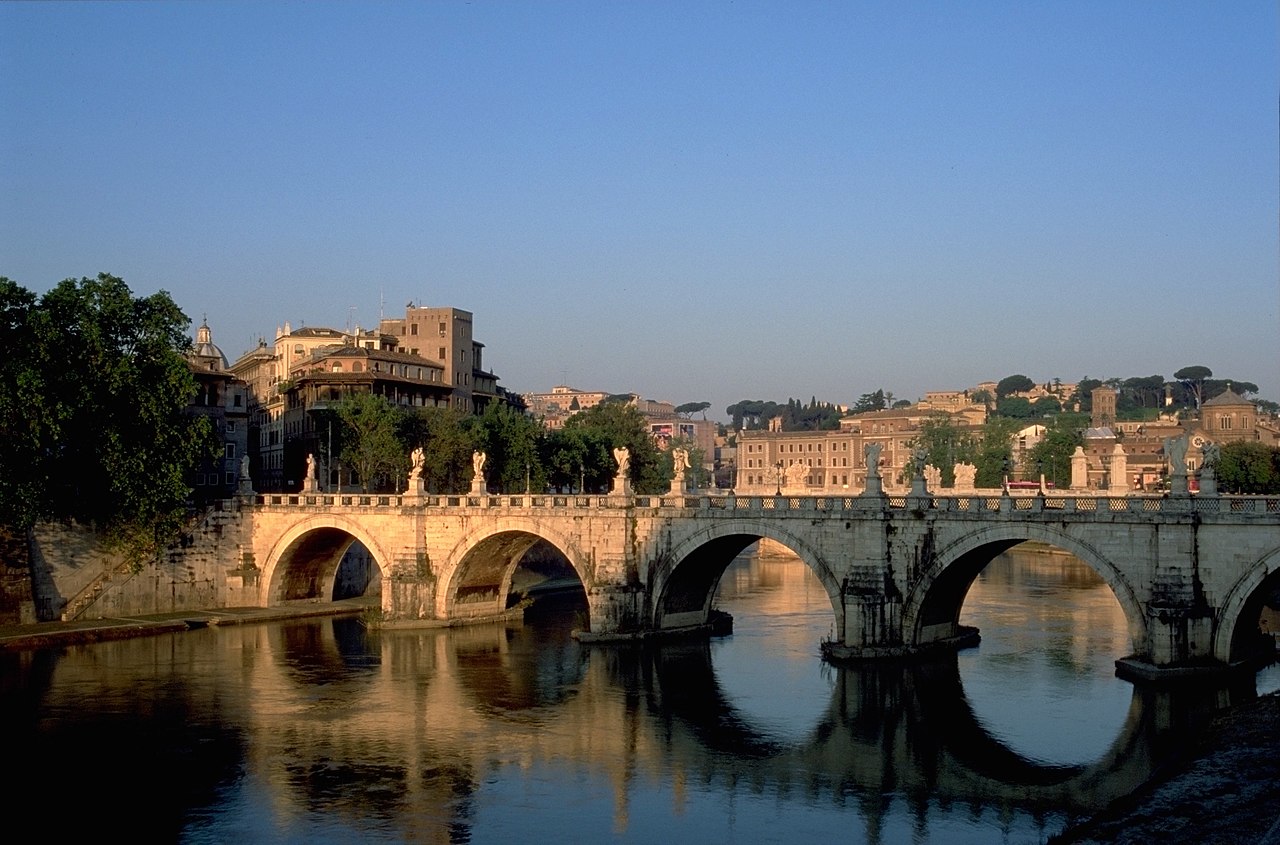
Source: Wikimedia Commons
Not that the Eads bridge is ugly now by any stretch of the imagination, but one has to admit that some of the alterations made over the years were somewhat insensitive to the original look of the bridge; many were functional first with aesthetics as an afterthought. Much of the work Metro did a few years back restored some of the original look; perhaps some federal grant money or even a private fund could be found to restore even more of Charles Eads' original design?
I'd think that'd be unlikely, but how impressive would an Eads bridge restored as closely as possible to its 1874-era (minus the changes necessary for the modern street deck and the Metrolink, of course) be?
-RBB
Answering my own question re: the statues...
Apparently those first two images are conceptual; the statues were never actually installed. According to history/legend (that some contend), the statues were carved but then later the decision not to install them was made and they were ultimately placed on the roof of the Equitable Building. Somehow they then ended up at the 1904 World's Fair. Supposedly Doctor T.R. Goulding of Ironton, bought three of the statues as a gift for his home town, but the town leaders wouldn't accept them so he kept them on his personal properties. Two of the three were sold at auction in 2011 (1) (2).
I wonder if the structures with the flags were also cut from the final design?
-RBB
Apparently those first two images are conceptual; the statues were never actually installed. According to history/legend (that some contend), the statues were carved but then later the decision not to install them was made and they were ultimately placed on the roof of the Equitable Building. Somehow they then ended up at the 1904 World's Fair. Supposedly Doctor T.R. Goulding of Ironton, bought three of the statues as a gift for his home town, but the town leaders wouldn't accept them so he kept them on his personal properties. Two of the three were sold at auction in 2011 (1) (2).
I wonder if the structures with the flags were also cut from the final design?
-RBB