sc4mayor
sc4mayor

PostJun 03, 2021#26

Laife Fulk wrote:
Jun 03, 2021
What’s the benefit of a streetcar over BRT? Financially, I’m assuming BRT with dedicated ROW would be much easier to build and run and easier to adjust if needed.
I’m with you.  If built to the “gold standard” I see no difference in building out a streetcar system or a BRT system.  I get that the permanence of rails may lead to more development, but Cleveland’s Health Line (which has only obtained the “silver” rating) has spurred close to $6 billion in new development since it opened, according to this report.  Plus, look at all the new development popping up all over STL already...we’ll likely eclipse $1 billion in building permits again this year (just the core) with billions more proposed and that’s with no new transit being built anywhere.

I don’t buy that streetcars would be lower in maintenance...BRT has no rails, no overhead catenary, the vehicles are cheaper, they could be serviced at existing Metro facilities, etc.  Dedicated lane BRT with frequent headways would be far more efficient for the city’s transit users than a bunch of slow mixed-traffic streetcars.

Edit: Here is that Cleveland report, I tried to link it into my original text but this site is garbage on my phone...
https://www.sasaki.com/projects/euclid- ... d-transit/

1,213
Expert MemberExpert Member
1,213

PostJun 03, 2021#27

Even if maintenance were lower, the capital investment costs are so much larger that would eclipse those current savings.

5,261
Life MemberLife Member
5,261

PostJun 03, 2021#28

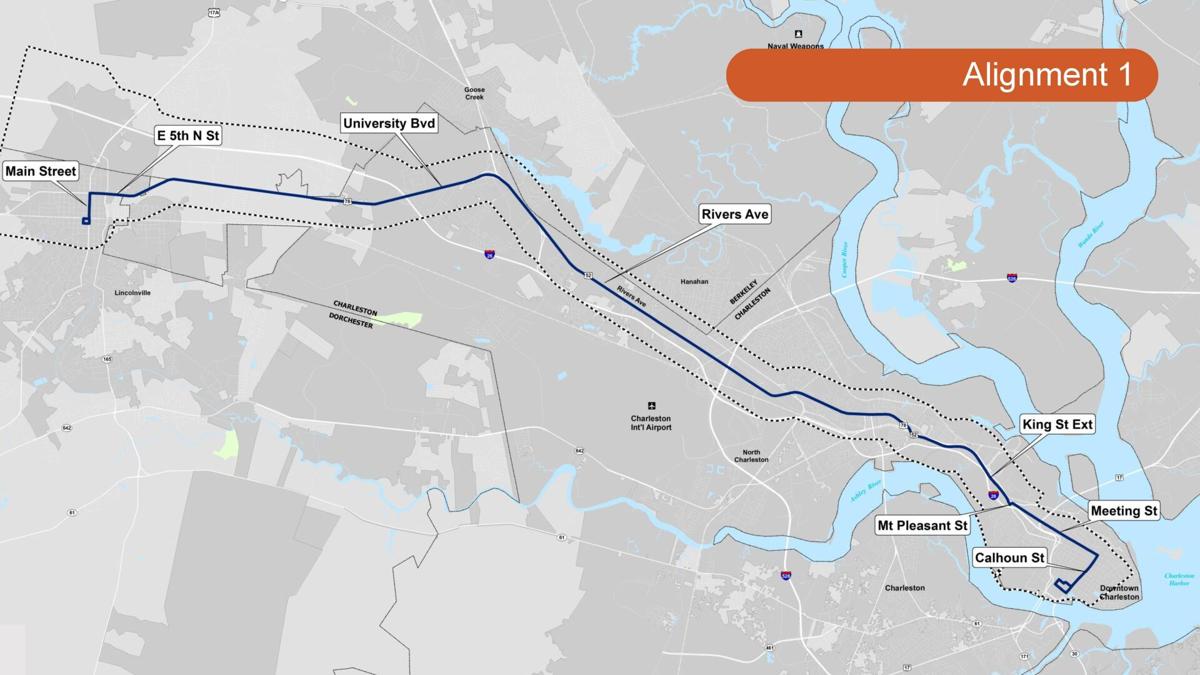
Anyone see the BRT line that Charleston South Carolina has proposed? It's called the Lowcountry Rapid Transit. It's supposed to be about 21.5 miles long, includes 20 stops, and would have 19 busses operating at the same time during peak times. The journey would take about an hour. The plan costs over $300 million with half being covered by Charleston area taxpayers and the other half coming from Federal Money. The intention is to start work by 2023 and be open by late 2026. Granted some of this information is from June of last year, so things could've changed since then. 
June 2020 story: https://www.postandcourier.com/news/new ... b2708.html
Most recent story: https://www.counton2.com/news/local-new ... it-system/

Route map: https://bloximages.newyork1.vip.townnew ... 34.pdf.pdf

sc4mayor
sc4mayor

PostJun 03, 2021#29

^ I hadn’t, but thanks for sharing. 21 miles of BRT for a local match of $150 million (if I’m reading that right)...that’s the move right there, folks.

5,721
Life MemberLife Member
5,721

PostJun 03, 2021#30

I don't have numbers to add but I think the argument in some respects for fixed transit vs. bus/BRT is life cycle cost.   Bus simply has a higher labor cost associated over a 20, 30, 40 years.  Etc.   Especially if you have the ridership to support a more robust system.   Anyone who deals with costs, labors and budgets understands that labor is the elephant in the room at end of day as it never goes down on life cycle but only rises, has ton of burden associated with it, & not truly not known in a decade from now which is unlike equipment/capital investment with its upfront cost that you simply depreciate it over the life cycle.

Not advocating either way but it still gets down to what the US doesn't do very good in transportation or any infrastructure for that matter in applying a true life cycle cost to things when making decisions.

But one thing for St. Louis City sake and pretty much agreeable to everyone is that the city sets up for some great north-south/east-west BRT corridors that could come together rather quickly, be an upgrade to existing service and at a cost point for near term transit improvements that might also qualify for Fed funding a lot sooner   

1,868
Never Logs OffNever Logs Off
1,868

PostJun 03, 2021#31

Rather than BRT, I'd just like to see more frequency. I guess that's not sexy enough for grant money.

sc4mayor
sc4mayor

PostJun 03, 2021#32

All good points, dredger.  Here is an article that’s been making the rounds the last couple days that somewhat ties into your thoughts.
https://thefederalist.com/2021/06/01/wh ... expensive/

But I think your last paragraph is what most that favor BRT are thinking.  We could sit around in this (incredibly fragmented) region, spending decades attempting to cobble together $800 million or more to build less than 10 miles of LRT (that may not even get a federal match), or we could spend a quarter of that and get 15-20 miles of BRT across the city.

If the ridership is there it’s not like a dedicated BRT lane couldn’t be upgraded to fixed rail down the road should it be necessary.

5,721
Life MemberLife Member
5,721

PostJun 03, 2021#33

^ Yep,  that is what I'm thinking.   The city with a vision, some leadership and maybe not even gold standard but what MarkHaversham noted in previous post could get some pretty significant & desireable transit improvements on key corridors in near term at fraction of cost.

I'm still at the believe that city should pursue some fixed transit.   I would push N-S to be a low floor modern streetcar with free ridership within city limits but designed in such a way that future BRT could be incorporated to cover both county and city.  In other words model it after KC streetcar with free ridership.  As it is designed now it is essentially a stand alone system with transfers.   If not that, reimagine part of the Loop Trolley as  a modern streetcar via Delmar connecting FPP metrolink station to either Euclid metrolink or CORTEX station (future phase across Freeway into FPSE or Grove) - Might have to get creative or add different stop for when you share rail on D Blvd but loop trolley makes left to go west toward U City and modern streetcar goes right into the city & then right on Euclid or Boyle to major jobs center.  

5,261
Life MemberLife Member
5,261

PostJun 04, 2021#34

sc4mayor wrote:
Jun 03, 2021
^ I hadn’t, but thanks for sharing.  21 miles of BRT for a local match of $150 million (if I’m reading that right)...that’s the move right there, folks.
I'm sure there are other examples of BRT systems in various phases of implementation in other cities across the country, just Charleston stuck out to me. My thoughts here are that if Charleston can do it, so can we. For the cost of North-South MetroLink, we could easily establish multiple BRT corridors to the benefit of people, neighborhoods, and general road infrastructure. As was pointed out, say if a North-South BRT line exceeded ridership expectations, then a conversion to Light Rail could happen with very minimal debate (mostly coming from funding).

In my view, BRT would go a long way in connecting our dense Southside neighborhoods to the job centers in the Central Corridor and then hopefully spur some stabilizing development on the Northside. The one thing about MetroLink is that it leaves out the parts of Southside where the population density is high enough where transit would be used more often by people if frequency was higher and transit was, in general, faster and less of a hassle than driving. I get that it's the case now in many ways, but it needs a push to meet criteria where people would prefer to leave their car behind. That's where BRT comes into play. Introduce it on thoroughfares such as Broadway, Grand, Gravois, Kingshighway, and Hampton while increasing frequency on the "secondary" bus routes. In my view, this would be more than enough to serve the Southside and change the tide a bit on transit usage.

We may not have the money or people for a robust light rail system, but we have enough people and money, as well as a pretty fair shot at federal funds, for a robust BRT system that could be the envy of many mid-sized cities who face the same dilemma as us (money and people). If done right, a BRT system here in St. Louis could become a model for other cities to use when establishing their own network. It takes time but when planning starts, we really need to be serious about making it the absolute best that it can be without going way overboard on budget. It's entirely possible, I know it is. Metro and City leaders are capable of thinking outside of the box on this.

6,158
Life MemberLife Member
6,158

PostJun 04, 2021#35

Laife Fulk wrote:
Jun 03, 2021
What’s the benefit of a streetcar over BRT? Financially, I’m assuming BRT with dedicated ROW would be much easier to build and run and easier to adjust if needed.
Mostly I'm dreaming and I think the correct answer is simply better busses with closer headways. (Not even BRT on a dedicated RoW.) Though the road diet for the dedicated RoW has some additional benefits. But in answer to your question, there's a significant energy savings as the rolling resistance is a tiny fraction. The maintenance is lower on steel tires, steel rail, and electric motors. Generally much lower lifecycle costs. A good rail vehicle has a lifecycle of fifty years or more. The initial investment is obviously higher, but my limited understanding suggests that in some scenarios you can make it up over the lifetime of the system. (Though obviously that will depend on how much of the RoW maintenance cost you can shift to someone else's budget.) 

Laife Fulk wrote:I don’t buy that streetcars would be lower in maintenance...BRT has no rails, no overhead catenary, the vehicles are cheaper, they could be serviced at existing Metro facilities, etc.  Dedicated lane BRT with frequent headways would be far more efficient for the city’s transit users than a bunch of slow mixed-traffic streetcars.
Metro has facilities to service LRT vehicles. A good, modern, dedicated RoW streetcar could use a very similar vehicle. I think we're really talking apples and oranges. I'm not advocating for the mixed traffic streetcars of old. But something much more akin to the LRT advocated for the street sections of N/S. I shouldn't really call it a streetcar.

Anyway, I've always been lead to understand the maintenance is lower. Steel on steel is certainly a lot more durable than what amounts to tar on tar. (Lower energy costs too, as noted above.) There's some wire maintenance issues, but even adding that in you still come out ahead over rubber and pavement. Mind you, conventional streets will always win at flexible routing. Each has its strength.

In the end, I think good bus service could probably be quite enough. Not even any real need for fancy BRT. Just have close headways on the busiest N/S routes and a few supplementary E/W routes and radials. The Grand bus is pretty fabulous, save for the lack of ticket machines at your average stop. And a good ap could solve that. (Maybe already did.) If all the city routes were run to that standard I think we'd be pretty close to where we need to be. (At least in the city.) Honestly, it's not a bad system even as it stands right now.

991
Super MemberSuper Member
991

PostJun 04, 2021#36

Rightly or wrongly, I think that BRT would receive less push back politically than any rail system would.  There would be many many people and politicians who would jump at a Delmar Trolley comparison to try and sink it immediately. 

438
Full MemberFull Member
438

PostJun 04, 2021#37

^Bingo. For better or worse, that danged Trolley has killed politically anything streetcar adjacent for the foreseeable future.

13K
Life MemberLife Member
13K

PostJun 06, 2021#38

Why Trolley Buses are vastly Superior to Battery Electric Buses - Armchair Urbanist


6,158
Life MemberLife Member
6,158

PostJun 07, 2021#39

^He also says Light Rail is superior to BRT. I'm not sure I'd use him as a source for my study, mind. Not sure what, if any qualifications he has and short documentaries lack a certain something in depth, citations, and transparency.

13K
Life MemberLife Member
13K

PostJun 07, 2021#40

He calls himself the Armchair Urbanist so.
He cites stats from research at Stanford on the losses from charging different types of batteries. Also there are four citations in the video's description.

2,663
Life MemberLife Member
2,663

PostJun 07, 2021#41

I personally like these short YouTube videos, I think they are an easy and digestible way to get more people thinking about planning issues. Most people won't be reading planning books or forums like this, but if they can watch a five minute video and come away thinking "transit good, parking bad" I think it's a win.

20
New MemberNew Member
20

PostJun 08, 2021#42

pattimagee wrote:
Jun 02, 2021
Seeing this mapped out feels really nice.

This is such a dream! I would love to see something like this happen. I feel like the money St. Louis is getting from the government is such a unique opportunity to do something like this.

6,158
Life MemberLife Member
6,158

PostJun 08, 2021#43

quincunx wrote:
Jun 07, 2021
He calls himself the Armchair Urbanist so.
He cites stats from research at Stanford on the losses from charging different types of batteries. Also there are four citations in the video's description.
Don't get me wrong. I like his work and subscribe to his channel. But four citations, two to other YouTube videos and one to a popular magazine, is not a deep pool of citations. He's clearly a smart guy. He describes the situation succinctly and his arguments hold together. But as you say he describes himself as an armchair urbanist. Which is pretty much all of us here. (Though there might be one or two professionals among us.) As it happens, I even agree with him. (Especially on the Light Rail is better than BRT business.) ;-)

2,940
Life MemberLife Member
2,940

PostJun 08, 2021#44

Think we all love that map. I'm a huge fan of the E/W lines consolidating along Tucker, and to a lesser degree at Fourth Street/Broadway. Our City's street infrastructure was designed to pipe workers into Downtown and the Central Business District via mass transit, and that map reflects this. This is how we get the Downtown CBD firing on all cylinders again, and maybe get that damn 909 Chestnut filled again. 

Whether streetcars or BRT, this could certainly differentiate the Downtown CBD from the Clayton CBD. Downtown has street cars that take you to the heart of the business district, and home. Clayton means driving back and forth. If I was a transplant living in the CWE, I'd absolutely prefer taking the BRT/tram/streetcar into Downtown versus having to drive into the suburbs. That's increased office space demand in Downtown. Cortex, too. 

Streetcars vs. BRT... I call for both, based on demand. Long term, streetcars are preferable. They increase development as they involve permanence in laying rails, and maybe future advancements in battery technologies could lead to future streetcars no longer needing investments into building catenary lines above their routes. Thing is, they cost a whole lot more up front. BRT is much cheaper to implement, even if it is not the cost saver over time. I'm incredibly curious what the cost difference would be between these two options: 
1. The one new N/S Metrolink line in the City; or
2. Full implementation of that BRT strategy. 
Best part about starting with BRT is that it would validate certain routes as being successful for usage without having to pay the costs of investing into extensive new infrastructure. 

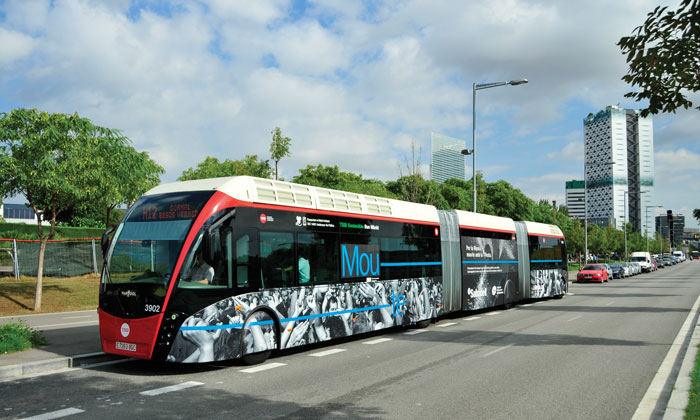
The one thing I'd prefer is if, instead of full City buses, BRT lines could be set up with trams, both as a ways to differentiate services and to allow for new infrastructure towards their usage, such as stations/stops. I've been a big fan of autonomous articulated rapid transit (AART) underway in China right now that has turned trams into de facto streetcars, just ones running on rubber instead of steel. I think Melbourne's looking at this, too. I bet initial costs would be comparable to new buses for this BRT system. Something like this in STL would be awesome... 


Going forward, I'm fully in favor of tram-centric BRT lines up and down STL as in that map. Concurrent, as certain lines succeed more than others, they become valid candidates for being upgraded to streetcars as funding for these upgrades present themselves. 

Q: How do we get this up and running? 

13K
Life MemberLife Member
13K

PostJan 14, 2022#45

By Seattlenative

NextSTL - Considering BRT on Kingshighway

https://nextstl.com/2022/01/considering ... gshighway/

337
Full MemberFull Member
337

PostJan 14, 2022#46

Hopefully, the image loads correctly. 

Now I certainly agree with the article on adding different transportation methods and of course removing lanes from Kingshighway but I just wanted to show a different option. I understand BRT traditionally runs next to medians and shares stops to save costs but in terms of St. Louis do we think that would encourage people to ride having to walk out into the middle of what is currently one of the widest roads? I would think BRT on the edge protecting bike lanes would work better here and also allows the 8' of shelter space to also be something else if needed such as outdoor patio for a bar or restaurant, bike/scooter parking, trash and recycling receptacles, pathway lighting/ped poles, planters, benches, etc. That or in some cases where parking may be beneficial have the bike shift over and create parking there to still create the buffer. I would even be okay with switching the bike lane and transit shelter. I just think putting the transit shelter in the middle creates fewer opportunities. Additionally, this option shortens the distance from curb to curb which will benefit pedestrians while crossing a wide street. Take note the planting strip in the center would also be a turn lane in places that are needed as well as a pedestrian buffer when used as mid-block crossing point.

To bad all of this is happy hopes and dreams.  
kingshighway-option-2 (1).png (470.78KiB)

805
Super MemberSuper Member
805

PostJan 14, 2022#47

LArchitecture wrote:Hopefully, the image loads correctly. 

Now I certainly agree with the article on adding different transportation methods and of course removing lanes from Kingshighway but I just wanted to show a different option. I understand BRT traditionally runs next to medians and shares stops to save costs but in terms of St. Louis do we think that would encourage people to ride having to walk out into the middle of what is currently one of the widest roads? I would think BRT on the edge protecting bike lanes would work better here and also allows the 8' of shelter space to also be something else if needed such as outdoor patio for a bar or restaurant, bike/scooter parking, trash and recycling receptacles, pathway lighting/ped poles, planters, benches, etc. That or in some cases where parking may be beneficial have the bike shift over and create parking there to still create the buffer. I would even be okay with switching the bike lane and transit shelter. I just think putting the transit shelter in the middle creates fewer opportunities. Additionally, this option shortens the distance from curb to curb which will benefit pedestrians while crossing a wide street. Take note the planting strip in the center would also be a turn lane in places that are needed as well as a pedestrian buffer when used as mid-block crossing point.

To bad all of this is happy hopes and dreams.  
Yeah, I think that could work too. I’d just love a road diet and improved public transit on Kingshighway in whatever configuration makes the most sense to planners.


Sent from my iPhone using Tapatalk

1,141
Expert MemberExpert Member
1,141

PostJan 14, 2022#48

Eh I prefer the center-running, and that's the norm among BRT systems. Something I've noticed often with bike lines that are on the sides of streets is that cars and trucks will frequently park in them and use that lane as a loading/waiting zone, in order for a bus lane to work there would have to be physical barriers or tight enforcement, which would limit their ability to be used for emergency vehicles like Tony wrote about. 

Also, transit passengers are used to crossing wide streets, if you're ever on the other side of where you need to go. I think the risk of BRT creep is also lower. 

Anyway, one question about a Kingshighway BRT line planner would have to answer is how the line would move through the Central West End. Right now the #95 turns off to go down Taylor by the CWE metrolink station. I think that setup is not ideal for a lot of reasons, but my dream would probably be to dig a two lane busway through the Euclid pedestrian mall so there would be a direct connection between the BRT and Metrolink. 

337
Full MemberFull Member
337

PostJan 14, 2022#49

PeterXCV wrote:
Jan 14, 2022
Eh I prefer the center-running, and that's the norm among BRT systems. Something I've noticed often with bike lines that are on the sides of streets is that cars and trucks will frequently park in them and use that lane as a loading/waiting zone, in order for a bus lane to work there would have to be physical barriers or tight enforcement, which would limit their ability to be used for emergency vehicles like Tony wrote about. 

Also, transit passengers are used to crossing wide streets, if you're ever on the other side of where you need to go. I think the risk of BRT creep is also lower. 
I like challenging the norm. Also, I agree and am frustrated with how bike lanes are built here that is why in my picture they are on grade with sidewalk and not the road plus have the 1.5' separation that can be light poles, bollards, and parking meter utilities. As for the bus traditional center running or on the sides I think there are issues with cars using it improperly. Simple paint lines won't stop people in either place maybe a rolled curb? Allows the bus to turn around when switching direction but maybe discourages drivers? That is probably too hopeful though considering I have seen drivers use the trolly tracks. 

2,791
Life MemberLife Member
2,791

PostJan 14, 2022#50

I love the proposal, Tony! Kingshighway has always made a lot of sense… maybe more so than any services that prioritize downtown.

On cynical days I’m convinced STL has passively regressed to the “transit mentality” of a region half its size. STL was a leader hitting above its weight as recently as 2010.

What makes this even more unfortunate? Voters have shown multiple times that they’re willing to financially support transit. Announcing a citywide BRT system would place Ms. Jones in favored history (and a second term if she like).

I want the region that was willing to take a “risk” and build the Blue Line Extension.

I don’t want more plans or proposals that rely on eventual economic development.

Read more posts (14 remaining)