
^My wife and I have a 3 episode rule for new sitcoms that we think we might like. If they can't find a groove by then, they probably won't.

I would highly recommend the last season. Pandemic. Felt more like a documentary.
Sent from my iPhone using Tapatalk
Sent from my iPhone using Tapatalk
- 1,620

Even then sometimes, it just hasn't clicked. Parks and Recreation is always my go-to example. First season and maybe half of the 2nd, it's not the same show as it became. I usually skip past those when I re-watch. The Office (US) is probably one of the biggest offenders of this. Writers hadn't found their voices/discovered their characters yet.Black02AltimaSE wrote: ↑Apr 14, 2021^My wife and I have a 3 episode rule for new sitcoms that we think we might like. If they can't find a groove by then, they probably won't.
- 474
^Last post on this digression: The Office had the problem that they were trying to recreate episodes of The Office (UK) beat for beat so they weren't exploring the US characters as their own thing.
I agree on Parks and Rec although I still liked the first season of that enough to keep watching. They found a groove, they just changed to a different groove after a while.
I agree on Parks and Rec although I still liked the first season of that enough to keep watching. They found a groove, they just changed to a different groove after a while.
- 6,199
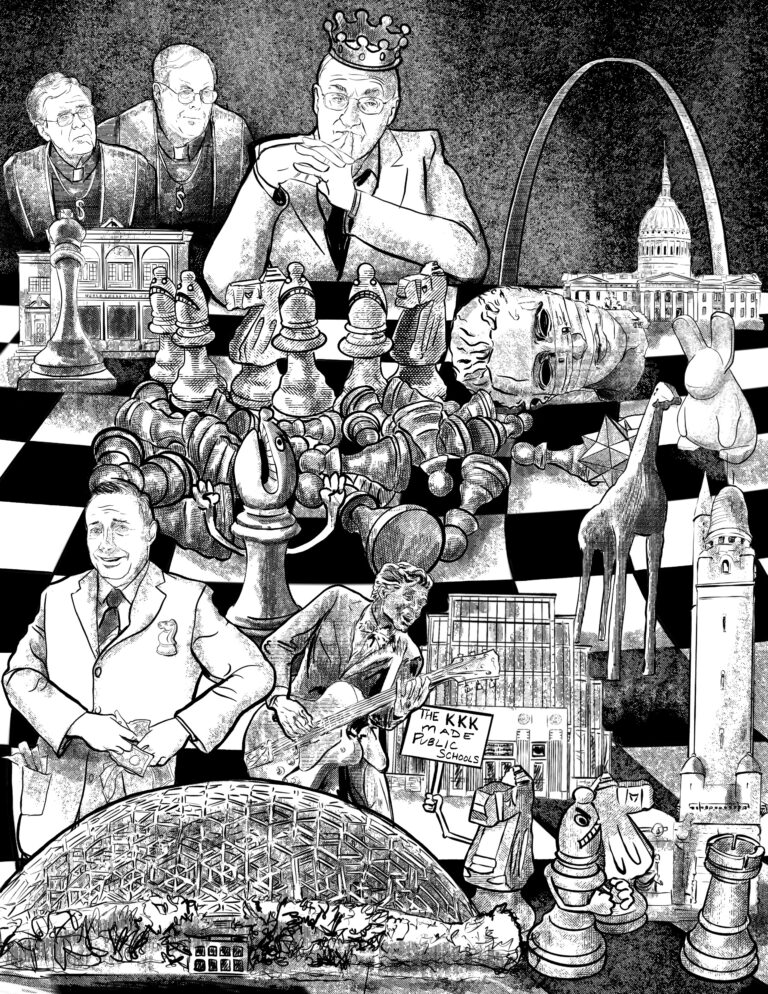
A story about Sinquefield seems to be the headline today on Current Affairs: "Libertarian Rex: How “the king” of St. Louis was defeated—for now—and how you too can topple your local hometown billionaire." Even if you don't agree with the politics, the banner is a great deal of fun, chock full of local references. (The article's banner uses the top third, more or less, of the image below.)
![]()


 sc4mayorsc4mayor
Damn good read. Thanks for sharing, SP. Fantastic illustration to boot.
- 6,199
There are some funny mistakes in it. The idea that St. Louis is the same size as Houston is . . . sadly laughable, for instance. But they're basically mistakes of storytelling. Errors of decorative fact, but nothing really structural that I could catch.
(I do have to wonder if we might be closer to the size of Houston had it not been for Reagan era deregulation. But comparing our metro to Houston's city is no more fair than comparing our city to Houston's city.)
(I do have to wonder if we might be closer to the size of Houston had it not been for Reagan era deregulation. But comparing our metro to Houston's city is no more fair than comparing our city to Houston's city.)
Not to derail this thread, but genuinely interested in how Reagan era deregulation possibly hurt St. Louis. Airline related???symphonicpoet wrote: ↑Apr 16, 2021I do have to wonder if we might be closer to the size of Houston had it not been for Reagan era deregulation.
- sc4mayorsc4mayor
All the anti-trust deregulation that allowed all of our home grown companies to get snatched up by the superstars on the coasts.
Though it started with Reagan, Democratic and republican presidents alike have kept it going.
The Atlantic dove into this about 6 years ago in a St. Louis centric piece...not sure if this is it...but STL is mentioned.
https://www.theatlantic.com/business/ar ... ge/417372/
Though it started with Reagan, Democratic and republican presidents alike have kept it going.
The Atlantic dove into this about 6 years ago in a St. Louis centric piece...not sure if this is it...but STL is mentioned.
https://www.theatlantic.com/business/ar ... ge/417372/
Another turning point came in 1982, when President Ronald Reagan’s Justice Department adopted new guidelines for antitrust prosecutions. Largely informed by the work of Robert Bork, then a Yale law professor who had served as solicitor general under Richard Nixon, these guidelines explicitly ruled out any consideration of social cost, regional equity, or local control in deciding whether to block mergers or prosecute monopolies. Instead, the only criteria that could trigger antitrust enforcement would be either proven instances of collusion or combinations that would immediately bring higher prices to consumers.
This has led to the effective colonization of many once-great American cities, as the financial institutions and industrial companies that once were headquartered there have come under the control of distant corporations. Empirical studies have shown that when a city loses a major corporate headquarters in a merger, the replacement of locally based managers by “absentee” managers usually leads to lower levels of local corporate giving, civic engagement, employment, and investment, often setting in motion further regional decline. A Harvard Business School study that analyzed the community involvement of 180 companies in Boston, Cleveland, and Miami found that “[l]ocally headquartered companies do most for the community on every measure,” including having “the most active involvement by their leaders in prominent local civic and cultural organizations.”
- 3,770
How America’s Coastal Cities Left the Heartland Behind
St. Louis and other Midwestern hubs prospered for much of the 20th century. Then lawmakers in Washington quietly changed the rules of the economy.
https://www.theatlantic.com/business/archive/2016/04/how-americas-coastal-cities-left-the-heartland-behind/478296/
![]()
St. Louis and other Midwestern hubs prospered for much of the 20th century. Then lawmakers in Washington quietly changed the rules of the economy.
https://www.theatlantic.com/business/archive/2016/04/how-americas-coastal-cities-left-the-heartland-behind/478296/
- sc4mayorsc4mayor
^ That’s the one! Thank you!
- 6,199
^I suppose you could make a good argument it started with Carter, even. As it was he that passed airline deregulation. Reagan isn't the only villain here, but he put his stamp on it to a large degree. Everyone after him was trying to grab a bit of his popularity. Kind of a "me too" game.
- 1,868

Neoliberalism is the bipartisan consensus, you can blame pretty much ever politician of the last forty or fifty years.symphonicpoet wrote: ↑Apr 17, 2021^I suppose you could make a good argument it started with Carter, even. As it was he that passed airline deregulation. Reagan isn't the only villain here, but he put his stamp on it to a large degree. Everyone after him was trying to grab a bit of his popularity. Kind of a "me too" game.
- 990

Rents are increasing but STL has the lowest rent rise
http://econintersect.com/pages/releases/release.php?post=202104201142
http://econintersect.com/pages/releases/release.php?post=202104201142
- 443
^I think a better characterization would be that rents are decreasing in many US cities, StL is not one of them.
- 990
Don't Call The Police
Community-based alternatives to police in your city
https://dontcallthepolice.com/
Community-based alternatives to police in your city
https://dontcallthepolice.com/
Great multimedia visualization by the NY Times on the manufacturing of the Pfizer vaccine, step 1 is Chesterfield MO
https://www.nytimes.com/interactive/202 ... d=tw-share
https://www.nytimes.com/interactive/202 ... d=tw-share
- sc4mayorsc4mayor
^ Really great read/watch. I’ve long enjoyed the NYT interactives, it’s just that usually they’re about the MTA haha. Nice to see one start here for a change...
- 6,199
^I swear to goodness it made me cry. It's lovely to see so many people working together to pull off such a miracle. And the fact that some of our own are involved . . . My dad was a chemist at Monsanto. My brother is a biologist. (Was in Cambridge at Sanger-Welcome until November. Now in Springfield freelancing and working on articles as he looks for a US position near his son.) Lots of other family and friends in the biz. In medicine and around town biology, mostly. It's beautiful to witness.
And it really does involve fermentation! Heh! Brewing up DNA like a very fine beer! That beer history comes to the rescue! (Sort of. Maybe. Not really. But hey, why not. It's a biological process.)
And it really does involve fermentation! Heh! Brewing up DNA like a very fine beer! That beer history comes to the rescue! (Sort of. Maybe. Not really. But hey, why not. It's a biological process.)
Here's a thought provoking one from KC's NPR affiliate that is surprisingly complimentary of St. Louis while accidentally missing the fact that we have the same problem. It's great to see the recognition of some of our best assets, but even if our parks system wasn't carefully constructed with the same use in mind some of the same factors do apply. (And if it wasn't it's probably just because there was no need. We pulled off the same stunts with less subtlety.) Anyway, without further ado: What's Keeping Kansas City Parks from Being Major Destinations? A Shameful History.
Glorious to see the praise for Tower Grove and Forest Park. But . . . I'm thinking we should take this one as an opportunity to look inward at our own sins rather than outward with swelling pride. (After all, both are guilty of the private funds the author points to. In spades.)
(Though it does genuinely make me happy to hear the idea that we really do have some dense mixed use neighborhoods. Even if we have plenty of sprawl, I think we really do have a few good, dense, general purpose neighborhoods where you can do everything you need to do in a life.)
Glorious to see the praise for Tower Grove and Forest Park. But . . . I'm thinking we should take this one as an opportunity to look inward at our own sins rather than outward with swelling pride. (After all, both are guilty of the private funds the author points to. In spades.)
(Though it does genuinely make me happy to hear the idea that we really do have some dense mixed use neighborhoods. Even if we have plenty of sprawl, I think we really do have a few good, dense, general purpose neighborhoods where you can do everything you need to do in a life.)
This may have been posted already and it’s from 2019, but pretty cool so I wanted to share... check out #1!
Niche.com: 2019 Top Urban Suburbs in America
https://www.niche.com/blog/city-life-in ... n-america/
Niche.com: 2019 Top Urban Suburbs in America
https://www.niche.com/blog/city-life-in ... n-america/