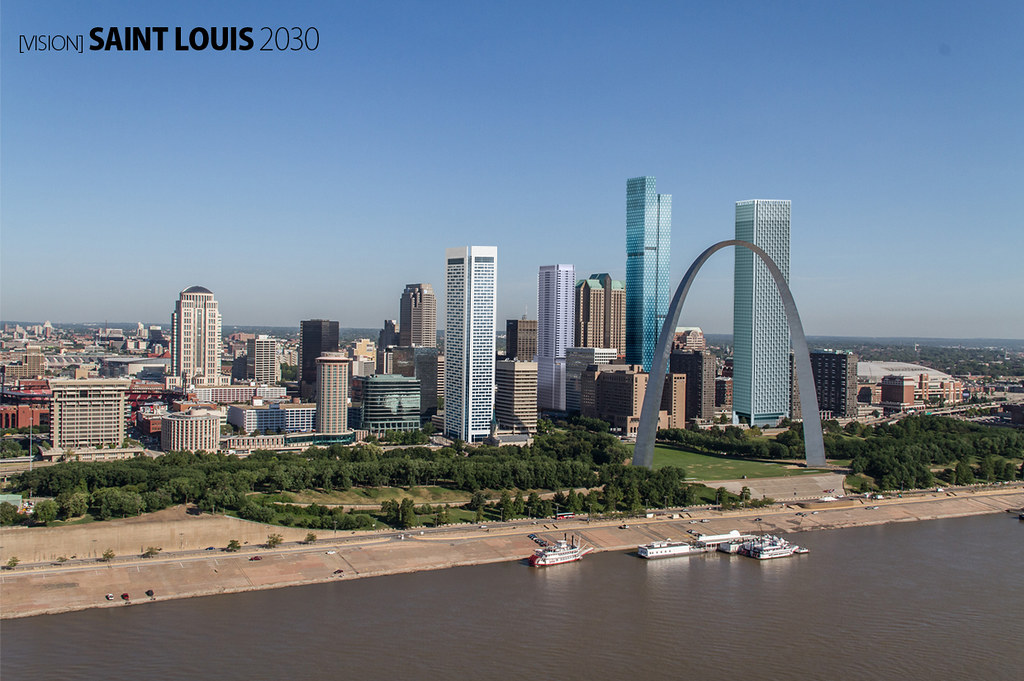
Over at the Skyscraper Page forum, there is a small debate about St. Louis's skyline.
One issue questions whether or not there is a height restriction in any part of downtown St. Louis. The other issue questions whether St. Louis needs height (above 630 feet) or simply more 400-600 footers plugged in around downtown's CBD.
Forumer sbarn created a nice concept of how downtown St. Louis could look with four new 600-800 footers added by 2030.
Don't quote me on this, but I think there is a height restriction, but it only refers to buildings built directly behind/in line with the arch.
That 2030 rendering looks awesome. It would definitely take a lot of new jobs and our local economy really taking off for something like that to happen.
Personally, I think that downtown could look like that regardless of the economy. What needs to happen is that the region has to become more centralized i.e. less sprawl.
Imagine if St. Louis City and St. Louis County had never "divorced". There would have been no need for Clayton because St. Louis City would have been the county seat - instead of Clayton. Most of the towers in Clayton likely would have either been downtown or in the CWE.
arch city wrote:Personally, I think that downtown could look like that regardless of the economy. What needs to happen is that the region has to become more centralized i.e. less sprawl.
As long as Clayton exists, I don't see the centralization (that I assume would be) required for it to happen, happening.
I think more infill between downtown west and midtown would be great. A few 400-footers max between Tucker and Jefferson would be great. Our skyline is already more impressive when viewed from the north or south, we need to fill it in before going up.
rawest1 wrote:As long as Clayton exists, I don't see the centralization (that I assume would be) required for it to happen, happening.
Downtown would be better 'centralized' with a strong East St Louis and Metro East. I'd like to see some towers on the other side of the river. It is amazing what a wasteland it is over there.
The height regulations are the same as those in the I central business district except that in no instance shall any portion of a building or structure including all appurtenances and super structures thereon, exceed a mean sea level elevation of seven hundred fifty-one (751) feet. It shall be unlawful to increase the height of an existing building or other structures located within this district unless it complies with the regulation of the district.
(Ord. 59979 § 17 (part), 1986.)
The Gateway Arch is 630 feet, with a city elevation of 465 feet. That would mean this restriction would keep building smaller than the arch.
The CBD also has a "height limit" based on the volume of a prism. "Buildings may be erected to such height that the cubic contents of said building above the established grade shall not exceed the volume of a prism having a base equal to the projected horizontal area of the building and a height of two hundred (200) feet."
Of course, all it takes is a vote by the Board of Alderman to repeal the ordinances or approve an exception. I have a hard time believing any serious proposal for supertall skyscraper would be denied on account of these ordinances.
Personally, I don't think there is anything in particular wrong with Clayton. The problem has been the longstanding neglect of downtown as a location for jobs and housing. I doesn't help that downtown is flanked on all four sides by East St. Louis, Columbus Square, Midtown, and Lasalle park which have their own problems. Soulard, Lafayette Square, and the CWE are all great neighborhoods but until they are linked to downtown by easily walkable streets or by streetcars, they are rather too isolated for their positive effects to easily spill into downtown. These are things that developers also think about when evaluating downtown as a potential construction site.
Downtown itself needs an affluent residential population or it needs a major affluent neighborhood immediately bordering it for its perception to change. It is getting there but not quite there yet.
The other failing is lack of imagination on the part of developers and financiers for downtown or the metro region. There is almost no speculative construction downtown for new commercial or residential buildings because of the vacancy rate... but heck even world class cities like chicago have older skyscrapers that are just abandoned too! See: http://www.chicagoarchitecture.info/Bui ... -Tower.php And this one is right next to Michigan Ave! But they don't appear to have any problems getting people to finance construction of new highrises. If a large residential tower were built downtown, I have no doubt that it would fill. When I was in London, it seemed like every subway station had highrises under construction around it, even when one block over, the neighborhoods had boarded up windows and broken glass...
Which also brings me to the topic of development around metrolink stations... The first impression of a visitor going from the airport to downtown on metrolink is just disastrous. There are so many stations that are just in the middle of junkyards or otherwise look crappy and shady. I have to admit the first time I arrived in town, by the time I got to the forest park station, I almost wanted to turn around and get back on my airplane. However, if this line had gone through clayton, my impression would have been the opposite. Why is it that it seems like there is little commerce or residential around these stations? It seems contrary to my experience in every other city where they cause a spike in development. The delmar, forest park, and CWE stations in particular have enough foot traffic through and within them to easily support commercial development in an enclosed station.
I agree 100% - especially the comment about speculative development. Cities that I am most familiar such as Houston, Dallas, Austin, Atlanta - I know for a fact those cities had near-empty buildings in their downtowns, but new construction was booming.
A lot of the new construction in their downtowns was 100% speculative or had only one guaranteed tenant. I don't know why St. Louis feels that all of the existing space downtown has to be absorbed before new construction commences. I refer to St. Louis' speculative development as "skeptical" development. Speculative buildings, when developed, are usually small and dinky.
Also, building new improves land and property values so eventually some owner is likely to update vacant property to make it more attractive to prospective tenants.
Further, think of all of the Class B and C space that has been wiped off the market in downtown St. Louis due to new uses - millions of square feet. Because I know the state of the job market and economy are drivers for speculative development, the slowly recovering economy in St. Louis doesn't help, but St. Louis could be in worse shape. In Chicago's case, the city has been a lot more aggressive in luring firms back to downtown and from other cities alas Clayco.
Last, I read somewhere that Clayton's office vacancy has crept up to 9.9%. I can't help but wonder if potential developers of real estate in Clayton are thinking about putting projects on hold.
In regards to your MetroLink observations, they are very fair. I mentioned the same on another thread. However, recently there were plans revealed for many stations. Whether those plans come to fruition is another story.
I like your skyscraper page too Arch City, but I wish you would link to my photos when you use them. I request that on my flickr profile page: http://www.flickr.com/people/pasa/. I'm not too unhappy, but it would be nice of you to offer a link.
Like it or not warts and all please remember that capitalism builds buildings. It's not called the Chrysler Building and the Sears Tower (former) for nothing. We had a couple generations that didn't like the city or just gave up and surrendered and left. Those people are dying off. Best days are ahead!
leeharveyawesome wrote: It's not called the Chrysler Building and the Sears Tower (former) for nothing. We had a couple generations that didn't like the city or just gave up and surrendered and left. Those people are dying off. Best days are ahead!
I really liked that post on the Fiat showroom where the Don Fusz employee said that Mr. Fusz decided to move downtown after getting to experience it more. Unfortunately, he doesn't have the capacity to move thousands of employees downtown, but others do. With the right person following Dan Gilbert's example in Detroit, real impact could be made on downtown jobs and skyline.
stlexplorer wrote:I like your skyscraper page too Arch City, but I wish you would link to my photos when you use them. I request that on my flickr profile page: http://www.flickr.com/people/pasa/. I'm not too unhappy, but it would be nice of you to offer a link.
No problem. Although your photos were always credited, I never saw that specific request. Consider it done without hesitation. I like your work - a lot. Honestly, it's one of the best - if not the best - St. Louis photo albums on Flickr.com.
I am definitely in the build more shorter towers camp. It protects the Arch's deserved prominence and would assist with filling city blocks. We gots the room to spread out...
Curious... how many employees would something like these 4 new towers house? I've also been interested in trying to visualize what different parts of the city would have to look like to get 400 or 500K in population again, let alone our peak 850.
Curious... how many employees would something like these 4 new towers house? I've also been interested in trying to visualize what different parts of the city would have to look like to get 400 or 500K in population again, let alone our peak 850.
Last spec office building in downtown... Met Sq. - 1989 - 24 years and counting - right now we have a vacancy rate about 16% something dramatic would have to happen pretty quick if we want even 1 additional office high rise in the next 10 years, we are pretty much set on hotels, the only real option is residential, but I think the rest of the historic stock will get soaked up first. I don't see any new high rises, office, residential, or hotel for the next 5 years, of course I would be more than happy to be wrong
Sad thing is the last time I was reading this site with regularity it was full of all sorts of projects representing new downtown construction of all the ranges listed on this thread. Nadira Place= new lowrise infill commercial/office space with modern/glassy touches. Skyhouse= midrise residential, glass, "edgy" design (by conservative STL standards. Port St Louis= low to midrise glass residential on the Landing. Bottle district had a little of everything including 3 pointed giants that would have topped the Arch. Chouteau's Pond and Landing had undergone various renderings including residential, commerical, and educational buildings. This developmemt would have particularly helped solve the problem of expanding downtown's funcational footprint into the quagmire of neighborhoods to its near south and connecting better to Soulard/Laf Square/Benton Park as mentioned above. I won't even mention the Judas move by Centene and the downsizing of Ballpark Village's Skyline altering towers (sidenote: now that I'm out of town, my glimpses of downtown are coming from Cards' broadcasts and the beams going up point to an enhanced stadium experience in and out of Busch. No matter what it "could have been" between the metrolink access and increased perimeter entertainment with rooftop viewing, this puts Busch into a category that most parks in baseball can't claim). I can't speak as to why all the above projects flopped. Most would blame the 2008 econonmy. One of the projects that did slip through the cracks-our one new sleek residential Roberts Tower, sits totally vacant and can't sustain a ground floor chain steakhouse.
The biggest issue with blaming the ecomony alone is projects like the Great American Tower in Cincinnati. If the economy was really so poor, things like that shouldn't have been happening in similar tier cities. Comparisons to Chicago seem unfair to both STL and Chicago given its resources, popuation, and amenities. Cincinnati, however, is our twin with the exception of having a strong corporate presence in its downtown core. Cincy really brings our shortcomings in this arena into high definition, in my opinion. Their big players are at the front lines of the postcard shots: Kroger, Macy's, P&G, Great American, and PNC are well represented in the height and density of their downtown. As much as we quibble about small firms (architectural, law, CPA, etc) coming and going from the city to the county (certainly valuable on a different scale), until our Fortune 500 companies make their presence known, I don't see how large scale construction or even vacancy filling can occur. The power players with the most influence sit from an office park perched beyond 270 watching the plight of the city through binoculars. Meanwhile their waiting rooms, board rooms and hallways are lined with sleek black and white shots of Busch Stadium, the Arch, Forest Park and Bevo Mill (it would be a little too "real" for those shots to be out their windows). Our downtown should be represented by ABI, Edward Jones, Scottrade, Energizer, Scottrade, Monsanto, Express Scripts, Panera (Starbucks is a "Seattle thing" why can't Panera be a "St Louis" thing), even Scnhucks and Dierbergs. I realize this will likely not happen for a number of reasons, but is a symptoms of the overall culture of our region.
On the metrolink issue, I think that the zone between the airport and Forest Park is an accurate slice of that area of the city. I agree that we need to work on making stations safe for the average rider, but just because they are not shiny, flashy, or oozing with indicators of young and progressive development doesn't mean that they aren't serving a purpose. When I've ridden in from the airport I usually see college students, airport employees, old folks as well as teenagers using the metrolink for its intended purpose; namely getting around their neighborhood. It was very similar to the glimpse into the realities of a city that I experieced traveling around the airport on bus or train in Atlanta, Philadelphia or Boston. These are cities that are large enough to have the requisite diverse experience of demographics. I would rather have the luxury of mass transit and have it show what life in certain areas of the city is really like rather than not have it at all. I've ridden into plenty of places and after passing homogenous development after homeogenous deveolopment after vanilla residential area felt like turning around and going home. And if visitors saw Clayton right out of the gate and that is attractive, then we should be discussing moving downtown to Clayton; I thought the efforts and opinion of this site was the other way around.
And, who says there is no development or attempted development around the Forest Park, CWE, or Delmar Stations? The CWE station alone spawned a design competition for local architects a few years ago and BJC is booming with development. The CWE seems to be relatively healthy with progress unless I am missing something (certainly possible). Delmar seems to be making the most efforts in TOD with the streetcar efforts and attempts to expand Delmar ever-eastward and link two metro stations in a creative way. The Forest Park station is surrounded by residential in DeBaliviere. There were all sorts of plans to rebuild the whole retail zone around DeBaliviere and Pershing all the way north to Delmar bringing buildings closer to the street and cleaning up exteriors to reflect a more historical context (brick, iron, nods to World's Fair). The Grand Avenue Bridge project centers on the Metro Station.
Also I have to disagree that the problem is lack of creative ideas. We all have creative ideas. The above failed projects I listed didn't necessarily show a lack of creativity. The problem is lack of people with money and an urban centered mind. Cities like Houston, Dallas, Atlanta, and probably more and more Austin, have people (and more importantly a growning demographic of younger people) with money and ideas; or just money and pay people to create the ideas. Its reasonable to have vacancies in buildings but continue to build when a nidus of rich investors and developers think they can outdo what is there. STL is notorious for having people with lots of money and no desire to share, spend, or risk it. THE PEOPLE WITH VISION HAVE NO MONEY AND THE PEOPLE WITH MONEY HAVE NO VISION. This is the plague my untrained eye has observed over the laset decade; another malady that will take generations to fix.
I think to make the skyline look amazing and centralized. Is to not have buildings taller than the arch directly behind it but around it tall buildings. To centralize the skyline is to make it wider and connect downtown, central west end, and Clayton by sky scrapers in between and around.
Well this post is old, but I did like the renders of the 630+ ft. blue tower. Its now almost 2020, and the cities of the world are building so many supertalls, and residential towers that easily would hover over the Arch. If the city's 1960's iron clad height restrictions are foolish and time to let the damn dust be swiffered. The Arch grounds that was a huge awesome change for us locals...visitors still come see it and go up, see a small underdeveloped city. The court house is right behing the Arch and we should make NEW Zoning for behind the Arch and some distance around it. The Arch is only recognized for what it is , and nowhere else has it, but the height is just a portion of its prowess. The south side of downtown is a sad empty large plot of land, as well as Midtown. One multi-use 800 ft. tower, or 1000ft. with several shorter skyscrapers surrounding a new business, shopping and entertainment will not obstruct our precious steel Arch. NY, Chicago, or others stopped at some landmark. Unlike all the other cities we are similar to, have nothing close to STL pride, and business HQs, that would love to have a new 2020s tower cbd. Purina. Monsanto. Bayer. Busch. Cortex. and many more global giants that are big and boring...we have History. And it shocks a dying city.
I think it is smart to keep putting sports and entertainment downtown. There are only a few cities where the downtown is so far from major crossroads across the metro. Our downtown is like Detroit — against a barrier on a peninsula out of the metro center crossing. Compare to Boston or Chicago where the downtowns are at the focus of an acute angle, and transit north south has to go thru downtown. So business still see downtown as a central access center.
We are a little better off than Detroit. We just have another state across our large barrier. Not another country. Cities like New York kept Manhattan central to the region with lots of bridges and subways. We can do the same. Now we need the East Side to become attractive. It used to flood right across the river, but suburbs are pretty attractive and close to downtown. What else would make the East side as attractive as St Charles? I used to think new cheaper houses. Too bad we didn’t build a new airport there in the late 70’s as planned.
There is a lot of beautiful rolling farmland on the East side. It would be great for new housing and would pull downtown back to the center crossroads of the metro which would make downtown more attractive for central business towers.
Downtown and Illinois should work together to help both expand.